

ETF Flows Indicate Sector Rotation: Tech Out, Defensive In
Sunday, August 30, 2026
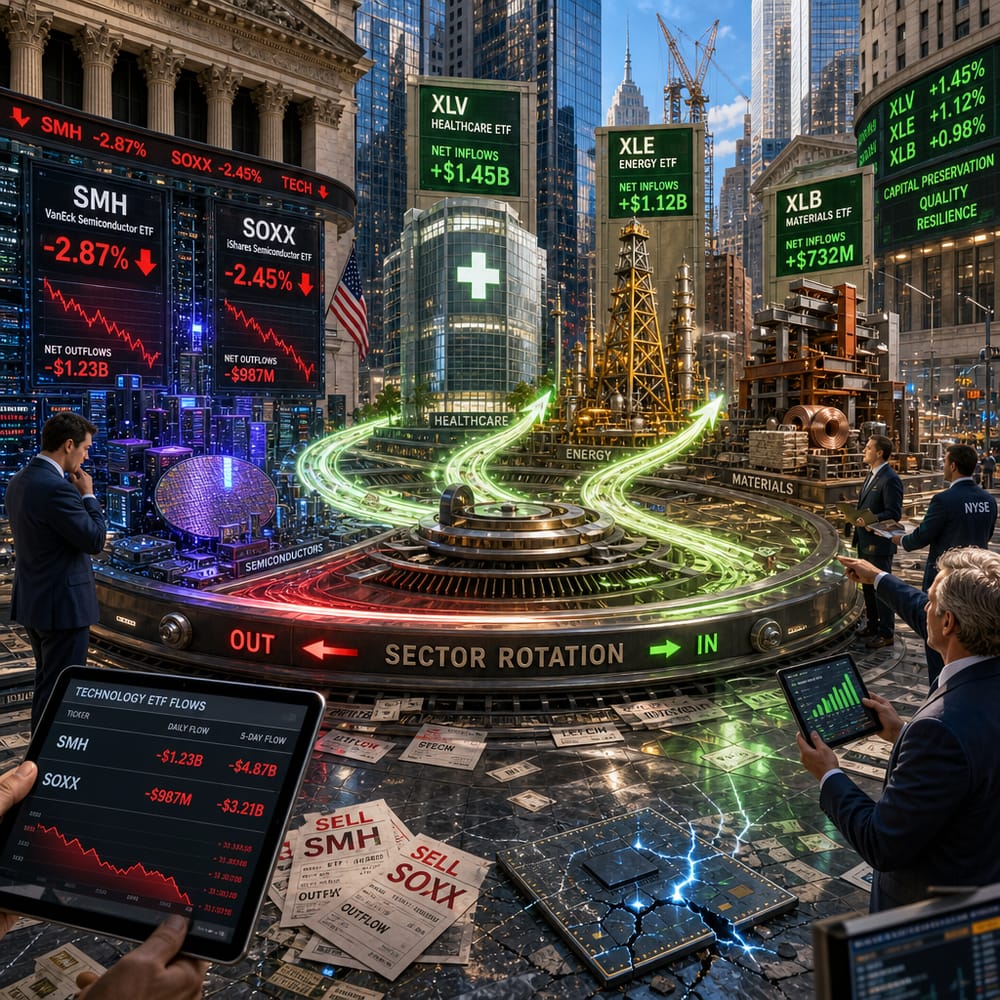
ETFS REARRANGE THE FURNITURE: TECH OUT, DEFENSIVE IN
What happens when the tech darlings of Nasdaq get swapped out for the more stable soldiers of the Dow? You get an intriguing market shuffle that's turning heads and tweaking investments. Look no further than the latest ETF flows, where the tech sector, those usual suspects with names like SMH and SOXX, are seeing outflows faster than you can say "Silicon Valley." Meanwhile, healthcare, energy, and materials are rolling out the welcome mat for fresh investor dollars. So what's going on? Is this a short-term blip or a seismic shift in investor mentality?
Welcome to Sector Rotation 101, where understanding the market's mood swings can mean the difference between a booming portfolio and a personal recession. But what exactly does this tech-to-defensive leap mean for the average investor?
First off, let's break down these ETFs. SMH and SOXX are essentially groupies for the tech industry. They track semiconductor stocks, which have been hotter than your air fryer as AI and 5G have driven demand sky-high. Yet, recent outflows suggest investors aren't as keen on tech as they were last season. Why? Market volatility, AI fatigue, or maybe it's just that age-old investor rule of thumb: what goes up must eventually simmer down.
On the other side of the trade, healthcare, energy, and materials ETFs are like the unassuming but reliable friend who always remembers your birthday. These sectors are regarded as "defensive," meaning they tend to do well when the economy gets wobbly. In today's unpredictable market, these sectors are catching investors' eyes—and dollars. Unsettling geopolitical tensions, inflation drama, and the ever-looming threat of a recession might have folks looking for a safer harbor.
With all this sector rotation, you might wonder: which ETFs are riding this wave? Consider healthcare ETFs, which offer exposure to stalwarts like Johnson & Johnson and Pfizer. Then there's energy, bolstered by big names like Exxon Mobil, a company that's been on a dividend-paying spree for 43 years. Don’t forget materials—think of mining companies and industrials that are essential when the world decides it needs to build more stuff.
So, what should you do with your portfolio? Should tech companies buy their own farewell cake, or is it just a temporary adieu? The choice depends on how you view market fundamentals. If you're all-in on the tech revolution, you might see this as a buying opportunity. After all, tech has reinvented itself more times than Madonna. However, if you think the market's set for a defensive play, here's your chance to diversify.
Adjusting your portfolio to align with sector rotation is like fashion for finance—some staples, some trends, and a dash of risk. Perhaps consider allocating a portion of your assets toward the defensives. But hey, don’t cut tech out of your life like a bad ex. Keeping a balanced portfolio is key. After all, today’s defensive darling might be tomorrow’s outdated shoulder pad.
Understanding the shifts in ETF flows is akin to knowing when to switch lanes during rush-hour traffic. Make the wrong move, and you’re stuck idling in a carpool lane while everyone else zooms past. With the right balance between tech and defensive sectors, you can maneuver through whatever market conditions lie ahead.
In essence, the current sector rotation is a cocktail of cautious optimism and pragmatic realism. Tech isn't getting the cold shoulder entirely, but it's definitely being eyed with caution. Meanwhile, defensive sectors are emerging as the market's comfort food. By keeping an eye on ETF flows and understanding the why behind the shift, investors can smartly position themselves to not just survive, but thrive, in these tumultuous times.
This article is for informational purposes only and is not investment advice. Always do your own research or consult a licensed financial professional before making investment decisions.
© Copyright 2024. All Rights Reserved.
© Copyright 2024. All Rights Reserved.