

Equity Futures Rise as Fed Rate Hike Odds Decline
Thursday, August 20, 2026
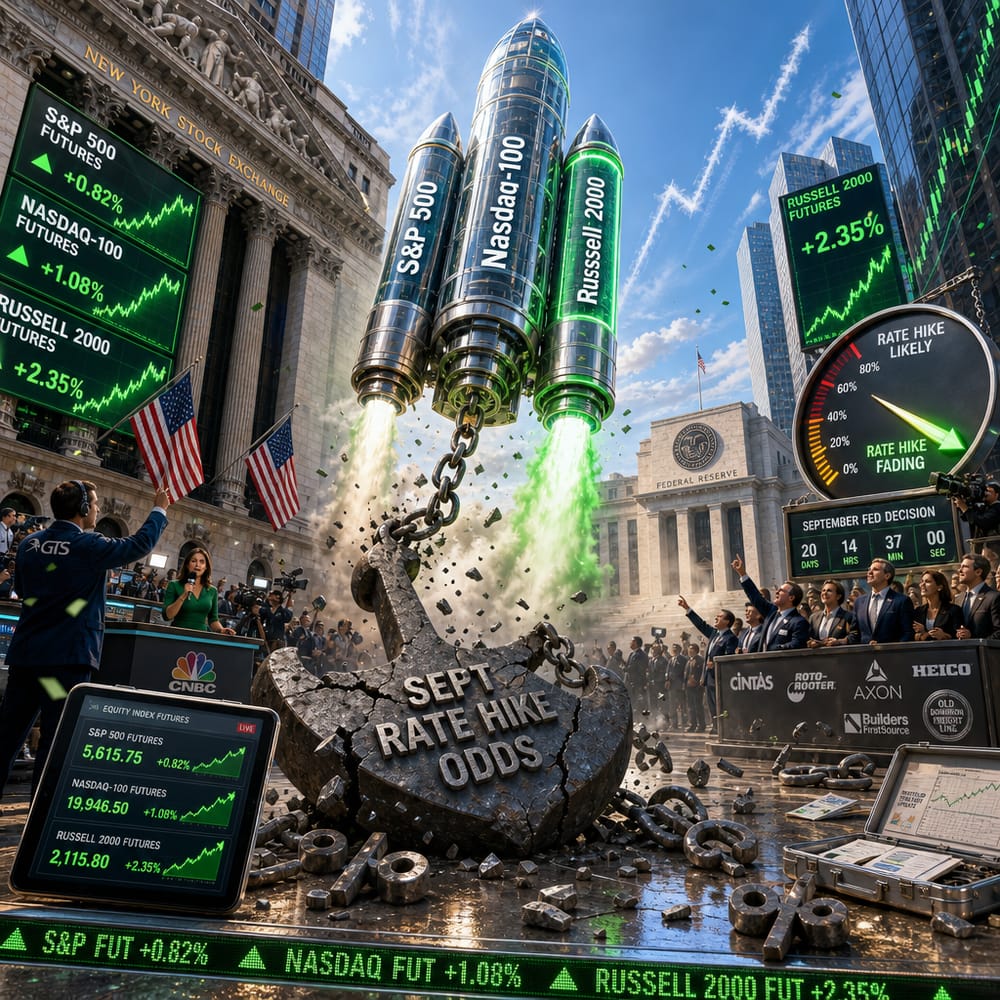
EQUITY FUTURES RISE AS FED RATE HIKE ODDS DECLINE
If Wall Street were a soap opera, the latest twist has left audiences on the edge of their seats: U.S. equity futures are inching higher, and we have the Federal Reserve’s decreasing appetite for a September rate hike to thank for that. Our protagonist in this drama? Small-cap stocks, which are having their moment in the spotlight as they ride the wave of shifting expectations.
For the uninitiated, a rate hike is the drama king of financial policy, often grabbing the spotlight with the power to shake markets. But in this episode, the Fed seems more inclined to sit back and watch from the wings. The odds of a rate hike next month have taken a tumble, which has sent ripples through the markets faster than you can say ‘interest-sensitive sectors.’
THE RISE OF SMALL CAPS AND BIG INDICES
In this financial kerfuffle, the S&P 500, Nasdaq-100, and Russell 2000 are shining bright like diamonds. Futures for these indices have gained traction, riding on the back of falling Treasury yields. The word on the street is that this drop is fueled by the Treasury Department’s surprise plan to double down on bond repurchases, making long-term debt less of a drag on wallets.
The Russell 2000, which houses small-cap stocks—the Davids to the Goliaths of the S&P 500 and Nasdaq-100—has shown some promising pep in its step. Small caps are the high-wire act of stock indices; more volatile, but nimble enough to make big moves when conditions are right. With the Fed’s rate hikes potentially taking a breather, these stocks are dusting off their dancing shoes, ready to party.
WHAT’S COOLING THE RATE HIKE FEVER?
So, what’s got the Fed hitting pause? Look no further than the intertwined dance of the economy’s strengths and weaknesses. Inflation, like an uninvited guest, has been overstaying its welcome, but it seems to be getting the hint and packing its bags. This gives the Fed some breathing room to reconsider its aggressive rate hiking strategy.
In addition, the U.S. national debt has just hit a staggering $40 trillion—yes, trillion—raising eyebrows and making any interest rate increase feel like pouring gasoline on a fire. With the government keen to keep borrowing costs down, there’s even more reason to keep interest rates steady.
SECTORIAL SHIFTS: WINNERS AND LOSERS
Now, let’s talk sectors, because not everyone’s invited to this celebration. Technology stocks have been leading the charge, basking in the glow of lower interest rates, which make their future earnings more attractive in today’s dollars. Meanwhile, traditional sectors like utilities and real estate, which often rely on stable, high dividend yields, might find themselves left out in the cold as their appeal dims.
The bond market’s reaction has been equally telling. Lower yields boost the allure of non-yielding assets like precious metals, with gold holding firm near its recent highs. Miners like Wheaton Precious Metals are seeing a lift, as lower yields make these shiny assets, well, shinier.
WHAT’S NEXT ON THE FED’S AGENDA?
As we watch this financial drama unfold, the Fed's next moves remain a guessing game. While a September pause is on the cards, future meetings are a different beast altogether. The Fed might just be giving us a breather before resuming the rate hike crusade if inflation decides to stage a comeback.
Investors will need to keep their fingers on the market pulse, as these rate expectations could change faster than a Tesla on Autopilot. The Fed’s decisions will continue to ripple through various sectors, shifting strategies and adjusting portfolios as investors seek the optimal balance between risk and reward.
In this high-stakes financial theater, staying informed is your best bet to play along with the twists and turns. So grab your popcorn, keep your strategy flexible, and remember that in the world of finance, change is the only constant.
This article is for informational purposes only and is not investment advice. Always do your own research or consult a licensed financial professional before making investment decisions.
© Copyright 2024. All Rights Reserved.
© Copyright 2024. All Rights Reserved.