

Elevated Jobless Claims Reflect Lingering Labor Market Friction
Sunday, November 15, 2026
ELEVATED JOBLESS CLAIMS REFLECT LINGERING LABOR MARKET FRICTION
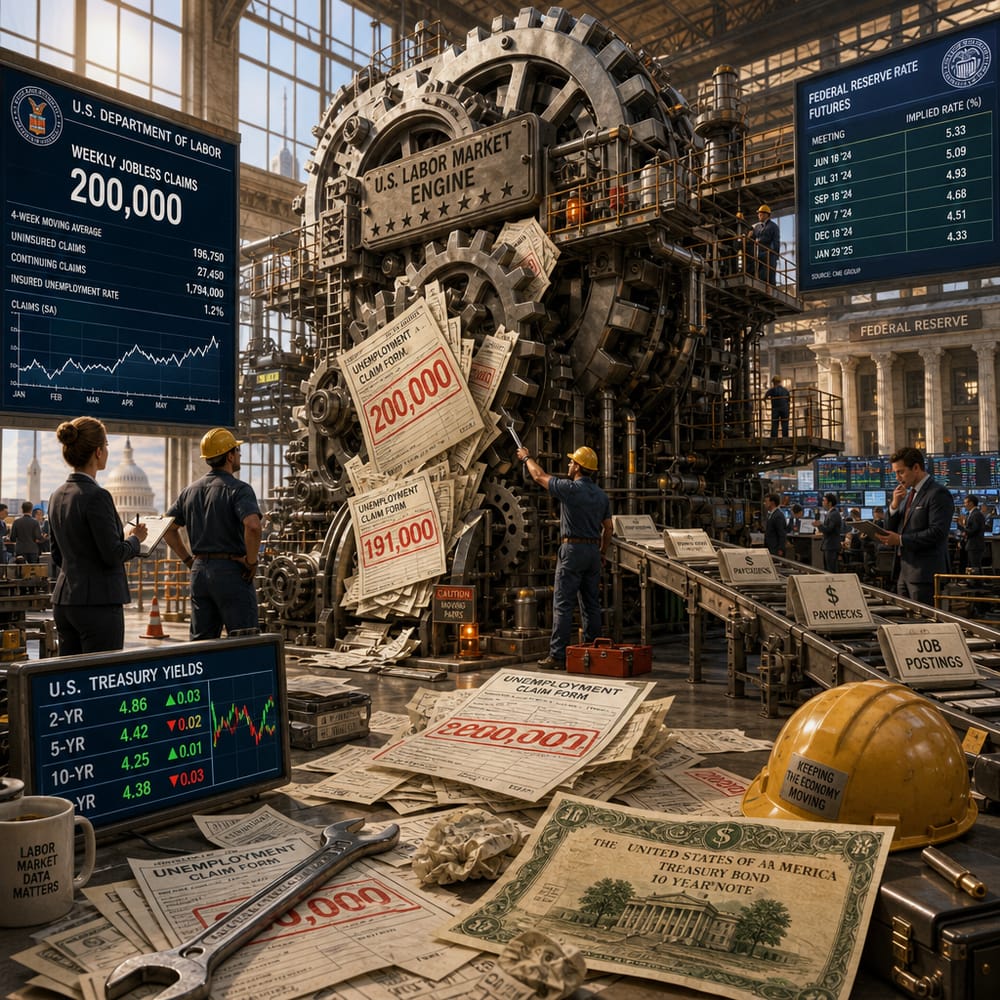
Hold onto your hats, folks, because the job market rollercoaster just took another twist. Last week, the U.S. Labor Department dropped a little bombshell, announcing that weekly jobless claims have risen to 200,000. That’s an uptick from 191,000 the previous week. Now, in any other context, a number like 200,000 might just sound like a big crowd at a rock concert, but here it's causing a ruckus in the labor market chatter.
When jobless claims are on the rise, it’s usually the financial world’s equivalent of seeing storm clouds on the horizon. It's a signal that all may not be well in the land of employment, hinting at a possible slack in the labor market. For those new to this carnival, jobless claims are basically the number of people filing for unemployment benefits after losing their jobs. It’s a barometer of sorts, giving us a glimpse into the health (or lack thereof) of the job market.
So, what’s stirring this pot, you ask? Well, a cocktail of factors might be at play. First off, there's the aftermath of recent disruptions, much like the air travel chaos we saw recently where thousands of flights were grounded or delayed. Such disruptions can have ripple effects, leading to temporary layoffs or reduced hours, pushing more folks to seek unemployment benefits.
And then there's the economy's perpetual boogeyman: inflation. As costs rise across the board, from groceries to gadgetry, companies might start tightening their belts, opting to keep fewer staff on the payroll. This is especially true if businesses are bracing for consumers to start pinching pennies, which can lead to a downward spiral of reduced demand and, well, more job losses.
But wait, there's more on the horizon that could shake things up — the Federal Reserve and its interest rate decisions. The Fed's like the wizard behind the curtain, pulling levers that can either slow down or speed up the economy. When jobless claims rise, it’s a signal that the labor market might be cooling off. This might just give the Fed the nudge it needs to reconsider its current course on interest rate hikes.
Now, a pause or even a cut in interest rates could be a double-edged sword. On one hand, it could spur economic growth by making borrowing cheaper. On the other hand, if inflation persists, the Fed will have to play a high-stakes game of balancing economic growth with price stability. With the possibility of a labor market slowdown, the Fed's upcoming decisions could be pivotal in shaping the economic landscape.
So, what does this mean for the broader U.S. economy and the average Jane or Joe scrolling through this on their lunch break? Well, the stakes are high. Rising jobless claims can signal shifts not only in employment but also in consumer confidence and spending. If people are unsure about job security, they might hold off on big purchases like homes or cars, which can slow down economic growth even further.
And let’s not forget the ripples in the financial markets. Rising jobless claims might just be the nudge that U.S. Treasury yields need to dip a smidge, as investors seek the safety of bonds over volatile stocks. Futures on Fed interest rates are bound to dance to this new tune as well, as traders recalibrate their expectations based on the latest economic signals.
In the end, this uptick in jobless claims might just be a blip on the radar, or it could be the canary in the coal mine. Either way, it’s a moment to pause and ponder. For the Federal Reserve, it's another puzzle piece in the increasingly complex economic jigsaw they’re trying to solve. For the rest of us, it's a reminder to keep an eye on how these numbers paint the bigger picture.
So, job seekers, hold tight and job holders, maybe think twice before splurging on that luxury vacation. The job market's got some friction, and we're all just trying to grip the steering wheel as the economy takes its latest turn. Let's stay tuned and see if this is just a speed bump or the start of a winding road ahead.
This article is for informational purposes only and is not investment advice. Always do your own research or consult a licensed financial professional before making investment decisions.
© Copyright 2024. All Rights Reserved.
© Copyright 2024. All Rights Reserved.