

Economic Outlook Divergence: Private Forecasts vs. Fed
Friday, August 21, 2026
WHO'S RIGHT? PRIVATE PROPHETS OR FEDERAL FORTUNE TELLERS?
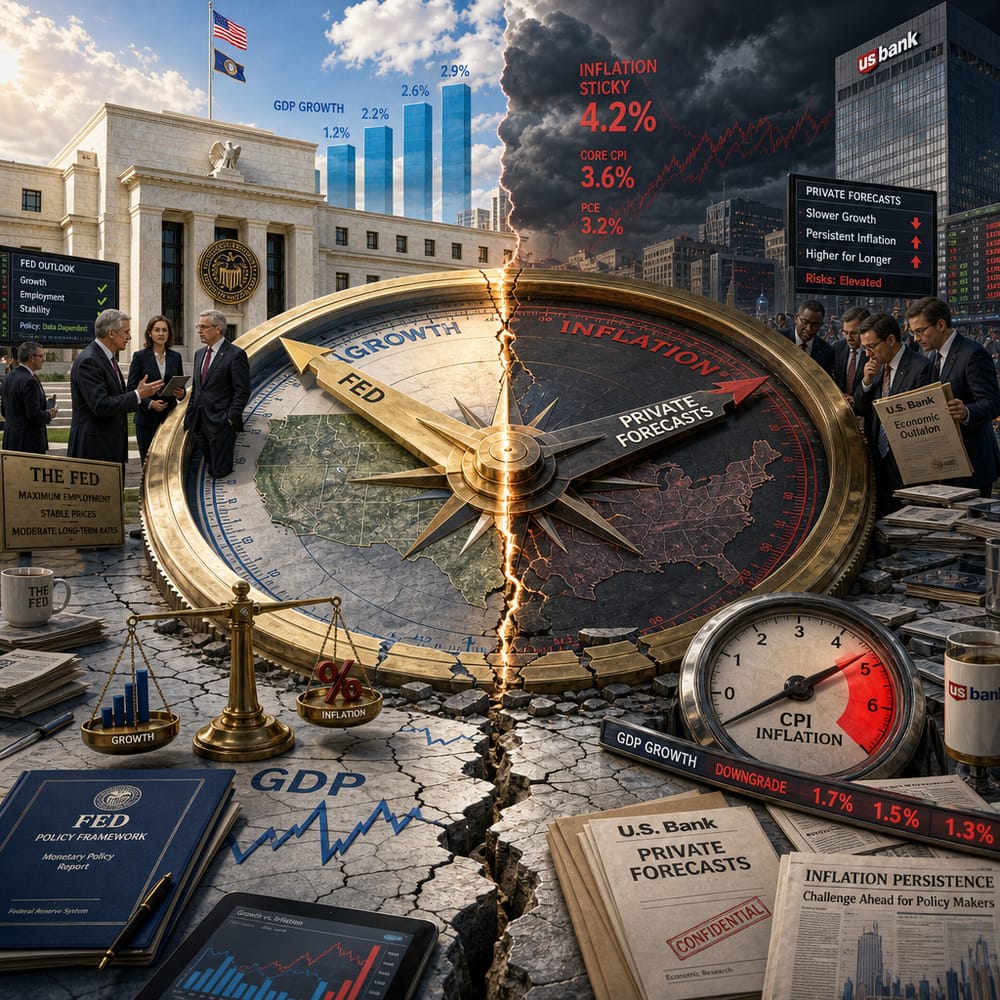
In one corner, we have the Federal Reserve, America’s economic soothsayer, promising blue skies and calm seas ahead. In the opposite corner, U.S. Bank is sounding a bit like your skeptical uncle, warning of storm clouds and anchoring inflation. Welcome to the latest episode of "Who's Got the Crystal Ball?" where economic forecasts are clashing like titans, and investors are left to choose their adventure.
The Federal Reserve, America's self-appointed economic weatherman, is signaling sunny skies ahead. Their optimistic projection sees GDP growth and inflation cooling down like a summertime iced tea. Not so fast, says U.S. Bank. They’re projecting sluggish growth and inflation that just won't quit, like that one guest who never leaves the party.
DIFFERENT LENSES, DIFFERENT VIEWS
The Fed's rose-tinted glasses are glued to an upbeat narrative. They’re predicting a gradual but steady economic recovery with inflation easing back into its comfortable 2-3% zone. They're suggesting that the current hiccup in inflation is just a passing fever, not a chronic condition.
U.S. Bank, however, is reading from a different script. They’re arguing that the economic engine isn’t firing on all cylinders and inflation is less of a sneeze and more of a stubborn cough. The bank predicts GDP growth will slow, leaving consumers and businesses in a bit of a rut, while prices continue to rise stubbornly, making everyday life a little less affordable for everyone.
RIFFING ON THE IMPLICATIONS
So, what does this squabble mean for our wallets and portfolios? Well, strap in because the stakes are high. Divergent forecasts can make the market shakier than a first-time rollercoaster rider. If the Fed's outlook is overly sunny, we might see interest rate hikes coming slower and gentler than anticipated. That could keep borrowing costs lower and the stock market bubblier. But if U.S. Bank is on the money, and inflation proves stickier than old bubblegum, the Fed might have to slam on the brakes, hiking rates more aggressively, which could send markets into a nosedive.
Investors, therefore, need to play detective. Diversifying portfolios could be the name of the game. Consider sectors that traditionally perform well when inflation sticks around, such as commodities or real estate. And keep a close eye on those interest rates because they could turn out to be your best economic weather vane.
A MATTER OF PERSPECTIVE
The divergence in forecasts isn't just an academic debate — it's a matter of perspective. The Fed has its fingers on the pulse of macroeconomic health, focusing on data like unemployment rates and overall economic growth. Private banks like U.S. Bank, though, might be taking a closer look at the nitty-gritty, like consumer sentiment and business investment levels, providing a more granular view that feels the pinch of inflation more keenly.
For everyday investors, the reality likely lies somewhere in the middle. The economy isn't a perfect science, and forecasts can sometimes be more of an art. But keeping an eye on these differing narratives can provide clues about where to place your bets.
THE FINAL BELL
As this epic forecast face-off unfolds, investors find themselves in the role of referee, trying to balance optimism with caution. Understanding these forecasts and their implications isn't just for Wall Street wizards — it’s crucial for anyone with skin in the game.
So, as you scroll through the latest market news on your smartphone, remember this isn’t just a nerdy numbers game. The predictions of today could shape the economy of tomorrow, impacting everything from your savings account to your grocery bill. Choose wisely where to place your chips, because, in this game of economic roulette, the stakes are higher than ever.
This article is for informational purposes only and is not investment advice. Always do your own research or consult a licensed financial professional before making investment decisions.
© Copyright 2024. All Rights Reserved.
© Copyright 2024. All Rights Reserved.