

Dow Plummets 700 Points Amid Bond Market Turmoil
Thursday, August 20, 2026
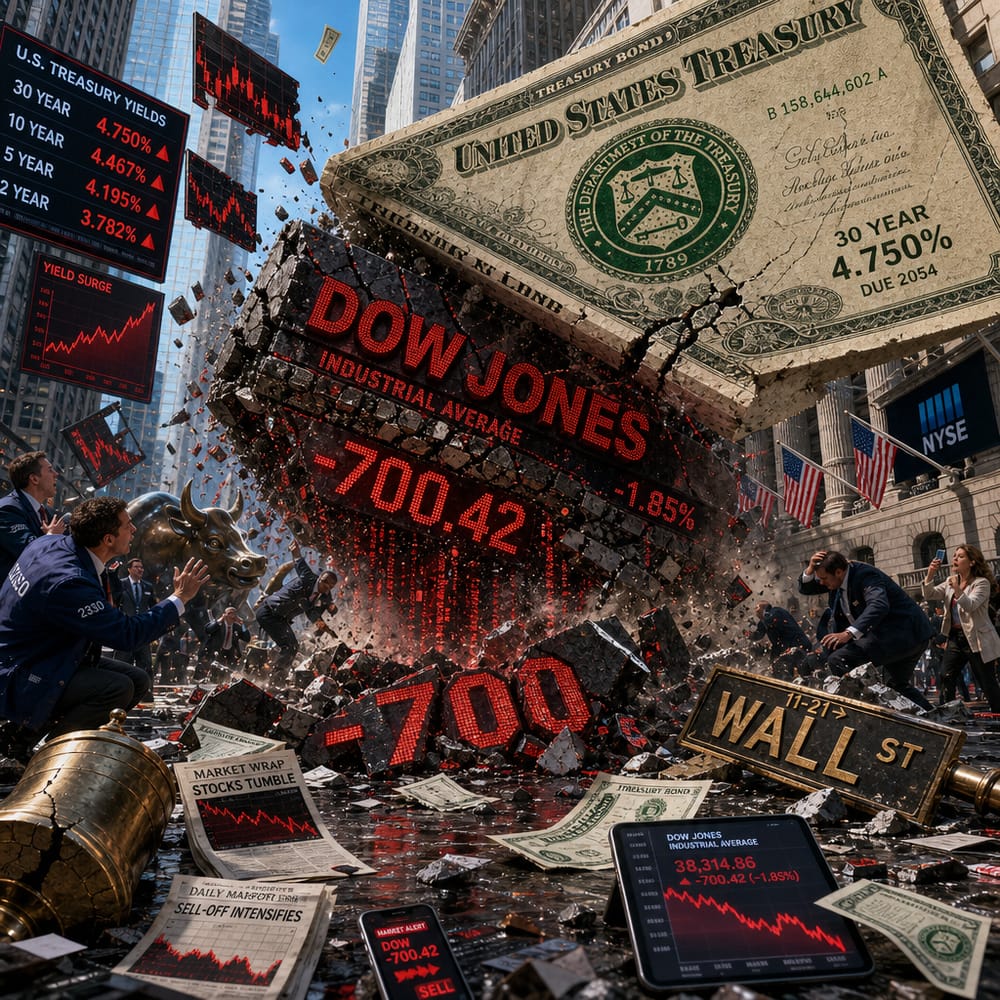
DOW PLUMMETS 700 POINTS AMID BOND MARKET TURMOIL
If you're feeling a jolt in your portfolio, it's not an earthquake—it's the Dow dropping over 700 points. In Wall Street terms, that's a seismic event, and it's all thanks to rising bond yields that have investors running for the hills. So, what's shaking up the market, and why does it matter to you and your morning coffee?
Picture this: the Dow Jones Industrial Average took a nosedive of 703.84 points, tumbling to 52,759.21. That's a hefty 1.32% drop, which might have your 401(k) limping. And it wasn't just the Dow; the S&P 500 and Nasdaq weren't spared from this market drama, slipping 0.87% and 1%, respectively. Want more juice? Walmart, the retail titan, shed 9% of its stock value after its earnings report failed to dazzle Wall Street. Just when you thought going to Walmart was about saving money, right?
But back to the bond market—what's going on there? Bond yields, the interest rates on government bonds, are like the market's mood ring, and right now, they're screaming "anxious." The 10-year Treasury yield, a key benchmark, is climbing. When bond yields rise, borrowing costs for everyone—companies, governments, and yes, you—shoot up. Higher interest rates can slam the brakes on economic growth and, naturally, spook investors away from riskier assets like stocks.
The recent chaos kicked off with the Treasury Department's announcement of a buyback scheme. Treasury Secretary Scott Bessent took to the stage, announcing plans to double down on repurchasing 10-, 20-, and 30-year bonds. The idea was to cool off the bond market by injecting liquidity—basically making sure there's enough cash floating around to keep things smooth. But investors weren't entirely buying it, and yields just kept climbing. So much for market intervention being a magic trick!
Here’s where it gets spicy. With Treasury stepping in, the bond yields did a little dance—initially dropping before bouncing back up faster than a toddler on a trampoline. Investors are eyeing Bessent's efforts skeptically, wondering if this will really shore up the bond market or if it's just a temporary Band-Aid on a deeper issue.
Adding more zing to the story is the Federal Reserve, led by Chairman Kevin Warsh, who’s watching this bond market drama unfold with what's presumably a very large tub of popcorn. Warsh has been clear about the Fed's usual hands-off approach unless there's a full-blown economic meltdown. So, don't hold your breath for a knight-in-shining-armor moment coming from the Fed just yet.
So, why should you care about these financial fireworks? Well, first, your investment portfolio might be feeling the love—or lack thereof. Rising bond yields can push down stock prices as investors hop from stocks to the perceived safety of government bonds. It's a bit like choosing a stable llama over a rambunctious stallion on a rocky trail.
Moreover, if you're in the market for a mortgage or planning to finance a new car, brace yourself for higher interest rates. This bond market drama doesn't just stay in Wall Street's sandbox; it spills into everyday life, affecting loan rates and possibly even the cost of your next home renovation.
Now, the big question: what's next? If there's one thing investors hate, it's uncertainty. The bond market's future looks as clear as mud, with many wondering if Bessent's moves will eventually win over the skeptics or if we're in for more rollercoaster rides.
Meanwhile, shop smart if you're considering a dip in stocks. Are rising rates poised to throw a wrench into the economic engine? Possibly. But as always, with risk comes opportunity, so keep a keen eye on your options and maybe consider chatting with a financial advisor if you're feeling a little dizzy.
In the stock market circus, the only certainty is uncertainty. Whether you're watching from the sidelines or right in the thick of it, it's one heck of a show. Stay tuned, stay sharp, and don’t spill your coffee while the market decides its next move.
This article is for informational purposes only and is not investment advice. Always do your own research or consult a licensed financial professional before making investment decisions.
© Copyright 2024. All Rights Reserved.
© Copyright 2024. All Rights Reserved.