

Dollar Index Pauses at Key Resistance After Five-Week Rally
Friday, November 27, 2026
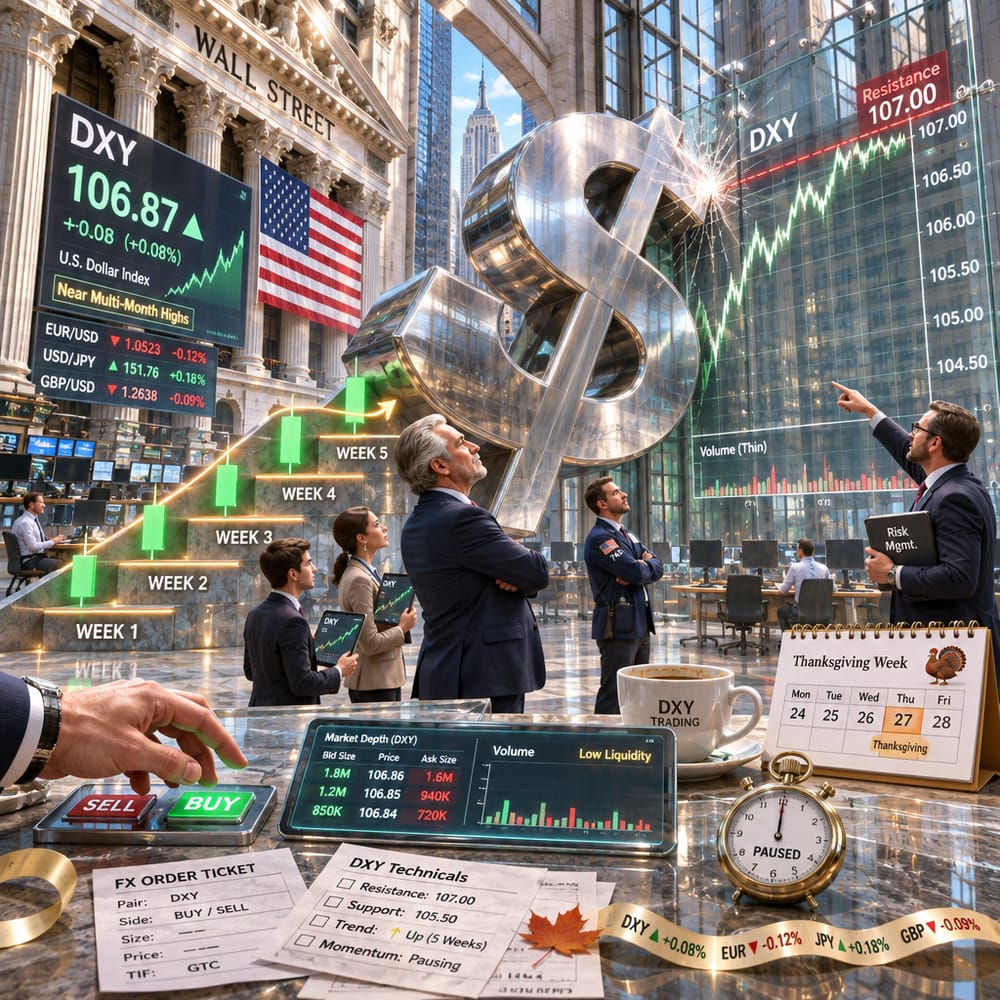
IS THE DOLLAR PLAYING HARDBALL, OR JUST WAITING FOR TURKEY LEFTOVERS?
Let's talk turkey, folks. Not the kind you gobbled up last Thursday, but the kind that has kept the global financial stage buzzing: the U.S. Dollar Index, or DXY for those who like their financial lingo a bit snappier. The DXY has been on a five-week tear, charging valiantly towards heights not seen in nearly two years. Yet, just as it seemed destined to etch new records, it hit a wall — a wall of resistance that’s about as stubborn as your uncle insisting on his turkey carving technique.
So, what's the big deal with this resistance? Imagine the DXY as a marathon runner. It's sprinted through several laps, each lap representing investor optimism about the Federal Reserve’s next move or global economic sentiments. But now, it's like the runner's hit that infamous 20-mile wall. This isn't just any wall, though. It’s the 22-month-high hurdle, and with holiday-week trading being as flimsy as that paper plate you stacked mashed potatoes on, the dollar is taking a breather.
Why does this matter to you, the savvy retail investor scrolling past cat videos and pie recipes? Because the DXY's performance often signals how confident investors are about the Fed's future moves, not to mention how jittery – or not – they are about global risks.
IMPLICATIONS OF THE DXY STALL
The dollar's current pause could mean a few things. If the DXY eventually breaks through this resistance barrier, consider it a signal flare. It may suggest that investors are bracing for a hawkish, or aggressive, Fed — perhaps preparing for higher interest rates to tango with inflation. Why? Because a strong dollar generally hints at higher rates that make dollar-denominated assets more attractive.
Conversely, the dollar stalling could indicate a more dovish, or cautious, Fed approach. Investors might be predicting the Fed will opt for a softer stance if inflationary pressures ease or if the economy shows signs of needing a breather itself.
HOLIDAY-WEEK TRADING: THE GOLDILOCKS CONUNDRUM
Now, let's mix in a little festive flavor. Thanksgiving week is notorious for uneven trading volumes. Picture this: Wall Street's bustling trading floors take on a ghost town vibe as traders play hooky to stuff themselves with pumpkin pie. Thin liquidity — basically fewer trades happening — can make the market act like your hyper cousin on a sugar high, jumping around unpredictably.
This thin trading tends to magnify the effects of whatever trades do happen, meaning that any significant movements could lead to exaggerated market responses. It’s a time when the market, much like your waistband, is just a bit more elastic.
SIGNALS FOR FUTURE FED POLICY
Let’s not forget to squint into the crystal ball of future Fed policy. The DXY’s movements could very well forecast the Fed’s next steps. If investors believe the Fed will keep its militant stance against inflation, expect the dollar to try bulking up past this resistance level. It’s like watching a heavyweight champ gearing up for another bout.
But remember, this is all part of a larger dance with global risk sentiment. Should geopolitical tensions simmer or new economic uncertainties arise, the dollar might find itself in a defensive crouch, reflecting a market seeking safety.
THE BIG PICTURE
As we roll away from turkey leftovers and head towards the frenzy of holiday shopping sprees and New Year’s resolutions, keep an eye on the DXY. Whether it busts through that resistance or gets comfortable lounging on it like a post-feast nap, its trajectory will provide clues about where the market thinks the Fed and global economic risk are heading.
So, next time you're on your phone, sandwiched between videos of dancing dogs and AI-powered kitchen gadgets, spare a moment for the mighty dollar. It’s more than just green paper—it’s a key player in the global financial orchestra, and its current pause could be the calm before a very intriguing storm.
This article is for informational purposes only and is not investment advice. Always do your own research or consult a licensed financial professional before making investment decisions.
© Copyright 2024. All Rights Reserved.
© Copyright 2024. All Rights Reserved.