

Dollar Index (DXY) Stalls Amid Softer U.S. Data, But Eyes Weekly Gain
Wednesday, August 19, 2026
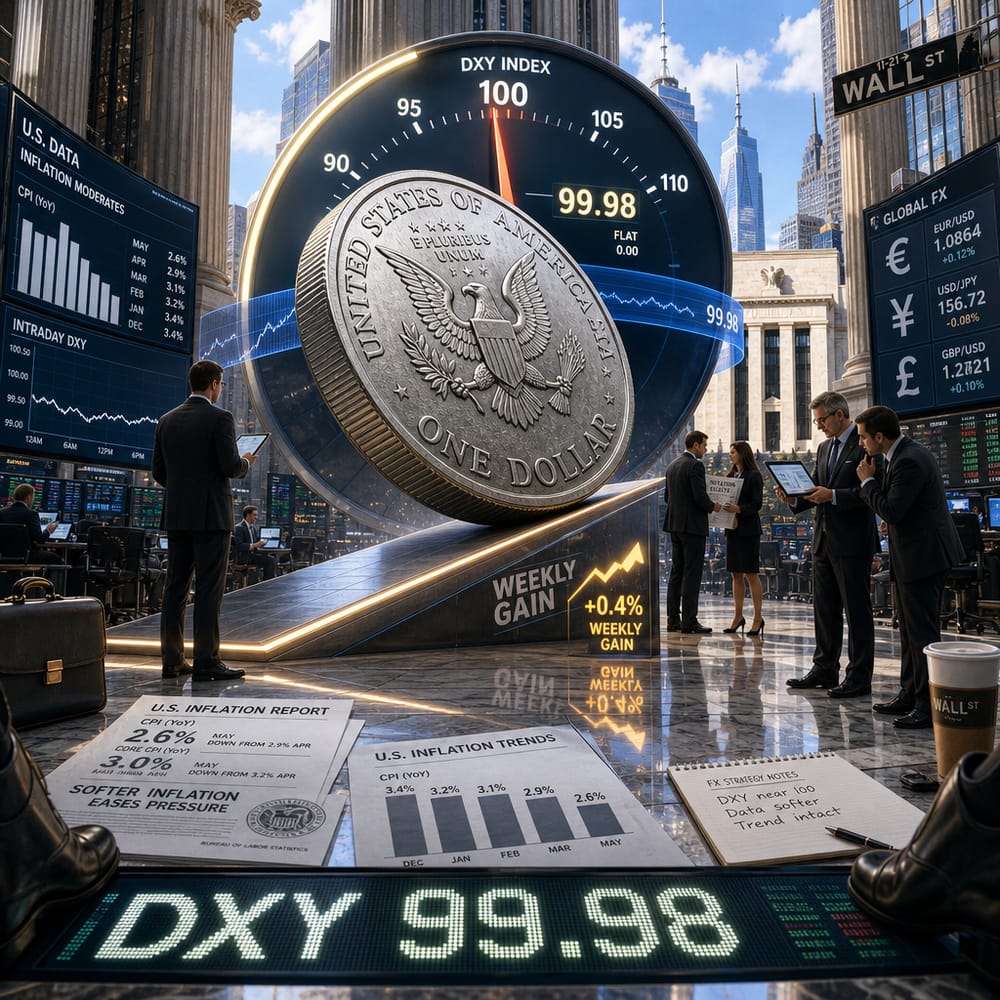
IS THE DOLLAR ABOUT TO DANCE OR DROP? A LOOK AT THE DXY'S LATEST MOVES
If the dollar were a dancer, it would be caught mid-step right now, unsure of whether to twist, shuffle, or break into a full-blown samba. Hovering at a tepid 99.98, the U.S. Dollar Index (DXY) seems to be taking a breather, but make no mistake—this lull doesn’t mean it's out of energy. In fact, the dollar is eyeing a 0.4% weekly rise despite some softer U.S. economic data. So what’s really going on here?
THE DOLLAR PLAYLIST: WHAT’S DRIVING THE TUNES?
The dollar’s current performance is like a mashup of different beats—part economic data, part market sentiment, and a sprinkle of global dynamics. Recently, softer U.S. inflation data has taken center stage, catching the attention of both retail investors and financial wizards. Inflation numbers can often move markets like a DJ drops a beat. When inflation's low, it suggests the Fed might take a chill pill on interest rate hikes, making the dollar look less enticing compared to its global peers.
But not so fast. Don't throw the dollar out of the club just yet. The market’s also factoring in the relative strength of the U.S. economy compared to other countries. With the European Central Bank still trying to get its groove back and China dealing with its economic challenges, the dollar remains a kind of safe haven—a familiar oldie but goodie when the global future feels as unpredictable as a teenager’s Spotify playlist.
WHAT’S NEXT ON THE DJ’S SETLIST?
So what about future tracks? Any upcoming U.S. economic data could either amp up the beats or slow things down, influencing the DXY's next moves. Pay particular attention to the Federal Reserve's comments and any new economic indicators. If we get a flurry of positive economic news, it could give the DXY the shot in the arm it needs to bust out the big dance moves. Conversely, disappointing data might have it slumping in the corner like a wallflower.
And let's not forget the international stage. Global trade, geopolitical tensions, and policy changes can all remix the dollar's beat. Just look at the current U.S.-China chip tango—restrictions on tech exports could not only impact trade balance but also ripple through currency valuations. In a world as interconnected as ours, what happens in Beijing, Brussels, or anywhere else is never just a local event.
MARKETS AND TRENDS: HOW RETAILERS AND TECH ARE GROOVING
Meanwhile, over in the stock market club, retailers like Target have come out swinging with strong earnings reports, aided by some tariff refunds that are as sweet as a surprise cameo by a favorite artist. Although earnings are up, Target’s stock took a pre-market stumble—proof that even when the fundamentals are jiving, the market mood can wobble.
In the tech world, AI darlings like Nvidia are caught in a whirlwind, with U.S. export restrictions to China causing a bit of a ruckus. As these companies navigate evolving trade policies and supply chain quirks, their stock performance can sway investor sentiment, potentially nudging the dollar along with it.
IN THE GRAND SCHEME OF THINGS
For retail investors, the dollar's dance might seem like background music, but it's a critical component of the broader economic playlist. It influences everything from global trade balances to the cost of your next overseas vacation. It also sets the scene for investments, impacting sectors and individual stocks alike.
So, as you scroll through your financial news feed, keep an eye on the dollar. Whether it decides to boogie upwards or take a rest, it’s a key player in the financial symphony. Stay tuned, because in the world of currencies, the next big hit—or flop—is always just around the corner.
This article is for informational purposes only and is not investment advice. Always do your own research or consult a licensed financial professional before making investment decisions.
© Copyright 2024. All Rights Reserved.
© Copyright 2024. All Rights Reserved.