

Dollar Index Climbs as Traders Anticipate Jackson Hole Symposium
Thursday, August 27, 2026
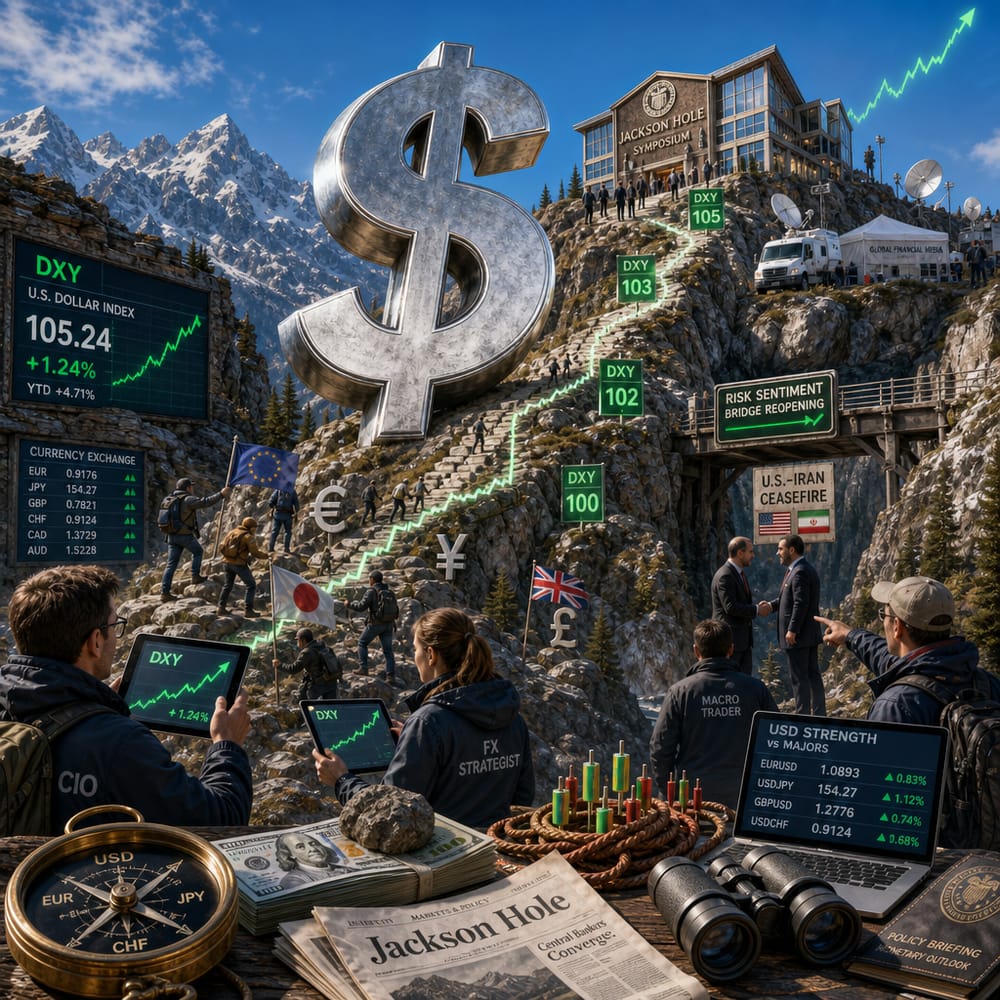
In the financial world, anticipation is like caffeine — it keeps everyone on their toes, jittery and wide-eyed. The current buzz? It’s all about Jackson Hole. The U.S. Dollar Index (DXY) is strutting its stuff, gaining some muscle as traders brace for the annual Jackson Hole Symposium. But why is this quaint Wyoming town suddenly the center of the financial universe? Let's dive into the monetary tea.
WHAT TO EXPECT FROM JACKSON HOLE
For those not living and breathing finance, think of the Jackson Hole Symposium as the Coachella of central banking. It’s where central bankers, finance ministers, and economic bigwigs gather to drop hints and vibes about where the world economy might be headed. The Federal Reserve’s chief, Kevin Warsh, is expected to take the stage, and much like a headline act, everyone is waiting to see if he’ll play "Inflation Rocks" or "Rate Hike Blues."
Traders have been whispering about a possible indication of the Fed's next move. Will they continue to tighten monetary policy, or will they ease off the brakes? The dollar is flexing because a hawkish Fed, which is a central bank more likely to raise interest rates to curb inflation, often leads to a stronger dollar. Higher rates make the dollar more attractive to investors seeking better returns.
THE U.S.-IRAN CEASEFIRE CHATTER
Adding some spice to the mix, there’s chatter of potential U.S.-Iran ceasefire talks. While a truce may sound like a political issue, it has huge financial implications. A ceasefire could stabilize oil markets, reducing global economic uncertainty. This would be a breath of fresh air for markets weary from geopolitical tensions, potentially spurring riskier investments.
If tensions ease, it could lower the risk premium on oil, dampening prices and, paradoxically, weakening the dollar. Why? Because oil, priced in dollars, becomes less expensive, and countries need fewer dollars to buy the same amount of oil.
DOLLAR MUSCLES AND GLOBAL TRADE
A stronger dollar isn't just flexing in the mirror; it ripples across the world economy. While it makes imports cheaper for Americans — hello, more affordable Italian wine and Japanese gadgets — it puts pressure on U.S. exports. American goods become pricier abroad, which could dent sales and profits for U.S. companies with international footprints.
Developing economies, which often have debts denominated in dollars, might feel the pinch. Their repayment costs rise when the greenback appreciates, potentially leading to financial strain. Think of it as paying off a loan, and suddenly the interest rates double — not fun.
THE MARKET'S NEXT MOVE?
So, with the dollar riding high, and all eyes on Jackson Hole, what's the next move for those scrolling through investments on their phones? Well, it's time to consider the domino effects. If the Fed signals that rates will stay high or go higher, the dollar might continue its powerhouse performance. This could be a cue to evaluate investments, particularly in sectors sensitive to currency swings.
For instance, companies reliant on exports might face headwinds, while those importing goods could enjoy some cost savings. It’s a delicate balancing act that requires a keen eye and a quick hand.
In the end, whether you're a retail investor or a Wall Street titan, it all circles back to the same principle: anticipation drives markets. So, grab your popcorn (or perhaps a latte), and tune into the Jackson Hole Symposium. Whatever happens, it’s bound to be a show.
This article is for informational purposes only and is not investment advice. Always do your own research or consult a licensed financial professional before making investment decisions.
© Copyright 2024. All Rights Reserved.
© Copyright 2024. All Rights Reserved.