

Dollar Holds Near One-Week High After Hawkish Warsh Speech at Jackson Hole
Sunday, August 30, 2026
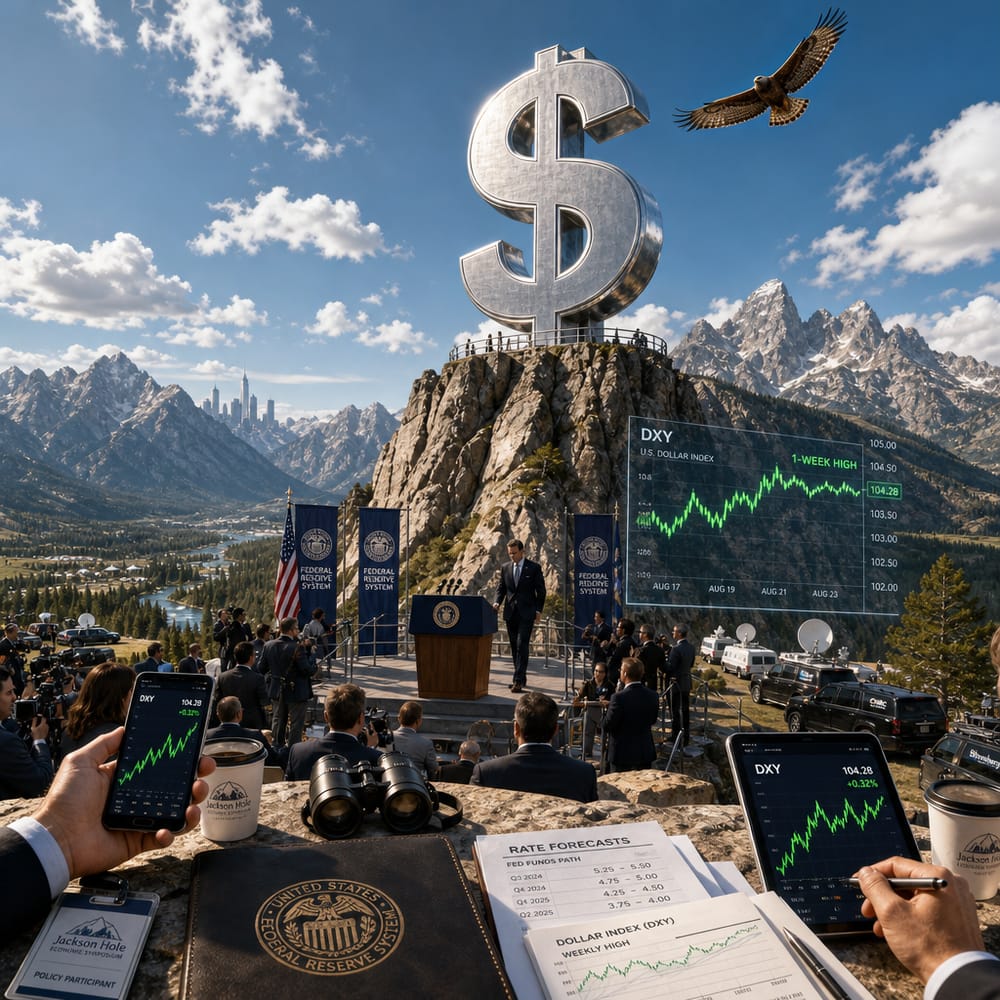
DOLLAR HOLDS NEAR ONE-WEEK HIGH AFTER HAWKISH WARSH SPEECH AT JACKSON HOLE
Just when you thought the financial world couldn't get any more dramatic, enter Fed Chair Kevin Warsh with a performance worthy of an Oscar at the Jackson Hole economic symposium. With all the flair of a Shakespearean soliloquy, Warsh's hawkish tones have set the US Dollar Index (DXY) alight, leaving it hovering just below a one-week high. But don't toss your greenbacks into a celebratory confetti shower just yet—let's unpack what this means for you, the savvy retail investor scrolling through your feed for the next big scoop.
HAWKISH OR JUST HAWK-EYED?
In the world of central banking, "hawkish" isn't about birds of prey. It's Fed-speak for tightening the money taps, a.k.a., raising interest rates to keep inflation in check. Warsh's words have ignited expectations that the Federal Reserve is not done with rate hikes. The implication? Borrowing costs might climb faster than you can say "adjustable-rate mortgage," and that sends ripples through the currency markets. Higher rates typically make a country's currency more attractive to investors, which is exactly why the dollar's strutting its stuff like a peacock on Wall Street.
Of course, when the dollar flexes its muscles, it's not just the US markets that feel the burn. In the global economic gym, a stronger dollar can bench press its way to more expensive commodities like oil and gold, which are priced in dollars. This means potentially pricier gasoline for your summer road trip or a heftier bill if you're planning to stockpile gold in your basement.
GLOBAL IMPACT AND WHETHER OTHER CENTRAL BANKS WILL FOLLOW SUIT
Now, the million-dollar question—or should we say the multi-billion-dollar question: How will other central banks respond to this Fed-induced commotion? Will they follow Warsh's lead and raise rates, or sit tight and hope for the best? It's a high-stakes game of follow-the-leader, and the global economy is watching closely.
In Europe, the European Central Bank (ECB) has been working overtime to juggle inflation concerns with growth considerations. If they choose to follow the Fed's path, we could see interest rate hikes across the pond too. Over in Asia, central banks might weigh the impact on exports, as a stronger dollar could mean their products are more expensive on the international market. But with inflation being a global party crasher, many might have no choice but to join the rate hike conga line.
WHAT THIS MEANS FOR YOU
So, what does this mean for you, the savvy investor trying to make sense of it all? Well, if you're holding US dollars, you might find a spring in your step as your purchasing power increases abroad. Maybe a European vacation is in your future, with your dollars stretching further than that yoga class you bailed on last week.
On the investment front, higher rates could make stocks a bit of a roller coaster ride. Companies that rely heavily on borrowing might feel the squeeze, while sectors like banking and finance could pop the champagne as higher rates often mean bigger profits. As for bonds, rising rates can spell trouble for existing holdings but may present new opportunities if you're buying in.
In the long run, Warsh’s hawkish tone signals a vigilant Fed that's not afraid to play the inflation-fighting game hard. It's a cautious dance between ensuring economic growth and keeping inflation in check, with the US dollar taking center stage.
So, as you sip your latte and scroll through your feed, keep an eye on the DXY and the central bank chatter. The dollar might be riding high today, but in the world of finance, the only constant is change. Stay sharp, stay informed, and keep asking the big questions—that's the real currency of savvy investing.
This article is for informational purposes only and is not investment advice. Always do your own research or consult a licensed financial professional before making investment decisions.
© Copyright 2024. All Rights Reserved.
© Copyright 2024. All Rights Reserved.