

Diverging Labor Market Signals: Jobless Claims vs. Payrolls
Tuesday, August 25, 2026
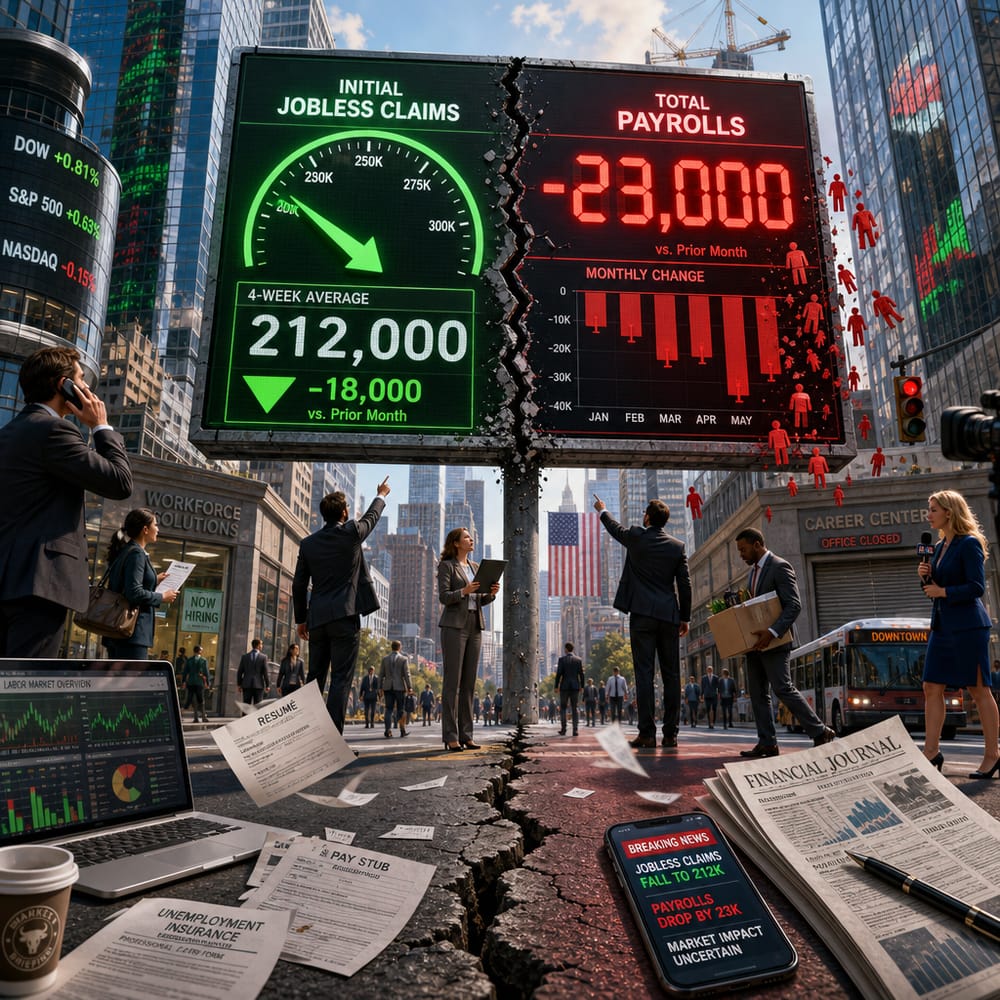
THE JOB MARKET JIGSAW: WHEN TWO PIECES DON'T FIT
Imagine you're assembling a puzzle and two pieces just refuse to fit. Nope, not happening. Now replace that puzzle with the U.S. labor market, and you've got a glimpse of the current chaos. Buckle up; we're diving into a perplexing paradox.
On one hand, we've got a cheering section for the economy: initial jobless claims have dropped like your phone when you're too confident it won't shatter. This normally screams, "Recession? What recession?" as it suggests that companies are holding tight to their workers like they're hoarding gold in a pirate movie. Yet, the July employment report just threw a soggy sponge party with its unexpected loss of 23,000 jobs. That's right, folks, thousands of jobs gone like socks in the laundry.
So, what's going on behind the curtain? Why these funky dance moves in the labor market?
THE JOB LOSS MYSTERY
A deeper dive into the July data reveals some clues. For starters, the tech sector isn't exactly throwing a party right now, and it's not the only one. After a couple of years of hiring frenzies, some industries are getting cozy with the idea of hitting the brake pedal. Companies are reassessing their needs, aligning with the whispers of economic cooling, and, in some cases, battling the costs of doing business in this inflation-riddled landscape. Plus, the summer vacation season might have played a mischievous role, with fewer people looking for work as they chose sunlit beaches over office desks.
Yet, the drop in layoffs suggested by lower jobless claims hints at companies hedging their bets. They're not pulling the trigger on layoffs, perhaps holding out hope that this is a temporary blip rather than a sign of a storm on the horizon.
FEDERAL RESERVE: TO HIKE OR NOT TO HIKE
Enter the Federal Reserve, which loves a good puzzle as much as the next central bank. These mixed signals make it tricky for the Fed to decide whether to raise interest rates again – their go-to move to cool inflation – or take a breather. Raising rates could slow down the economy further and push up unemployment, while holding steady might fuel inflationary fires.
Seeing the Fed delicately balance these concerns is like watching a tightrope walker who suddenly realizes they're also juggling flaming torches. How do these labor market riddles impact their decision? Think of it as a game of Jenga, where every wobbly piece could either stabilize or topple the tower.
BROADER ECONOMIC RIPPLE EFFECTS
Now, let's zoom out and look at the bigger picture. The labor market is a cornerstone of the U.S. economy, influencing everything from consumer spending to broader economic growth. If job losses continue, it doesn't take a crystal ball to predict that consumer confidence might take a nosedive. After all, if people are worried about job security, they're less likely to splurge on that extra avocado toast.
Furthermore, these labor market shifts could have ripple effects across sectors. Tech, retail, and manufacturing might feel the turbulence first, but don’t assume other industries are immune. The stock market likes clarity, and this labor data cocktail of contradictions has investors feeling like they're at a party with no idea what the theme is.
THE ROAD AHEAD
So, what should everyday investors make of this labor market puzzle? Keep a keen eye on future employment reports, as they will be crucial in deciphering whether July was a one-off blip or the start of a more challenging trend. Pay attention to the Fed's moves, as any changes in interest rates will likely have implications for your portfolio.
Remember, economic landscapes are like a good thriller novel – always changing, filled with unexpected twists, and sometimes leaving you scratching your head. But stay informed, keep asking questions, and most importantly, don’t lose sleep over every market hiccup.
In the great labor market dance-off, it's unclear who's leading. But with eyes wide open and ears attuned to the Federal Reserve's every move, we might just find the rhythm or, at the very least, not trip over our own feet.
This article is for informational purposes only and is not investment advice. Always do your own research or consult a licensed financial professional before making investment decisions.
© Copyright 2024. All Rights Reserved.
© Copyright 2024. All Rights Reserved.