

Divergence in Fed Views: Internal Dissent Remains Visible
Friday, August 14, 2026
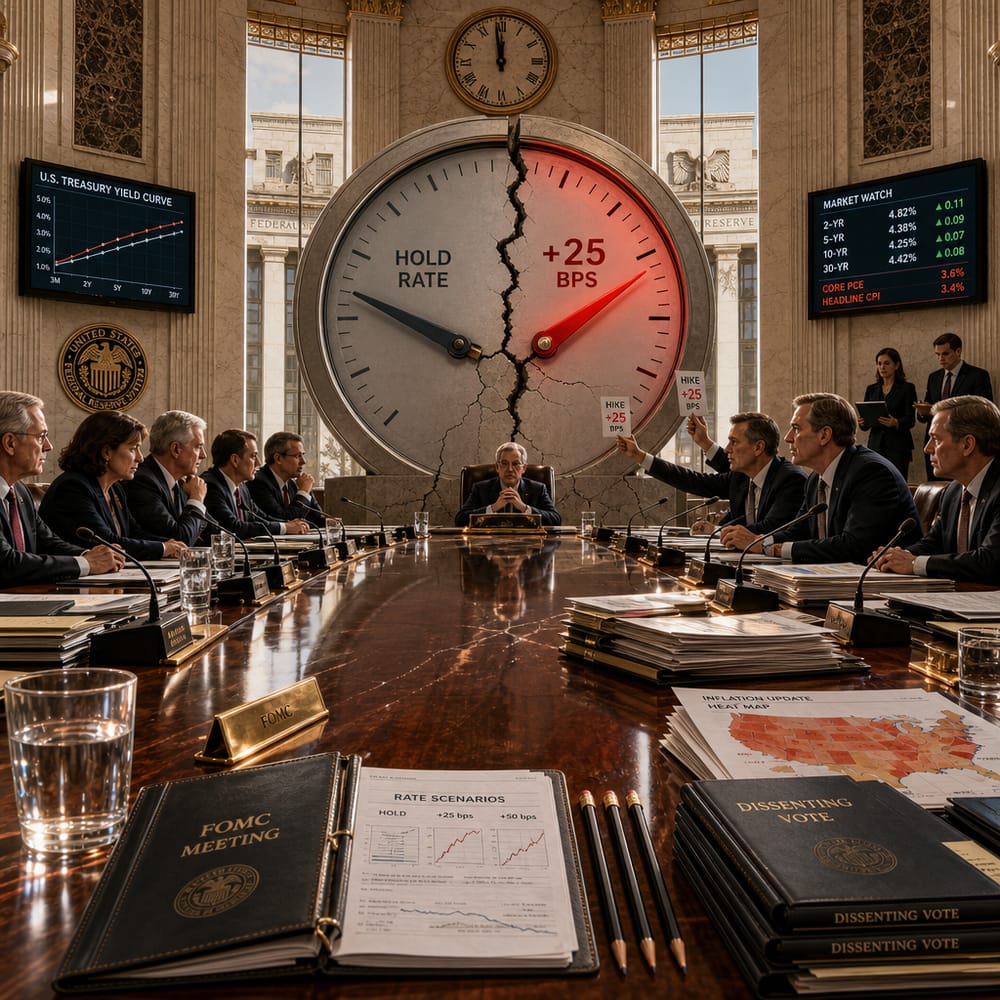
If you’re looking for drama, don’t bother with a new binge-worthy series. The real action is happening behind closed doors at the Federal Reserve, where internal tensions are bubbling hotter than an overcaffeinated barista’s latte steam. At the recent July 29 Federal Open Market Committee meeting, three outspoken Fed officials broke ranks and called for a 25 basis point (bps) interest rate hike. Why? Because inflation is hanging around like that one party guest who just won't leave.
WELCOME TO THE FED’S HIGH-STAKES FAMILY DINNER
Imagine the Fed as a family, gathered around a massive table littered with economic charts instead of mashed potatoes. Everyone agrees they want to rein in inflation, but how to do it? That’s where the squabble begins. With inflation getting more stubborn than a mule on a hot day, some members think it’s time to bring out the big guns—higher interest rates.
Now, a 25 bps increase might sound like small potatoes, but in the world of finance, it’s the equivalent of switching from mild salsa to ghost pepper sauce. Even a subtle tweak can have investors dancing on a razor’s edge.
WHAT HAPPENS WHEN THE FED ISN’T SINGING KUMBAYA?
A divided Fed is like a car with the GPS arguing with the driver. The markets thrive on predictability, so when there’s uncertainty about interest rates, it’s akin to throwing a banana peel onto the stock market highway. Investors hate not knowing where rates are going as much as cats hate water.
A split Fed adds a layer of unpredictability. Will rates go up, stay the same, or perhaps even dip? It’s like trying to figure out how to dress for the weather when the forecast swings between snowstorm and heatwave.
The consequence? Market indecision. Stocks could get jittery, bond markets might frown, and even the dollar could feel the sting. But let’s be clear, this isn’t just about investors. Higher interest rates would hit home for everyone, from mortgage seekers to credit card holders.
HOW THE DISSENT MIGHT DRIVE FUTURE DECISIONS
So, what’s next? With internal dissent on the rise, the Fed is in a bit of a pickle jar. Some members are eager to nip inflation in the bud by raising rates now, while others are concerned about stunting economic growth. It’s like trying to diet while standing in a bakery—temptations and fears pulling in different directions.
The outcome of this tug-of-war will shape how the Fed proceeds. If the hawks (those who want higher rates) gain momentum, we might see further interest rate hikes sooner than anticipated. On the flip side, if the doves (those in favor of keeping rates low to support growth) hold their ground, the Fed may lean towards a wait-and-see approach.
THE MARKET REACTION: KEEPING AN EYE ON THE BALL
For everyday investors watching from the sidelines, the key is to keep your eye on Fed announcements like a hawk (pun intended). A unified Fed can mean stability, but a divided one? Expect the market to behave like a cat in a room full of rocking chairs—nervous and unpredictable.
Yet, not all is doom and gloom. A divided Fed could signal the start of a new strategy, one that might better balance inflation and growth. Investors might start looking to defensive sectors like utilities or consumer staples, which tend to be less affected by rate hikes. Meanwhile, tech and growth stocks, which are more sensitive to changes in rates, will keep investors on their toes.
CONCLUSION: WHERE DOES THIS LEAVE YOU?
The Fed’s internal divide is a stark reminder of the challenging economic landscape we’re navigating. It’s a tale of inflation, interest rates, and the delicate dance of economic stability. While the dissent adds a layer of unpredictability, it also keeps us engaged, offering a front-row seat to the economics theater.
For you, dear reader, staying informed is your best strategy. Whether it’s watching the next Fed meeting like a hawk or diversifying your portfolio to hedge against the unexpected, being in the know is your secret weapon. After all, in the world of finance, knowledge isn’t just power—it’s your ticket to making savvy investment decisions amidst the chaos.
This article is for informational purposes only and is not investment advice. Always do your own research or consult a licensed financial professional before making investment decisions.
© Copyright 2024. All Rights Reserved.
© Copyright 2024. All Rights Reserved.