

Delta's Profit Warning: Fuel Shock Slashes 2026 EPS by 24%, Stock Slides Nearly 3%
Friday, October 09, 2026
DELTA'S PROFIT WARNING: FUEL SHOCK SLASHES 2026 EPS BY 24%, STOCK SLIDES NEARLY 3%
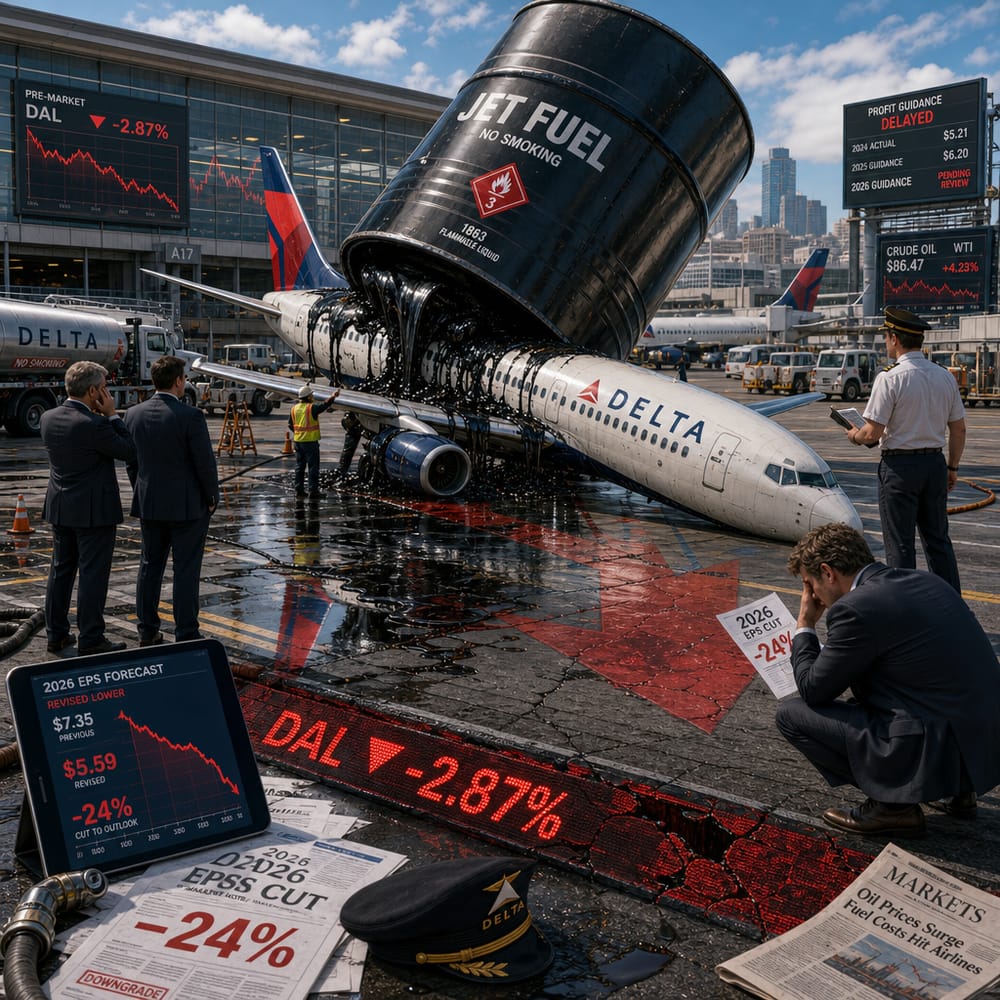
In the high-flying world of air travel, where the skies are supposed to be the limit, Delta Air Lines just hit the brakes hard. Let's be frank: nothing grounds an airline's profit dreams faster than a surge in jet fuel prices. The airline titan has clipped its full-year 2026 earnings expectations, sending investors into a mild panic and the stock sliding nearly 3% in pre-market trading. Why? A jaw-dropping increase in jet fuel costs has left its mark.
So, how did Delta end up in this unfortunate mid-air turbulence? Well, it's not for lack of passengers. Delta’s CEO, Ed Bastian, assures us that travelers are still happily getting on planes, even shelling out more for tickets. But it's not the demand Delta's worried about—it's the cost of filling up the tank. Jet fuel prices in the Gulf of Mexico region have nearly doubled from last year. Ouch.
Delta's earnings-per-share forecast took a nosedive from the once hopeful range of $6.50 to $7.50 to a much gloomier $5.10 to $5.60. That's a 24% drop, folks. And if you’re wondering what that means for Delta’s free cash flow, it's another unpleasant surprise—now projected at $2.5 billion, down from the $4 billion previously predicted. Not a pretty picture.
The burning question: how will this profit warning impact Delta's stock in both the short and long term? In the immediate future, it's a bit like flying through turbulence—expect some ups and downs as the market digests this dose of reality. However, if fuel prices stabilize or if Delta finds efficiencies elsewhere, the long-term damage could be less severe than today's news suggests. Nevertheless, with the airline sector’s notorious volatility, keeping an eye on these trends will be crucial for investors.
Delta's plight paints a broader picture impacting the entire airline sector. If Delta, with its robust operations and market share, is feeling the pinch, smaller carriers and those with less efficient fleets might just be reaching for the oxygen masks. The ripple effects could be significant, with a potential domino effect of earnings revisions across the sector. Other airline stocks could see similar downward pressures, at least until there's clearer air on the fuel price front.
Let's zoom out: what does this mean for future airline earnings? It's a stark reminder of the industry's exposure to volatile fuel prices. This isn't just a Delta issue—it's an airline issue. If fuel prices remain high, airlines might be forced into a tricky balancing act, passing costs to consumers while maintaining competitive pricing. And let's not even get started on the impact of environmental regulations and taxes that could add to the cost pressures.
The storyline here isn’t just about Delta’s numbers or even the airline sector's immediate woes; it's about understanding the fragility of an industry at the mercy of the fluctuating energy market. For retail investors scrolling through their feeds, it’s a wake-up call to pay attention to these dynamics when considering airline stocks. Profitability can quickly turn turbulent with just a few shifts in fuel prices.
In summary, Delta’s profit warning is a clear signal: while demand remains strong, the cost side of the equation is a fierce headwind. Keep your seatbelt fastened, because the ride for airline investors could be a bit bumpy as we head towards 2026. The skies might be friendly, but they sure aren't cheap.
This article is for informational purposes only and is not investment advice. Always do your own research or consult a licensed financial professional before making investment decisions.
© Copyright 2024. All Rights Reserved.
© Copyright 2024. All Rights Reserved.