

Deere & Co. Positioned for “Beat-and-Raise” Despite Tough Ag Outlook
Wednesday, August 19, 2026
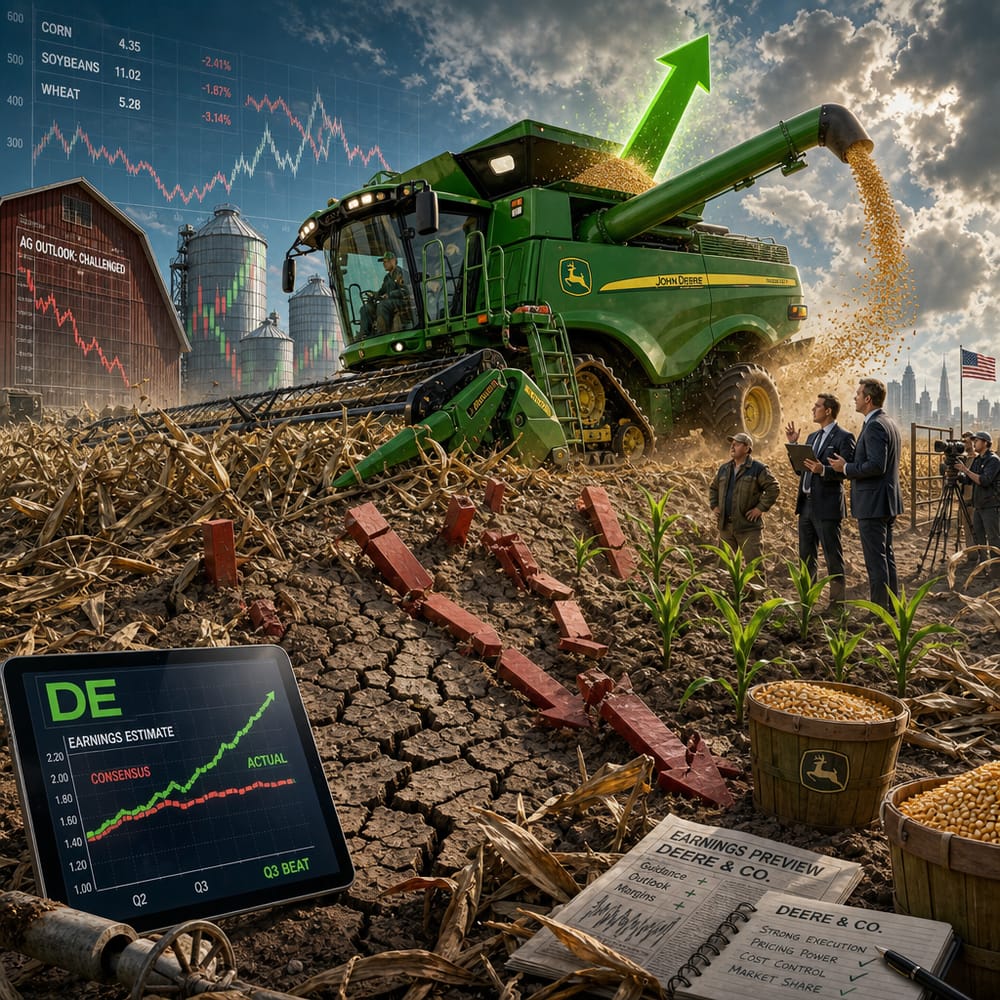
DEERE & CO: SOWING PROFITS DESPITE AGRICULTURAL HEADWINDS
In a world where lettuce costs more than a latte, and farmers wrestle with the economic rollercoaster of fertilizer prices and unpredictable weather, Deere & Co. is plowing ahead, ready to pull off a feat some might call agricultural wizardry. Cue the “beat-and-raise,” a market darling move where a company not only surpasses earnings expectations but also jacks up its future guidance, giving investors a reason to dance a jig in their John Deere hats.
Now, let’s not pretend this is happening in a vacuum. The agricultural landscape these days looks, well, challenging. Think trade tensions, extreme weather, and rising costs of everything from seeds to steel. Yet, like a seasoned farm dog, Deere seems to know how to navigate through the muddy fields.
WHAT’S DRIVING DEERE’S SUCCESS?
First off, Deere’s secret sauce has a lot to do with diversification. Beyond the iconic green tractors, the company is knee-deep in technology. We’re talking smart farming equipment—machines that practically drive themselves and come equipped with the kind of AI that could give Silicon Valley a run for its money. This technology makes farming more efficient, using less labor to harvest more crops, and it’s a big hit with farmers who are increasingly tech-savvy.
Moreover, Deere is not just whispering sweet nothings about sustainability; it's taking solid steps forward. Renewable energy equipment and water management systems are part of its portfolio, appealing to a generation of farmers keen on embracing greener practices. These initiatives not only bolster Deere’s reputation but also attract investment dollars that are eyeing sustainable growth.
NAVIGATING AGRICULTURAL CHALLENGES
The truth is, the agricultural sector has more ups and downs than a country music love story. But Deere has been weathering the storm like a pro. Part of the strategy is simple: global reach. While the U.S. might be dealing with a drier season or fluctuating tariffs, there are other markets worldwide where Deere’s products are in high demand, such as in regions with burgeoning agricultural economies.
Plus, let's not forget financial prudence. As the cost of raw materials creeps higher, Deere has been adept at cutting costs elsewhere. By optimizing supply chains and employing just-in-time manufacturing, they’ve managed to keep profit margins healthy. Think of it as the corporate equivalent of tightening your belt without skipping dessert.
LONG-TERM PROSPECTS
Looking ahead, Deere isn’t just betting on tractors. It’s eyeing the future with investments in robotics and AI, envisioning a future farm that’s more like a sci-fi movie set than Old MacDonald’s farm. The idea is to create smart farms where every part of the process, from planting to harvesting, is optimized for efficiency. And with the global population booming, the demand for food—and efficient ways to grow it—will only rise.
Then there’s the potential in construction and forestry equipment. As urbanization continues, the need for robust machinery in building and infrastructure projects boosts another arm of Deere’s business. It's not just planting seeds but also paving roads to future profits.
BOTTOM LINE FOR INVESTORS
For investors, Deere presents a compelling narrative. This is not a company resting on the faded laurels of past achievements. Instead, it’s a forward-thinking entity positioning itself at the intersection of technology and agriculture, ready to ride the waves of current market challenges and future opportunities with aplomb.
While the agricultural sector might be facing some stormy weather, Deere seems to have packed its raincoat—and maybe an umbrella or two. So, if you’re looking for a stock with roots as deep as its resilience, Deere might just be the green in your portfolio that thrives, even when other crops are struggling.
This article is for informational purposes only and is not investment advice. Always do your own research or consult a licensed financial professional before making investment decisions.
© Copyright 2024. All Rights Reserved.
© Copyright 2024. All Rights Reserved.