

Decentralized Exchanges Gain Ground in U.S. Spot Trading
Friday, August 28, 2026
DECENTRALIZED EXCHANGES GAIN GROUND IN U.S. SPOT TRADING
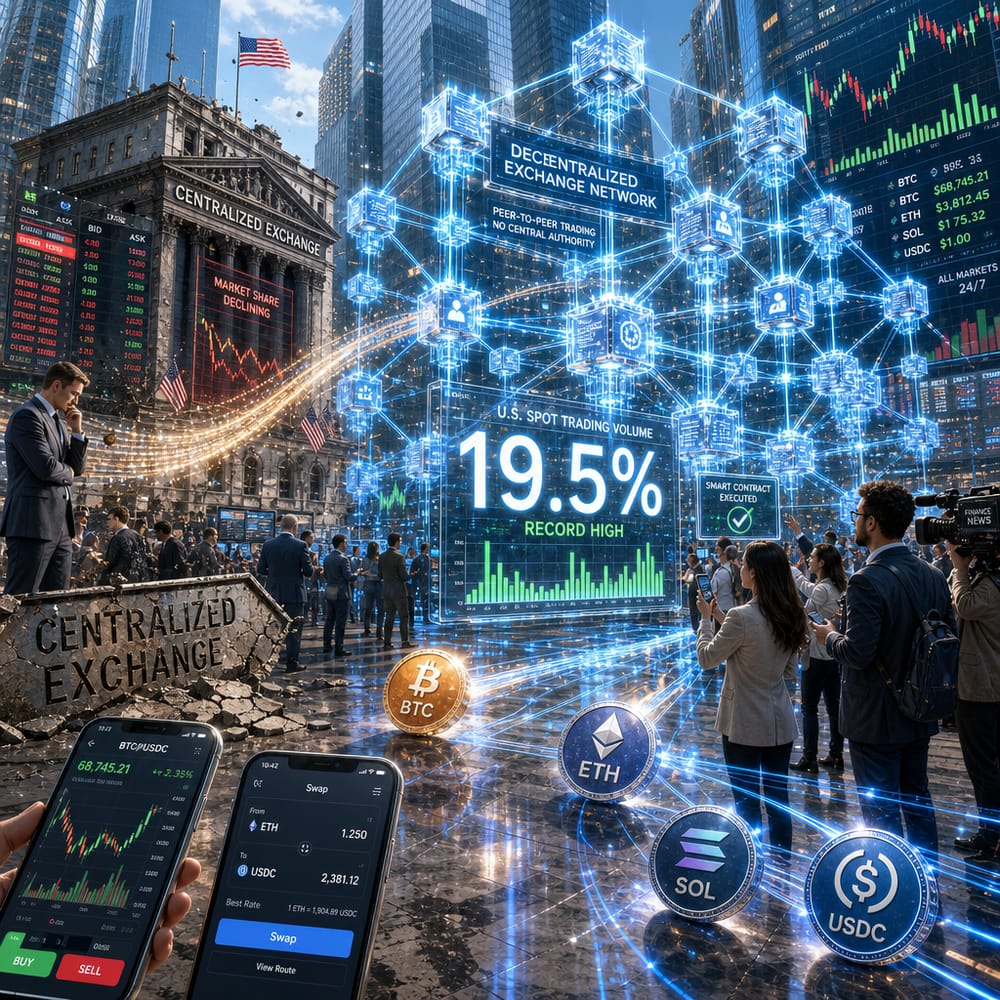
Forget about Bitcoin for a second—there's a new sheriff in the Wild West of crypto, and it's turning heads. Decentralized exchanges (DEXs) are racking up a serious win, now accounting for nearly 20% of crypto spot trading volume as of July. If you’re scratching your head and wondering why that matters, think of it as a seismic shift in where and how cryptocurrencies are traded.
Once upon a time, centralized exchanges like Coinbase and Binance reigned supreme. You’d deposit your crypto, they’d hold onto it like your stingy uncle at dinner, and you’d trade away. But in the land of digital assets, decentralization is the new cool. Like a high school prom where centralized exchanges are the chaperones and DEXs are the rebellious kids sneaking out to dance to their own tune.
WHAT’S DRIVING THE SHIFT?
So, what’s making these decentralized exchanges so appealing all of a sudden? For starters, DEXs champion the idea of giving you total control over your assets. No more handing over your hard-earned crypto to a middleman. It's all on the blockchain, transparent, and under your direct oversight. Think of it as taking your cash out from under the mattress and refusing to let the bank touch it.
Then there’s the security angle. With cyber hacks on centralized exchanges as common as spam emails, folks are starting to value the security that DEXs offer. When you trade on a decentralized platform, your assets stay in your wallet until the trade is made. No hot wallets to hack, no exchange holds to worry about. It’s like putting a triple lock on your front door in a rough neighborhood.
THE LIQUIDITY AND PRICE DISCOVERY PUZZLE
Here’s where it gets really interesting. DEXs are not just changing where trades happen; they’re changing how prices are set in the crypto market. With more traders and liquidity—a fancy term for how easy it is to buy and sell without affecting the price—moving to DEXs, price discovery is starting to mimic that of traditional stock markets. That could mean more accurate pricing and fewer wild west price swings when a whale decides to cash out.
But this shift doesn’t come without its own set of puzzles. Unlike centralized exchanges where you can match with buyers and sellers instantly, DEXs can suffer from slippage, where the price moves against you in the time it takes to execute a trade. And while some DEXs offer ‘liquidity pools’ to help solve this, not everyone’s convinced it’s a perfect fix.
CHALLENGES FOR CENTRALIZED EXCHANGES
Centralized exchanges aren't just going to sit back and watch their market share evaporate faster than Bitcoin on a Tesla balance sheet. They’ve got their work cut out for them in dealing with regulatory pressure—because let’s face it, Uncle Sam always wants his slice of the pie—and in providing services that DEXs can’t quite match yet, like fiat on-ramps for turning your dollars into crypto.
Moreover, these centralized platforms are trying to sweeten the pot with advanced trading tools, customer support, and various financial products. They’re like department stores that now need boutique charm to keep customers from leaving for the online shopping experience. But with the decentralized narrative picking up steam, they might have to pull more than just a few rabbits out of their hat.
THE ROAD AHEAD
What does the road ahead look like for these DEXs? While they’re riding high now, scalability is the name of the game. As more users flock to these platforms, DEXs must prove they can handle the load without watching transaction costs soar like a helium balloon.
We are witnessing a pivotal moment in the evolution of digital assets. The migration toward decentralized exchanges could redefine the crypto landscape, potentially influencing mainstream finance's approach to digital trading. Could the future be a hybrid model where centralized and decentralized exchanges coexist, each serving their niche with precision? Only time will tell, but one thing's for sure—crypto's not just a nerdy fad anymore, it’s a financial revolution with a serious power shift at play. Keep your eyes peeled, because the dance between decentralization and regulation is just getting started.
This article is for informational purposes only and is not investment advice. Always do your own research or consult a licensed financial professional before making investment decisions.
© Copyright 2024. All Rights Reserved.
© Copyright 2024. All Rights Reserved.