

Crypto Money Funding GOP Senate Campaigns
Thursday, July 30, 2026
CRYPTOCURRENCY: THE NEW POLITICAL SUPER PAC?
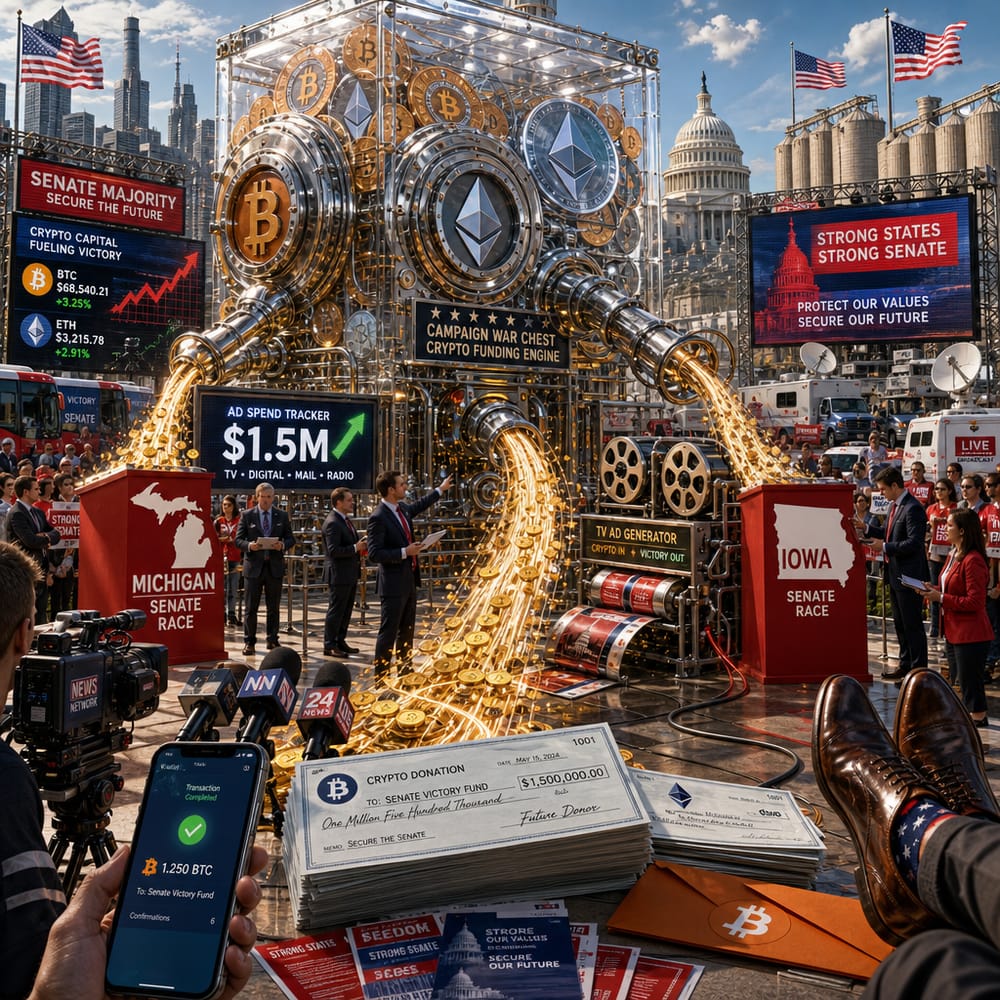
Crypto isn't just making headlines in the world of finance anymore—it's now a player in the political arena, too. A pair of crypto-aligned groups have dropped a cool $1.5 million on ad campaigns for GOP Senate candidates in Michigan and Iowa. And if you're wondering what Bitcoin has to do with a Senate seat, you're not alone.
In a landscape where dollars can dictate destiny, the injection of crypto money into political veins marks a seismic shift. It's like watching a plot twist in your favorite thriller, only this time, the stakes are real in the political game of thrones.
WHY IT MATTERS
Cryptocurrency isn't just shaking up the financial world; it's now shaking up politics. These digital assets, once the domain of tech-savvy nerds and speculative investors, have infiltrated campaign finance. And what's the aim of this crypto cash infusion? Influence, plain and simple.
Now, you're probably thinking, "How does this crypto cash really swing the vote?" Well, money in politics is like air in your lungs—essential. More funds mean more ads, more outreach, and more influence over voters who might be on the fence. In tight races where every vote counts, a wallet full of Bitcoin could be the difference between a win and a loss.
THE ETHICAL TIGHTROPE
Throwing crypto into the political mix isn't just about influence—it's about ethics. When traditional campaign financing meets digital currency, the lines can get blurry. Cryptocurrency thrives on anonymity, and that's a double-edged sword in politics. Who's actually backing these candidates with their blockchain bucks? It's not always clear.
Politicians are typically required to disclose donor identities, but with crypto, following the money trail can feel like chasing a ghost. This anonymity raises ethical questions: Are these crypto donations from well-meaning pioneers of digital finance, or shadowy figures with ulterior motives?
We live in a world where transparency is king, and yet, crypto's cloak of anonymity challenges that very principle. As these digital coins become campaign currency, the conversation around political accountability gets more complicated.
THE BIGGER PICTURE
Beyond the immediate implications for Iowa and Michigan, this crypto-campaign combo signals a broader trend. Crypto isn’t just about decentralizing finance; it's about decentralizing influence. If the experiment in these states is successful, we could see a flood of crypto cash into campaigns nationwide.
As with any financial revolution, there are ripple effects. Bitcoin and Ethereum, the twin titans of the crypto universe, might see their fates tied more closely to political outcomes. If crypto donations become a staple in political campaigns, expect the spotlight—and scrutiny—on these digital assets to intensify.
This development also forces us to ask: Is this the beginning of a new era in political funding, or just a passing fad? If crypto can successfully navigate the political labyrinth, it could cement its role as a major player in arenas far beyond finance.
WHAT’S NEXT?
As crypto's political influence grows, expect sparks to fly. It’s a brave new world where campaign regulators are scrambling to catch up, candidates are courting crypto cash, and voters are left wondering just what the future holds.
If you're a retail investor, you might want to buckle up. As crypto continues to evolve, its impact on politics—and by extension, the markets—could be profound. Keep an eye on those Senate races in Michigan and Iowa; they might offer a glimpse into our political—and financial—future.
The integration of crypto into campaign finance is not just a twist in the narrative—it's a whole new chapter. As with any good thriller, the ending is anyone's guess. But one thing’s for sure: cryptocurrency has arrived on the political stage, and its role in this drama is only just beginning.
This article is for informational purposes only and is not investment advice. Always do your own research or consult a licensed financial professional before making investment decisions.
© Copyright 2024. All Rights Reserved.
© Copyright 2024. All Rights Reserved.