

Crypto Miners Face Financial Strain as Revenue Declines
Thursday, August 13, 2026
CRYPTO MINERS FACE FINANCIAL STRAIN AS REVENUE DECLINES
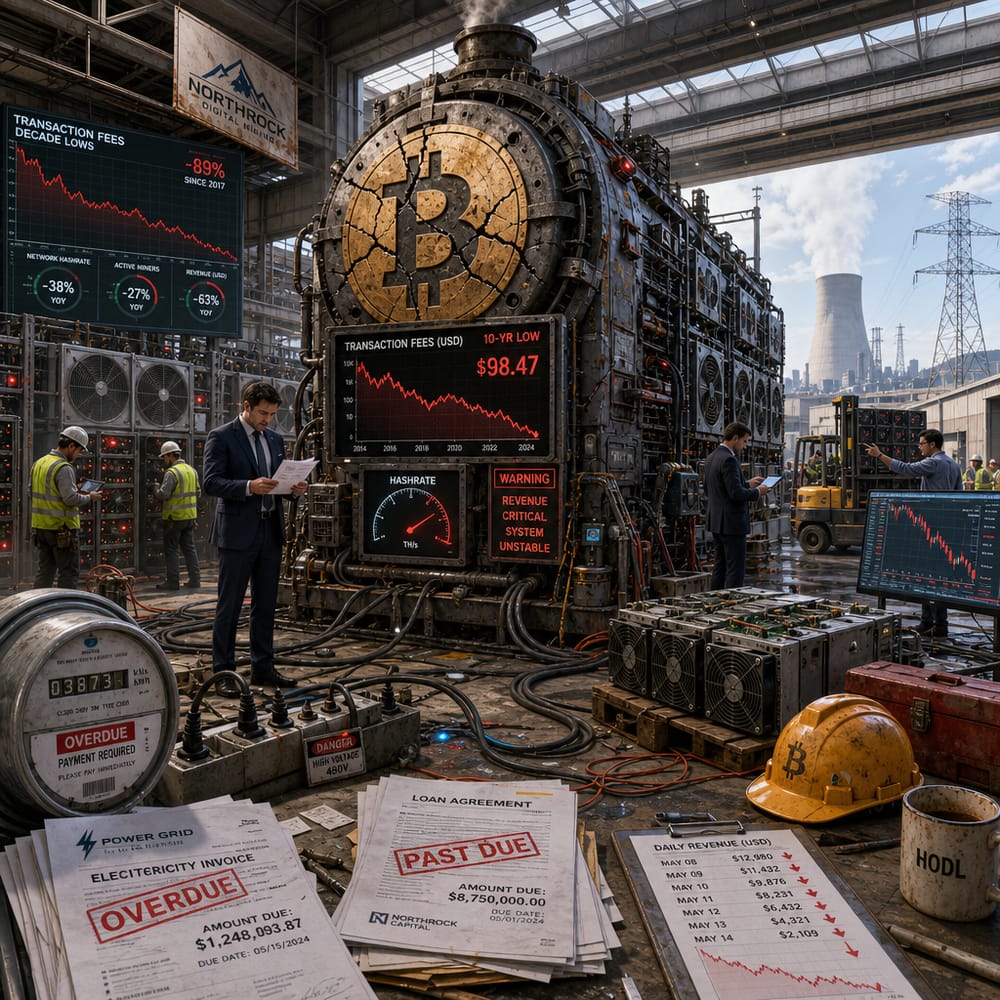
Once hailed as the wildcatters of the digital age, crypto miners are now finding themselves in a financial dustbowl. Their revenue, particularly from transaction fees, has plummeted to its lowest point in a decade. Add a significant drop in hashrate to the mix, and you've got a recipe for a full-blown existential crisis in the crypto mining sector.
Transaction fees, for those not knee-deep in crypto-speak, are the tips miners earn for processing and validating transactions on the blockchain. Think of it like a digital toll booth. When these fees hit rock bottom, as they have now, miners can't just shrug it off and think, "No worries, we'll just mine more Bitcoin." It's not that simple.
The reason for this financial squeeze is a cocktail of technological evolution and market dynamics. The introduction of the Lightning Network, which aims to speed up transactions and reduce costs, while beneficial for users, is eroding the fee income miners rely on. And then there's the dwindling volatility of Bitcoin prices, which curiously has become a double-edged sword. Less price swings mean fewer transactions as people play it safe, keeping their assets snug in digital wallets rather than moving them around and creating fee opportunities.
So, what does this mean for the Bitcoin network's stability and security? You don't have to be a cyber philosopher to see the potential risks. Miners are the custodians of the network's security, and if they're not financially incentivized, the allure of slashing operational costs or shutting down entirely becomes stronger. A decrease in mining power, or hashrate, leaves the network more vulnerable to 51% attacks — where a single entity could theoretically control the network. Think of it as the digital equivalent of leaving your front door ajar in a sketchy neighborhood.
The looming specter of industry consolidation is also casting a shadow. Smaller mining operations, unable to compete with deep-pocketed firms that can afford to ride out lean times, might find themselves swallowed whole or forced to hang up their mining hats. This could lead to a concentration of power in fewer hands, a scenario that should make any decentralized purist shudder.
But it’s not all gloom and doom. Some argue that this Darwinian winnowing could usher in a more efficient mining industry. Larger, more resilient companies could innovate at scale, driving down costs and improving energy efficiency — a win for the planet too. And let's face it, crypto mining has not exactly been winning any ‘Green Business of the Year’ awards.
For investors, though, the question remains: is this an opportunity or a red flag? Crypto mining firms are publicly traded, and those with the financial savvy might see potential bargains in companies with strong balance sheets. But it's a high-stakes game. The market's reaction to such seismic shifts can be as unpredictable as a teenager’s mood.
The crypto mining landscape is at a crossroads. Will we see a resurgence powered by innovation and efficiency, or will the current trends lead to a critical loss of network security and industry centralization? The next few months could be pivotal, and for those retail investors scrolling through their feeds — it's a story worth following. After all, the crypto world, with its roller-coaster dynamics and cast of characters, rarely delivers a dull moment.
This article is for informational purposes only and is not investment advice. Always do your own research or consult a licensed financial professional before making investment decisions.
© Copyright 2024. All Rights Reserved.
© Copyright 2024. All Rights Reserved.