

Cooling Wholesale Inflation and PCE Preview
Saturday, August 22, 2026
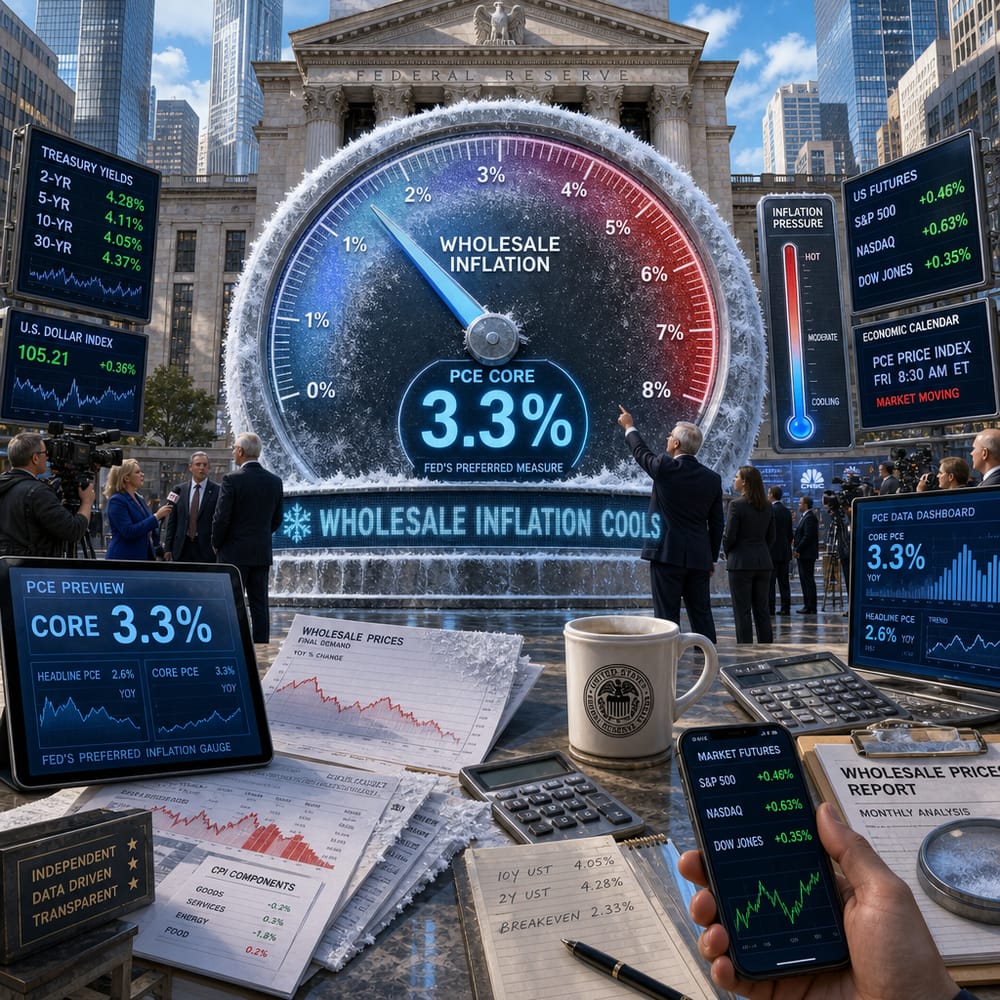
When it comes to financial markets, inflation isn't just the elephant in the room—it's the whole safari. And boy, do we have news! Recent data suggests wholesale inflation is cooling down faster than your coffee on a winter morning. Meanwhile, the Fed’s favorite inflation measure, the Personal Consumption Expenditures (PCE) index, is expected to show core inflation steady at a laid-back 3.3%. So, what gives? Could this chill vibe in inflation play Cupid between the Federal Reserve and interest rates, influencing economic growth and investor strategies? Let’s dig in.
Right off the bat, why should you care about the PCE index, a measure that sounds like it belongs in a science fair instead of your investment strategy? Well, the Fed loves it more than economists love their acronyms. The PCE index is the Fed's go-to tool for gauging inflation because it accounts for changes in consumer behavior (like when you switch from fancy lattes to instant coffee because, you know, budgets).
Now, the Fed has been on a crusade to tame inflation, which previously soared as if it had been sprinting alongside a Chinese robot breaking Usain Bolt's records. As inflation cools and the PCE index stays steady, the Fed might be tempted to put its rate hikes on ice. This cooling of inflation suggests the Fed's battle against rising prices might be paying off, leaving room to keep rates steady and allow the economy to breathe a little easier.
But before you pop the champagne, let’s talk about the 'core' in core inflation. This number excludes food and energy prices—the unpredictable toddlers of the economy that can throw tantrums at any time. If core inflation is indeed steady at 3.3%, it indicates underlying inflationary pressures are stable, but it doesn’t tell the whole story. If those kiddos—food and energy—decide to act out, the Fed might have to rethink its strategy.
For investors, stable core inflation can be a double-edged sword. On one hand, it suggests that the economy might not need more rate hikes, potentially boosting growth sectors. On the other, a steady number could simply mean we're stuck in the current rate environment for a while longer, which isn't exactly the green light for aggressive investment just yet. But hey, at least it’s not waving a red flag.
What about the broader economic implications? As it stands, slowing inflation might mean more spare change in your pocket, but before you start planning what to do with that extra cash, remember the broader context. The national debt just hit a staggering $40 trillion—yes, you read that right—so the economic movie we're in still has a ton of drama left to unfold. With debt concerns on every analyst's lips, and the potential for governmental belt-tightening, any good news on the inflation front might be counterbalanced by fiscal challenges.
In terms of investment sectors, keep an eye on consumer staples. As the Fed potentially eases on rate increases, companies like Unilever, Colgate-Palmolive, and Mondelez, with their robust dividend yields, continue to look attractive for dividend-focused investors. They serve up stability, and in a world where everything seems to be learning to run (even robots), stability is the quiet hero.
So, what's the bottom line? Well, if the PCE index shows core inflation steady, the Fed might just decide to let interest rates take a breather. This could mean more stability for bonds and potentially a more favorable environment for stocks. Just remember, while the Fed and Wall Street seem to be getting their bearings, the economy still has its quirks—the unpredictability of energy prices, the colossal national debt, and geopolitical factors that can change the narrative faster than you can say 'rate hike.'
Meanwhile, savvy investors should keep their ears to the ground—because while the Fed may hit pause, the markets are still anything but static. It's a dance between inflation rates, economic growth, and investment strategies—a dance as strategic and nuanced as a waltz. Or perhaps more aptly, a marathon between robots and world record holders.
This article is for informational purposes only and is not investment advice. Always do your own research or consult a licensed financial professional before making investment decisions.
© Copyright 2024. All Rights Reserved.
© Copyright 2024. All Rights Reserved.