

Commodity-linked FX Moves: AUD and CAD
Sunday, August 16, 2026
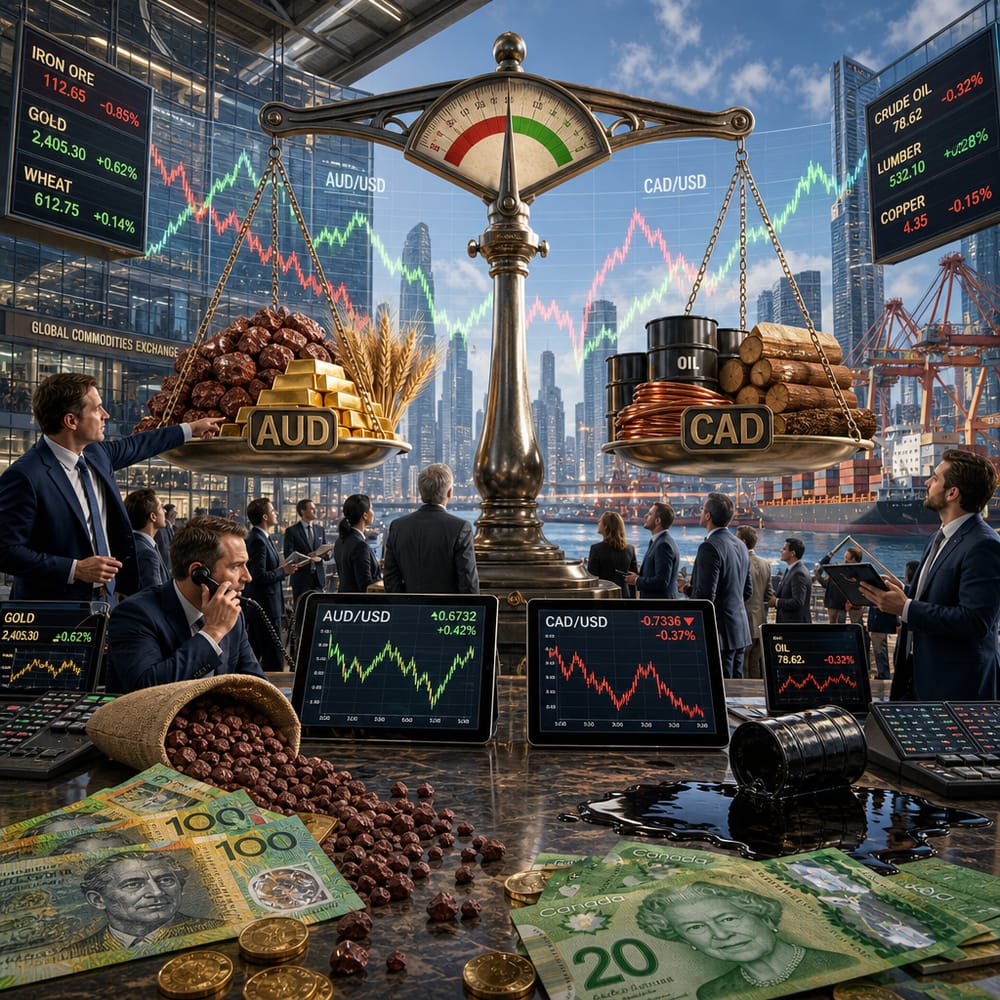
COMMODITY-LINKED FX MOVES: AUD AND CAD IN THE SPOTLIGHT
Blink and you might miss them, but those tiny nuances in currency markets can tell you a lot about where the world's money is headed next. Right now, the Australian and Canadian dollars are putting on a bit of a show, and the stars of this performance? Well, they've been lifting weights in the commodity market gym.
THE GREAT COMMODITY BALLET
Picture this: the Australian dollar (AUD) and the Canadian dollar (CAD) are like the puppets of commodity prices. When the price of iron ore and gold spikes, Australia goes cha-ching! And CAD dances to the rhythm of oil and lumber markets. These currencies aren't just pieces of paper; they're reflections of what the ground spits out in these resource-rich nations.
Now for the twist. Recently, both the AUD and CAD have been caught in a tango of rising and falling rhythms due to some interesting moves in commodity prices. You see, commodity-linked currencies like these are like those friends who live in your group chat—always talking, never still.
WHAT'S DRIVING THE MOVEMENT?
Australia's economy has always had a bit of a crush on iron ore, and its price movements are often a leading actor in the AUD's drama. When China, a heavyweight consumer, decides it needs more of the stuff to keep its factories humming, the AUD struts down the runway in its best outfit. But throw in a few geopolitical jitters or a slowdown in European markets, and suddenly the AUD is looking a little less shiny.
For Canada, it's all about the black gold—oil. With prices opening up like the plot of an unexpected thriller, CAD's been on a bit of a rollercoaster. OPEC's decisions, the U.S. oil market dynamics, and those Russian-Ukrainian tensions are all part of the story. It's like CAD's stuck in an old-school arcade game, dodging barrels and making leaps to score points.
THE GLOBAL IMPLICATIONS
Why should you, scrolling through this on a break, care about a couple of foreign currencies? Because commodity-linked currencies are like a stethoscope to the global economy's heart. They're sensitive to trade patterns, economic health, and yes, even international relations. The AUD and CAD can give you a peek behind the curtains at how different economies are interacting, who's winning the trade battles, and where growth might be stalling.
Think of it this way: if these currencies are flapping around like flags in a storm, it might tell you how uncertain the global trade winds are. If they're stable, well, maybe there's a bit of calm in the economic sea.
A GLIMPSE INTO THE FUTURE
Here's the million-dollar (or maybe million-AUD/CAD) question: where do these currencies go from here? If you're thinking of hopping on the investment train, pay attention to the signals in the commodity markets. Iron ore, gold, and oil are the bread and butter of these currencies' influence.
And let's not forget our friend, the U.S. dollar. When it flexes its muscles, it can overshadow even the most impressive commodity rallies. A strong USD often makes AUD and CAD less appealing, leading to a complex dance of strength and weakness.
But the narrative doesn't end there. Technology, evolving trade policies, and the unpredictability of climate events are likely to keep throwing curveballs. For retail investors like us, the challenge is keeping our eyes on these interplays without getting too dizzy.
THE TAKEAWAY
If you fancy yourself a bit of a global economy detective, keeping tabs on the AUD and CAD might just be the case you never knew you needed. They're not just currencies; they're storytellers of global commodity flows, geopolitical chess games, and the dance of economic powerhouses.
Next time you hear about soaring oil prices or a spike in iron ore demand from China, remember, those aren't just numbers—they're whispers of change, and the AUD and CAD are translating them into a language we can all start to understand.
This article is for informational purposes only and is not investment advice. Always do your own research or consult a licensed financial professional before making investment decisions.
© Copyright 2024. All Rights Reserved.
© Copyright 2024. All Rights Reserved.