

China’s Domestic DUV Lithography Breakthrough Sparks Global Chip-Equipment Sell-Off
Tuesday, July 28, 2026
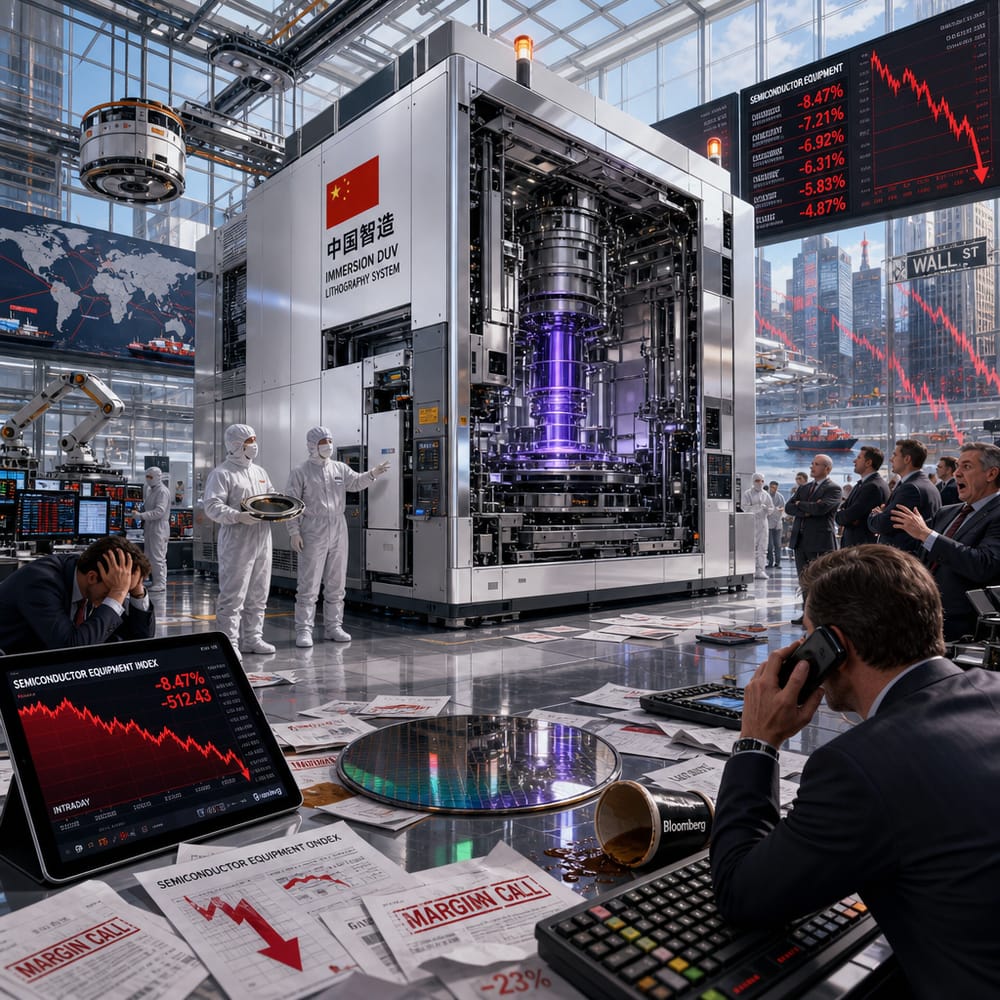
CHINA'S CHIPS BRING THE U.S. SEMICONDUCTOR STOCKS TO THEIR KNEES
In the world of high-tech drama, where circuits and silicon rule the day, a seismic shift has taken place. China, not content with its domination in other sectors, has strutted onto the semiconductor stage with its homegrown immersion deep-ultraviolet (DUV) lithography machines. As the news broke, U.S. semiconductor equipment stocks took a nosedive, plunging between 5% and 8%. If you're thinking this feels like the opening scene of a tech thriller, you're not wrong.
Imagine a world where your smartphone, laptop, or even your fancy AI-powered vacuum cleaner owes its smarts to tiny chips. These chips are birthed through a delicate process that involves DUV lithography machines, which are like the storks of the semiconductor world. Essentially, they print intricate circuits onto silicon wafers, the backbone of all tech devices.
Until recently, these machines were the domain of a select few, with Dutch giant ASML reigning supreme. But now, China has thrown its hat in the ring, potentially altering the global semiconductor supply chain forever.
Why should you, the average retail investor, care? Well, this development could mean serious trouble for U.S. semiconductor companies. If China can produce these machines domestically, they can potentially reduce their reliance on U.S. and European technology, shrinking the market share of companies like ASML, Lam Research, Applied Materials, and KLA.
MARKET SHARE QUESTIONS
Let's dive into the details. For decades, U.S. semiconductor companies have enjoyed a cushy position in the global market. They've been the gatekeepers of innovation, holding a large chunk of the market share thanks to their technological supremacy. But with China's new kid on the block status, that share might soon be up for grabs.
If China successfully scales production of these DUV machines, it could lead to more domestically produced chips—chips that won't require foreign machinery or expertise. This could weaken the grip of U.S. firms on the global stage and possibly impact the U.S.'s leverage in tech-related geopolitics.
IMPLICATIONS FOR GLOBAL SUPPLY CHAINS
Now, let's zoom out to the broader global supply chain picture. The semiconductor supply chain is a delicate ecosystem, with manufacturers, suppliers, and customers entwined in a complex dance. The entrance of Chinese DUV machines could mean a pivot point in this dance, with China potentially becoming a bigger player—not just as a consumer but as a producer of key technology.
Currently, the U.S. has significant control over semiconductor technology exports to China, using this control as a bargaining chip in the ongoing trade tussles. But China's breakthrough could mean they start setting their own rules—and prices—on their terms.
If U.S. companies lose overall market dominance, the ripple effects could be felt far beyond Wall Street. Picture this: chipmakers like AMD, which has already seen its shares slide over 3%, could face increased competition and potentially less lucrative contracts. Not to mention the broader tech industry, which relies heavily on these chips for everything from AI to data centers. The tech sector's dependency on chips is so ingrained that any shift could lead to a domino effect, touching everything from consumer electronics to advanced AI applications.
In such a scenario, companies heavily involved in AI and data centers, much like the ones Jim Cramer recently warned investors about, could see profitability margins squeezed. It's not just about immediate losses on the stock market; it’s about the long-term strategic shifts and how these companies adapt—or fail to adapt—to a changing landscape.
WHAT'S NEXT?
So, where do we go from here? As retail investors, your best strategy might be vigilance. Keep an eye on how U.S. companies like ASML, Lam Research, Applied Materials, and KLA respond to this new competition. Watch for strategic shifts, potential partnerships, and of course, any technological innovations that might keep them a step ahead.
And while you're at it, don't forget the global implications. A change in the semiconductor supply chain can trickle down to affect tech prices, innovation speed, and even global economic stability. It’s a high-stakes poker game, and the chips—pun intended—are on the table.
In conclusion, welcome to the new era of semiconductor drama, where geo-tech power plays are as gripping as any thriller. The next chapter is anyone's guess, but one thing’s for sure: the stage is set for a showdown. And as with any good show, we’ll be watching closely, popcorn in hand.
This article is for informational purposes only and is not investment advice. Always do your own research or consult a licensed financial professional before making investment decisions.
© Copyright 2024. All Rights Reserved.
© Copyright 2024. All Rights Reserved.