

Bond Markets React Sharply to Fed's Hawkish Signals
Friday, August 28, 2026
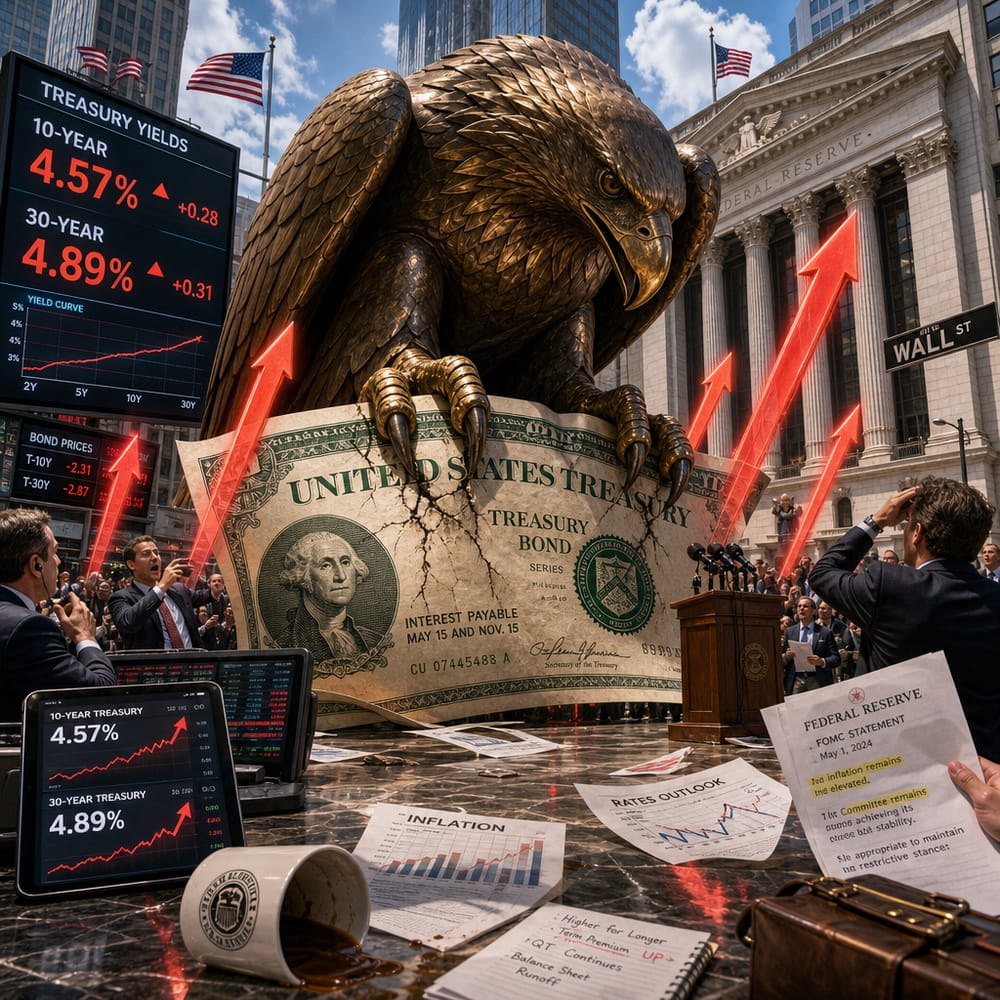
BOND MARKETS REACT SHARPLY TO FED'S HAWKISH SIGNALS
If you didn’t hear the collective gasp from the bond market last Friday, you might want to check your weather app for financial turbulence. Federal Reserve Chairman Kevin Warsh took to the mic at the famed Jackson Hole symposium, signaling a more hawkish stance on interest rates, and boy, did the bond traders listen.
Why did Warsh's comments have the bond market on high alert while stocks largely shrugged it off? Picture this: you’re at a concert, and the lead singer just muttered something about the next song possibly being the last. The crowd isn’t panicking, but those with front-row seats—aka the bond market—are starting to edge toward the exits. Bond traders are notoriously skittish about interest rates because when rates go up, bond prices go down. And Warsh just hinted at a potential encore performance of rate hikes if inflation doesn't start behaving.
His speech was a sequel to July’s muddled messaging, but this time, the message was crystal clear: inflation remains Public Enemy No. 1. He highlighted that recent inflation data isn’t as dreamy as it seems, implying that the Fed's rate hike playbook is still very much in circulation. That sent long-term Treasury yields soaring like a startled cat, as investors braced for tighter financial conditions.
But why were bond traders quicker on the draw than their equity counterparts? It's simple: the bond market is like that hyper-organized friend who always RSVPs first. It’s all about interest rate sensitivity. Stocks, especially those of larger companies, can often absorb some rate hikes thanks to their diversified revenue streams and international exposure. Bonds, however, wear their interest rate sensitivity on their sleeves.
When Warsh mentioned that financial conditions aren’t broadly restrictive, it was the bond market's equivalent of hearing the creaking floorboards in a horror movie. Time to act. The rise in Treasury yields tells us that traders are betting on a bumpier road ahead for borrowing costs.
So what does this mean for everyday investors? If you're eyeing any interest-rate sensitive sectors—think real estate or utilities—you might want to buckle up. These sectors traditionally rely on borrowed money to fund operations and expansions, so rising rates can make life a little more expensive. Companies in these sectors might face higher costs, potentially trimming profits and, by extension, dividends.
Now, this isn’t to say all hope is lost. It’s more about being prepared. Investors keen on real estate investment trusts (REITs) or utility stocks may need to reassess the returns these assets can generate in a higher-rate environment. It might also be a good time to consider whether your portfolio has a diversified mix to weather whatever the Fed decides to throw our way.
As for the rest of the market, Warsh’s words did cause a little wobble, with indices like the S&P 500 and Nasdaq sliding slightly. But in the grand scheme of things, the equity markets seemed to take his hawkish tone in stride, with the S&P 500 still on track for a modest weekly gain.
Warsh’s message was loud and clear: the Fed isn’t done, and they’re ready to hit that rate hike button if inflation doesn’t start following the script. It might be time for investors to take a page from the bond market’s playbook—stay alert, keep your ears open, and always be prepared to pivot if the economic winds shift.
In sum, we’re in for an interesting time. The bond market’s acute reaction might just be the first domino in a chain reaction affecting borrowing costs and investment decisions. So, while equities may have hit the snooze button on Warsh’s latest comments, it’s worth keeping an eye on those interest-rate-sensitive sectors. Because if there's one thing we’ve learned, it’s that when the Fed speaks, the bond market listens. And sometimes, it's the whispers that make the loudest noise.
This article is for informational purposes only and is not investment advice. Always do your own research or consult a licensed financial professional before making investment decisions.
© Copyright 2024. All Rights Reserved.
© Copyright 2024. All Rights Reserved.