

Bond-Driven Decline: How Surging 30-Year Yields Are Pulling Stocks Down
Tuesday, September 29, 2026
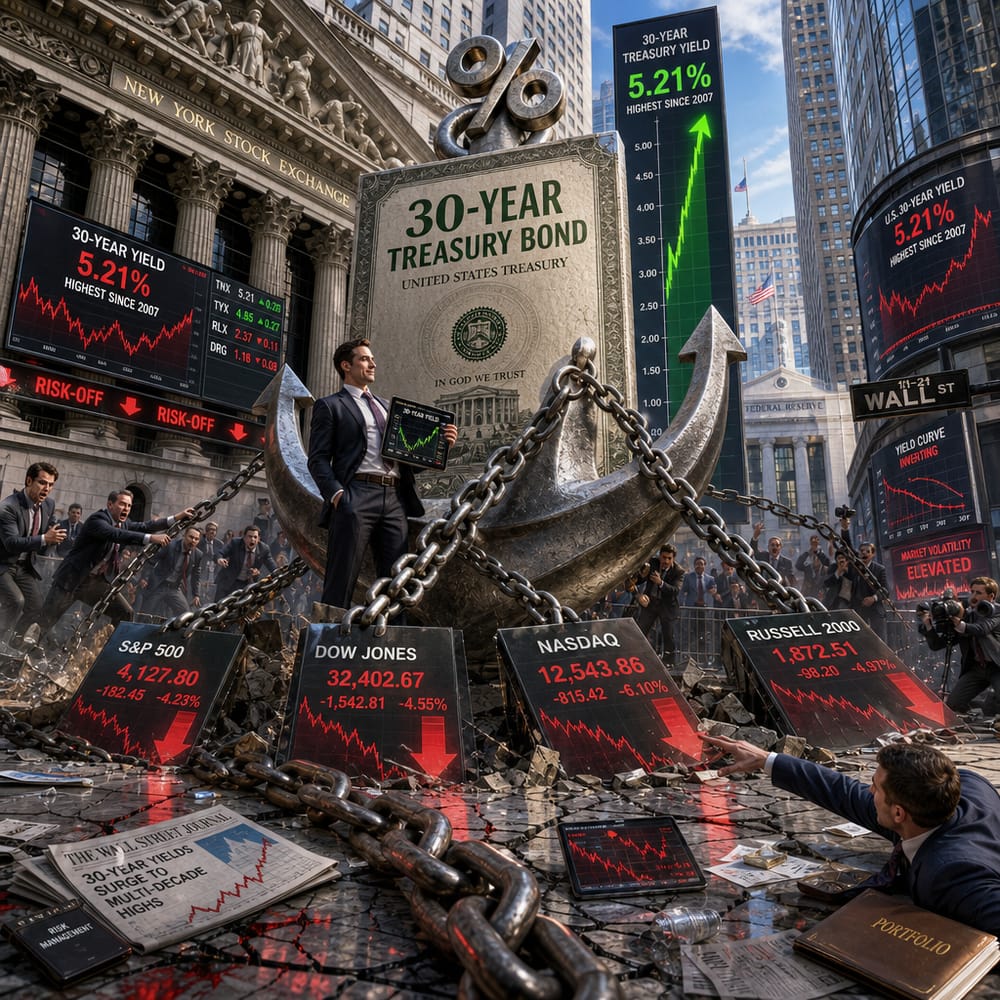
Imagine this: you're staring at your investment app, and it seems like your stocks are following the Yellow Brick Road in reverse, headed straight to Munchkinland. What gives? Well, it's not the Wicked Witch wreaking havoc; it's the mighty 30-year Treasury yields, climbing to heights not seen since we all had flip phones.
Here's the scoop: when these bond yields rise, they're like that annoying cousin who overstays their welcome, pressuring everyone at the party. Major stock indices like the S&P 500, Dow, and Nasdaq are taking a hit as investors start eyeing bonds like they're the last slice of pizza. With the 30-year Treasury yields reaching heights last seen almost two decades ago, panic is seeping into the stock markets.
Now, what's the big deal with these Treasury yields? Think of them as the heartbeat of the financial world; when they surge, borrowing costs swell like a soufflé gone wrong. This spike in borrowing costs can be a real bummer for economic growth and corporate profits. And guess what? When profits take a nosedive, stock valuations follow.
HISTORICAL IMPACT
Historically, when Treasury yields rise, it's like a ripple turning into a tsunami for the stock market. Higher yields mean investors can earn better returns from these 'risk-free' government bonds compared to the stock market's wild ride. So, they might start ditching stocks faster than folks leaving a stuffy party when the music stops.
Back in 1994, when bond yields last surged dramatically, the stock market had a full-on meltdown, leading to what's now known as the "Great Bond Massacre." Investors fled riskier assets, and the S&P 500 saw its worst performance in a decade. And here we are again, with yields flirting with those dizzying heights, and the stock market getting chills up its spine.
Today's scenario is similar. As those yields tick up, it reminds folks of the good ol' days when CDs weren't just for music. Why gamble on stocks when Uncle Sam is offering you a pretty sweet deal?
ECONOMIC GROWTH IN THE CROSSHAIRS
Rising yields aren't just throwing shade at the stock market; they might be casting a long shadow over economic growth too. Remember, higher yields mean higher borrowing costs for everyone—from your favorite tech giant to your neighborhood pop-and-mom shop. When borrowing gets pricey, these companies might pump the brakes on expansion and investments, which is like ice cream without the sprinkles—just not as fun.
Economic growth isn't just about companies; it's about you and me. With bonds seeming more attractive, the costs of mortgages, student loans, and credit cards could rise faster than your favorite TikTok trend. Consumers might tighten their belts, and if we're all spending less, the economy could hit a snag.
WHERE DO WE GO FROM HERE?
So, what's a retail investor to do when the market's acting like it's had one too many energy drinks? Well, it's time to get strategic. Diversification is key: think of it as the financial equivalent of not putting all your eggs in one basket. Bonds are gaining attention, but don't count out stocks just yet—especially if interest rates stabilize or even dip.
Consider sectors that might weather the storm better, like utilities or consumer staples—those essentials that people turn to no matter what's happening on Wall Street. Meanwhile, keep an eye on those tech giants; while they've been taking a hit, their long-term growth potential is still sizzling.
In the end, as bond yields make waves, remember that markets are like roller coasters. Buckle up, hold onto your hat, and try not to spill your popcorn. History tells us that these shifts happen, and seasoned investors know to ride them out—or sometimes, ride them to new opportunities. The trick is keeping your cool and your eyes on the horizon, because, as they say, this too shall pass.
So next time you check that investment app and see the numbers dip, take a deep breath. Maybe it's just a chance to grab a piece of the pie while others are selling their slices. After all, in the world of investing, fortune often favors the bold—and the patient.
This article is for informational purposes only and is not investment advice. Always do your own research or consult a licensed financial professional before making investment decisions.
© Copyright 2024. All Rights Reserved.
© Copyright 2024. All Rights Reserved.