

BlackRock and Fidelity Drive ETF Inflows — Concentration at the Top
Sunday, August 23, 2026
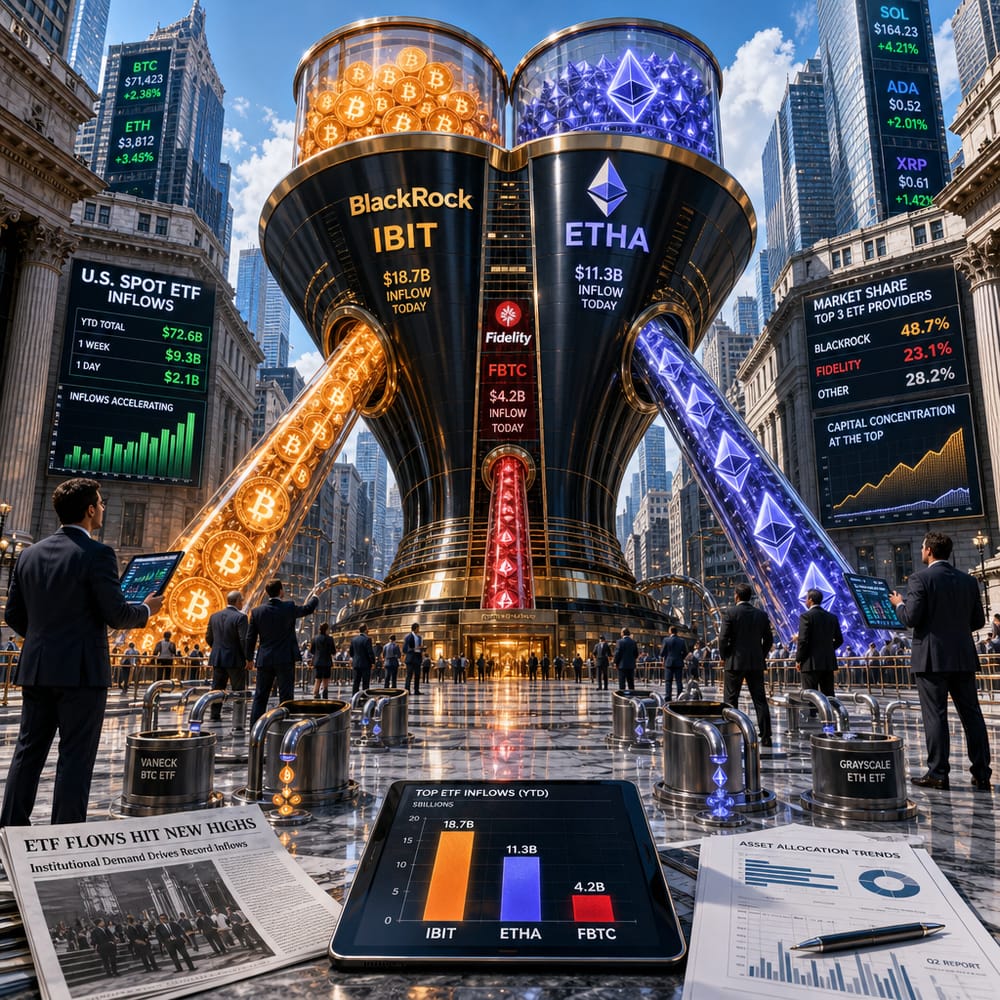
WHEN BIG FISH SNACK ON BITCOIN ETFs: BLACKROCK, FIDELITY, AND THE REST
Once upon a time in the land of financial fantasy, the little guy had a shot. Remember those days? When a scrappy up-and-comer could muscle in on the action? Well, wake up and smell the coffee, because in the world of Bitcoin and Ether ETFs, it’s becoming clear that the big fish are feeding, and they’re not leaving much behind for the minnows.
If you’ve been paying attention — and you really should be — you might have noticed that a couple of titans, namely BlackRock and Fidelity, are hogging the spotlight. Their IBIT and ETHA ETFs have captured most of the Bitcoin and Ether ETF inflows recently. And by "most," I mean these guys are drinking the milkshake right out of the glass.
Why does this matter to you, dear reader? Well, as BlackRock and Fidelity dominate the scene, they’re effectively crowding out the smaller asset managers who are trying to get a piece of the crypto pie. Imagine you're at a party, and the only ones allowed near the snack table are those two friends who can’t help but devour everything in sight. Everybody else barely gets a crumb.
THE MONOPOLY BOARD OF ETF MARKETS
So, what's the big deal about BlackRock and Fidelity's domination? For one, it puts smaller asset managers in a precarious position. With the big players dominating inflows, these smaller firms find themselves struggling to catch up — it's like trying to sprint with a piano strapped to your back.
The concentration of ETF inflows means that smaller asset managers may struggle to justify the cost of launching their own crypto ETFs. After all, why would investors take a gamble on the new kid when they can ride with the industry's heavyweights? It's like choosing between a no-name energy drink at a gas station and a chilled can of Coke. The name alone gives you the fizz you crave.
But beyond the immediate, this monopoly of sorts can also quash innovation. With fewer players scrambling for investment, you lose the diversity of strategies and new ideas that come with competition. And in a world as dynamic and fast-evolving as crypto, that’s not just bad for the little guys — it’s bad for everyone. After all, when the leaders use their heft to dictate the rules, you might miss out on the next big thing. It’s like sticking with Blockbuster when Netflix is just around the corner.
A TIDAL WAVE OF CHANGE
The crypto market thrives on innovation, adaptation, and, let’s face it, a little chaos. By concentrating ETF power in the hands of major players, you risk the market becoming stagnant. It’s the financial equivalent of being trapped in a whirlpool, where the titans spin round and round but nothing ever moves forward.
On the flip side, having institutions like BlackRock and Fidelity involved does signal some level of market maturation and validation. These aren’t fly-by-night operations; they bring a certain level of confidence and stability. But at what cost, and to whom?
THE MARKET'S FUTURE: AN UNFINISHED SYMPHONY
So, what do we do about it? For one, regulatory bodies might start feeling the pressure to ensure fair play and prevent market monopolies. After all, even in the wild, wild west, the sheriff occasionally rides into town to lay down the law.
Secondly, we might see smaller firms band together, pooling resources to create competitive alternatives to the dominance of BlackRock and Fidelity. Think of it as an indie band taking on a major label — it’s gritty, but it can change the tune.
And for us everyday retail investors, it’s a call to be vigilant. Don’t just follow the herd; look for the outliers, the innovators, the ones writing the next chapter in the crypto narrative. Because while the big fish are impressive, sometimes the most exciting stories come from the little guys who dared to dream.
So keep your eyes open and your portfolio diversified. Because in the ever-evolving world of crypto, the only constant is change, whether you’re swimming with the big fish or paddling your own canoe.
This article is for informational purposes only and is not investment advice. Always do your own research or consult a licensed financial professional before making investment decisions.
© Copyright 2024. All Rights Reserved.
© Copyright 2024. All Rights Reserved.