

Bitcoin Holds Near $80K, Rejected at 50-Week Moving Average Amid Macro Shifts
Wednesday, August 26, 2026
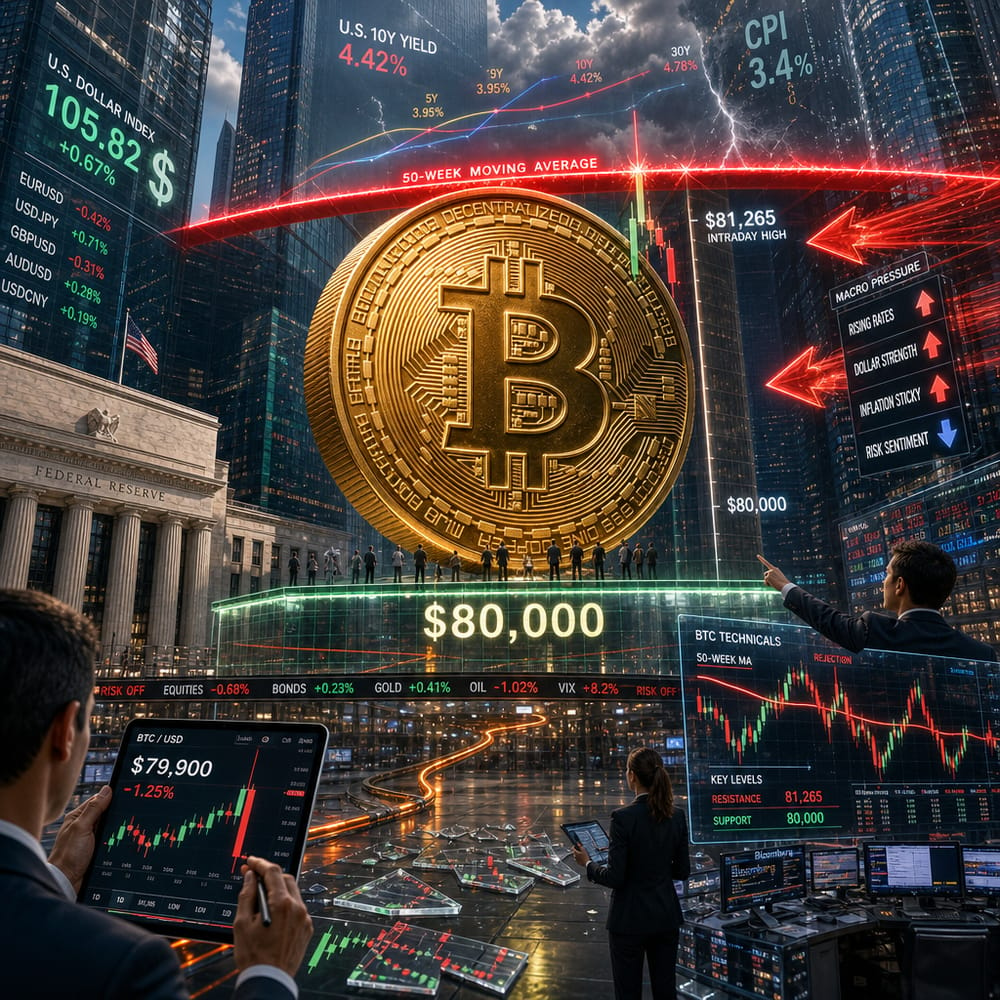
Bitcoin's wild ride through the financial markets has never been a dull spectacle, and this week, it reached an intraday high of $81,265, only to be rejected at the 50-week moving average like a partygoer bounced at the club door. Now, it's hovering just shy of the $80,000 mark, leaving investors both excited and jittery, wondering what's next in this volatile saga. Let's dive into the current crossroads of Bitcoin, where technical barriers and macroeconomic winds are battling it out for dominance.
TECHNICAL LEVELS HOLDING THE KEYS
If Bitcoin were a soap opera, the 50-week moving average would be that pesky antagonist constantly throwing spanners in the works. This technical level isn't just a random line on a chart — for Bitcoin, it's a significant resistance point that traders watch like hawks. Think of it as a psychological barrier; when Bitcoin crosses it, investors see green lights to pile in, and when it doesn’t, they hit the brakes.
This week, the market saw Bitcoin's price briefly flirt with $81,265 before retreating under the pressure of this technical level. Traders are now eyeing the next steps like it's the season finale. If Bitcoin can muster the strength to break past this infamous resistance, say hello to the bulls running riot again. However, if it fails, we might see the bears having their day, pushing the price back into the low-to-mid $70,000s.
MACROECONOMIC INFLUENCES: THE DANCE OF OIL AND BONDS
But wait, there's more! This isn't just a story of lines and charts. The larger macroeconomic environment is playing its own tune, and Bitcoin’s price is dancing to it. Oil prices and bond yields are two colossal forces influencing not just Bitcoin but markets worldwide.
Oil has turned around and is gaining traction due to geopolitical tensions, particularly in the Strait of Hormuz, where Iran and Oman have reached a contentious agreement. Higher oil prices often lead to higher inflationary pressures, and guess what? Inflation and Bitcoin are frenemies. Inflation fears can drive up Bitcoin's appeal as a hedge against the eroding value of fiat currencies. Conversely, significant hikes in oil could dampen economic growth prospects, which might weaken investor sentiment across risky assets, including our darling crypto.
Meanwhile, bond yields are playing their own game of seesaw. The recent spike in U.S. Treasury yields to multi-year highs has been a jolt for Bitcoin. When bond yields rise, they offer a more attractive, lower-risk investment compared to the rollercoaster that is Bitcoin. This can lead investors to shift money from Bitcoin to bonds, exerting downward pressure on crypto prices.
POTENTIAL SCENARIOS FOR BITCOIN'S NEXT MOVES
As we stand at this crossroads, what lies ahead for Bitcoin? The crystal ball is as hazy as ever, but we can sketch out a couple of scenarios.
If Bitcoin manages to break through the 50-week moving average and stabilize above $81,000, we could see the bulls taking charge, potentially pushing prices to new all-time highs. This could be fueled by continued inflation worries and a broader acceptance of Bitcoin as a digital gold.
On the flip side, if Bitcoin fails to break through, the bears may take the steering wheel, pushing prices down to test lower support levels. This would be exacerbated by higher bond yields and economic uncertainty, turning investors cautious.
In any case, Bitcoin's fate in the short term is likely to depend on a combination of cracking that technical code and how the macroeconomic field evolves. Whether the bulls or the bears win, one thing's for certain: Bitcoin will continue to be the headline-grabbing, heart-racing asset we've come to know and love — or fear, depending on your portfolio. So strap in, because this ride is far from over.
This article is for informational purposes only and is not investment advice. Always do your own research or consult a licensed financial professional before making investment decisions.
© Copyright 2024. All Rights Reserved.
© Copyright 2024. All Rights Reserved.