

Bitcoin ETF Outflows and Ethereum Inflows
Monday, August 03, 2026
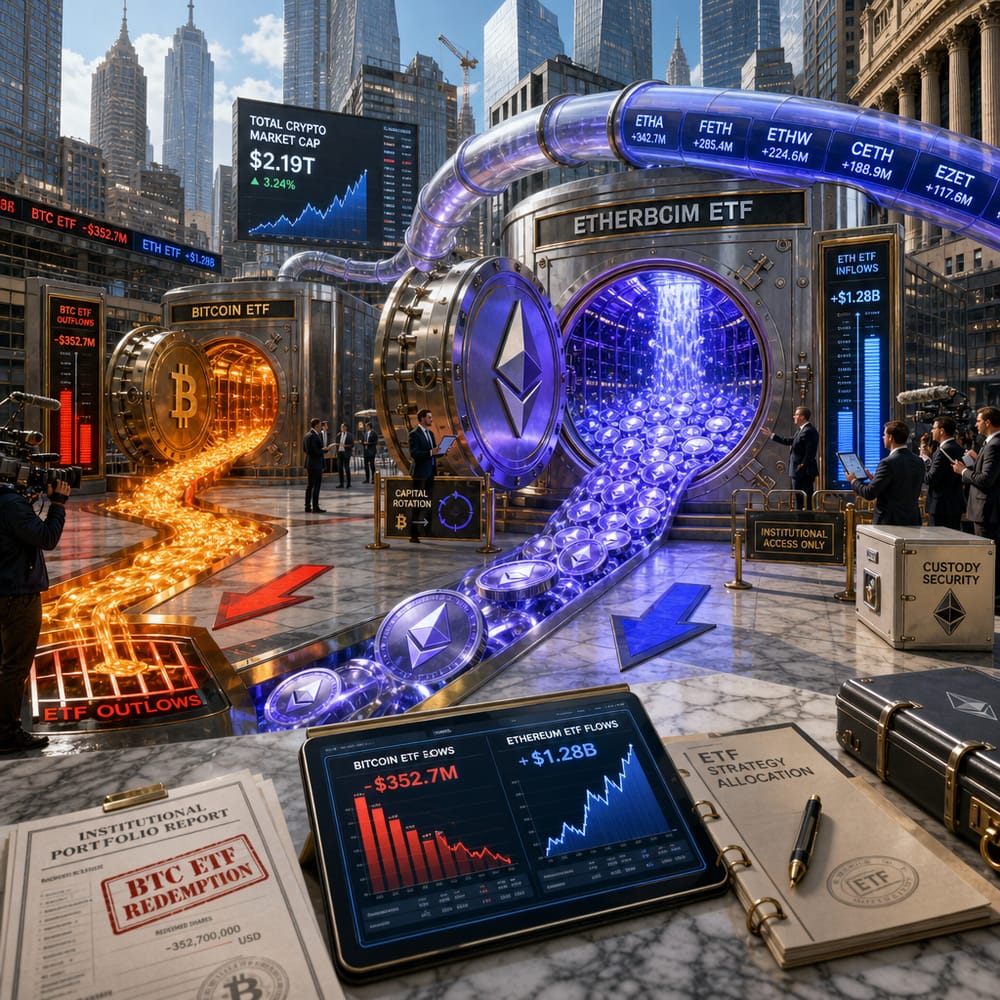
BITCOIN DOWN, ETHEREUM UP: A CRYPTO CROSSROAD
If you've been keeping an eye on the crypto scene, you might've noticed a curious trend. Bitcoin ETFs are heading for the exits, while Ethereum ETFs are rolling out the welcome mat. It’s like Bitcoin's throwing a party and everyone’s ghosting, while Ethereum’s neighbors just called the fire marshal because it’s packed to the rafters. But what’s really going on, and why should you care?
First, a little primer: an ETF, or Exchange Traded Fund, is like a mutual fund you can trade on the stock market. It allows you to invest in assets like Bitcoin and Ethereum without having to buy the digital coins themselves. Lately, Bitcoin ETFs have been leaking cash faster than a broken vending machine, while Ethereum ETFs are raking it in. And with the crypto market cap nearing a dizzying $2.2 trillion, these shifts are worth a second glance.
So why are investors switching dance partners from Bitcoin to Ethereum? Let’s break it down.
Bitcoin has long been considered the king of crypto—think of it as the Godfather of digital currencies. But it’s not without its issues. Step into any tech or financial forum, and you'll hear debates about Bitcoin’s scalability problems, its energy-guzzling mining process, and the regulatory questions hanging over it like a dark cloud. These factors are making some investors think twice before putting their chips on Bitcoin.
Enter Ethereum, the younger, more adaptable sibling in the crypto family. Sure, it’s not perfect—none of them are—but it did recently upgrade its system to Ethereum 2.0, moving from a power-hungry proof-of-work to a proof-of-stake model. This not only lowers the environmental footprint but also smooths out some of those pesky scalability issues. For investors looking to green their portfolios, Ethereum’s makeover might as well have come with a ribbon and a bow.
But wait, there's more! Ethereum has another ace up its sleeve—its platform is the backbone for a burgeoning array of decentralized applications (dApps) and non-fungible tokens (NFTs). This ecosystem is like Silicon Valley in the '90s: full of potential and attracting talent faster than you can say "initial coin offering."
What does this all mean for the future performance of Bitcoin and Ethereum? Well, if the current trends continue, this could signal a shifting balance of power in the crypto arena. Ethereum’s rising inflows suggest a growing confidence in its future prospects. Meanwhile, Bitcoin’s outflows could imply that investors are cashing out, possibly seeking newer avenues for potential gains.
Now, let’s not write Bitcoin’s obituary just yet. It still has a dedicated fan base and remains the go-to for those who view it as “digital gold.” But, it’s clear Ethereum is gaining ground, and it’s no longer just the understudy waiting for its moment in the spotlight.
And what about the bigger picture? As Ethereum potentially takes the lead in ETF inflows, it could drive more innovation and adoption of decentralized technologies, leaving Bitcoin to play catch-up—or pivot. The impact on overall crypto market dynamics could be profound, influencing everything from what startups get funded to how future platforms are built and scaled.
Ultimately, these ETF flows are more than just numbers on a page; they're a reflection of where investors believe the smart money is headed. And if you’re someone who’s riding the crypto rollercoaster or just watching from the bleachers, understanding these shifts can be as valuable as the coins themselves.
Whether you're all-in on the crypto craze or just crypto-curious, the unfolding story of Bitcoin and Ethereum is a saga worthy of your attention. So, keep your eyes peeled and your digital wallets ready—because when it comes to crypto, the only constant is change.
This article is for informational purposes only and is not investment advice. Always do your own research or consult a licensed financial professional before making investment decisions.
© Copyright 2024. All Rights Reserved.
© Copyright 2024. All Rights Reserved.