

Berkshire Hathaway's Strategic Buyback Amid Profit Decline
Sunday, November 08, 2026
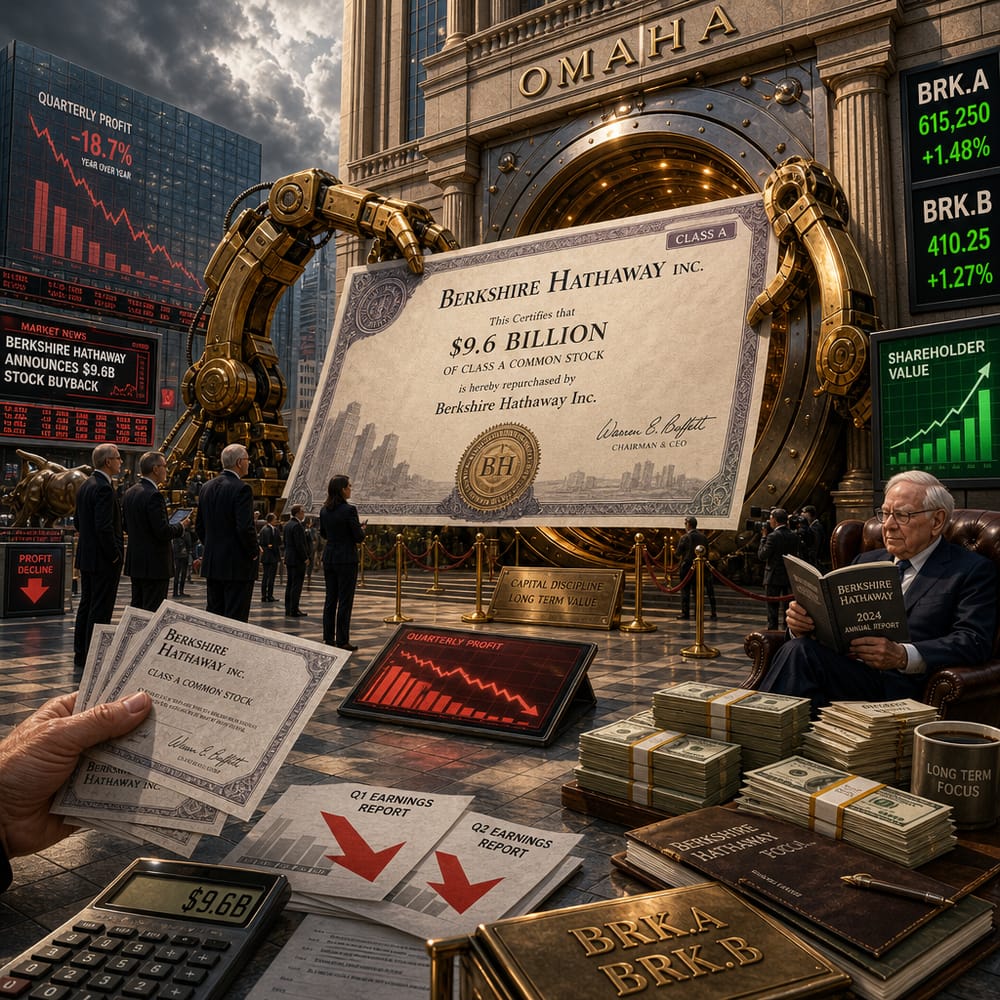
BERKSHIRE HATHAWAY'S STRATEGIC BUYBACK AMID PROFIT DECLINE
If you thought Warren Buffett was just going to let Berkshire Hathaway's slumping profits rain on his parade, think again. The Oracle of Omaha just whipped out his checkbook for a bold $9.6 billion stock buyback, proving once more that when the going gets tough, the tough double down on their own stock.
So, what's the deal with Buffett’s big move? Picture this: amidst a dip in quarterly profits, rather than sitting in a corner crying over spilled milk—or in this case, lackluster earnings—Berkshire is betting on itself. Think of it as a financial version of a Rocky comeback, sweaty and determined, with Buffett in the gym saying, “Ain’t over ’til it’s over.”
THE CONFIDENCE GAME
Let’s break it down. When a company buys back its own shares, it’s often a neon sign (read: massive signal) flashing, “Hey, we believe in our future!” It means Berkshire thinks the stock is undervalued and that they have better places to put their cash than just collecting dust in the bank. And if we're talking confidence, Buffett is basically the Beyoncé of the investing world—when he makes a move, people pay attention.
This buyback isn’t just a cool $9.6 billion thrown at the wall. It's a strategic play that could boost shareholder value by reducing the number of shares floating around. Translation: if you own a slice of the Berkshire pie, your piece just got a little bigger.
SHORT-TERM SHENANIGANS
As for the near-term effects, this move could give Berkshire’s stock price a nice little nudge upwards. Investors tend to respond positively to buybacks, seeing them as a vote of confidence from the company. Plus, there's the added bonus of boosting earnings per share—a nifty trick that happens because fewer shares are hanging around, making the ones that remain more valuable.
RISKS IN THE RING
However, let’s not get carried away on a cloud of buyback bliss. The risk here? Just because you believe in yourself doesn’t mean the market will nod in agreement. A buyback during a profit dip might raise eyebrows or even doubts. Critics might say it’s a Band-Aid for deeper issues—like slapping on cologne instead of taking a shower.
Moreover, there's the question of opportunity cost. The funds used for buybacks could have been invested in other growth opportunities, say acquiring new businesses or innovating existing ones. If Berkshire's stock doesn’t perform as anticipated, that could mean money better spent elsewhere is now tied up in buybacks.
THE BIG PICTURE: BERKSHIRE'S CRYSTAL BALL
So, what does this all say about Berkshire’s future outlook? Essentially, it’s a double-barreled message. First, that they trust their stock to rebound and continue delivering value. Second, and perhaps more subtly, it's a reminder that Buffett and his crew are playing the long game—they're all about where the company will stand years down the road, not just the next quarter.
In a world where market volatility and tech upheavals seem to be the name of the game, this move reiterates an age-old Buffett mantra: fundamentals over fads. While AI stocks might be rollercoastering and IPOs may be losing their sparkle, Berkshire is sticking to its guns.
In conclusion, this buyback isn’t just a financial maneuver; it's a statement of intent. Even when profits take a hit, Berkshire isn’t retreating into the shadows. Instead, they're stepping back into the limelight, buyback in hand, ready to face whatever music the market plays next. So while the rest of us might debate what the future holds, Buffett’s just out here, betting on himself like the legend he is.
This article is for informational purposes only and is not investment advice. Always do your own research or consult a licensed financial professional before making investment decisions.
© Copyright 2024. All Rights Reserved.
© Copyright 2024. All Rights Reserved.