

Benign Inflation Nowcasting Signals Cooling Price Pressures
Friday, August 21, 2026
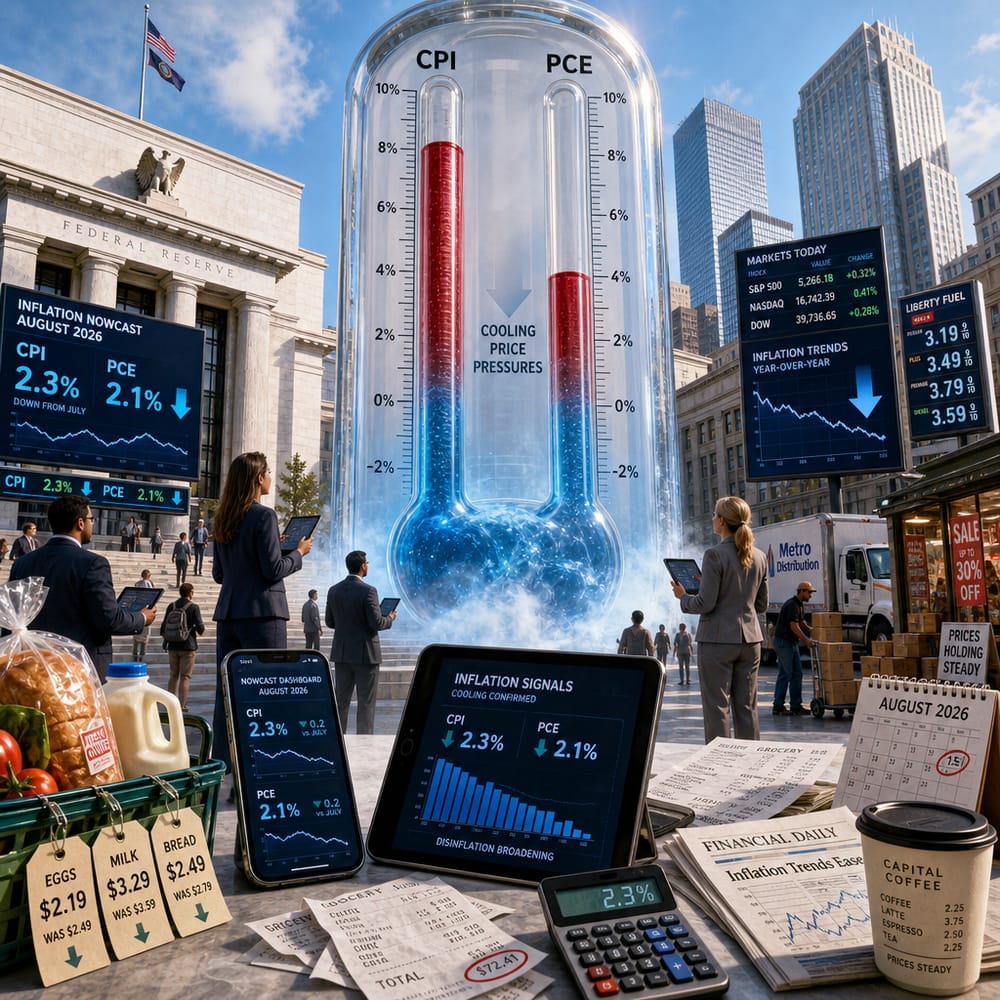
INFLATION: COULD THE HEAT FINALLY BE COOLING DOWN?
Inflation. The mere mention of it can make wallets quiver and send retail investors scurrying towards the comfort of bonds or gold. But hold onto your piggy banks, because the latest nowcasts from the Cleveland Fed are hinting that the inflation beast might be taking a breather.
THE CRYSTAL BALL: NOWCASTING
Imagine predicting the weather without a forecast; you'd be stuck choosing between a raincoat or sunscreen based solely on guesswork. Nowcastings are the financial world’s version of a high-tech weather app, serving up short-term predictions based on real-time data about inflation trends. The Cleveland Fed’s latest predictions have a whisper of promise, suggesting a slight dip in both the Consumer Price Index (CPI) and the Personal Consumption Expenditures (PCE) rates for August 2026. That's central to the Federal Reserve's favorite inflation measure – and if the Fed is watching, so should you.
THE HAWKS AND DOVES OF WALL STREET
So, why does this matter? Well, just like an unpredictable twist in a reality show, everything hinges on inflation trends. They can sway Federal Reserve policy decisions, impacting interest rates and, consequently, market sentiment. If inflation genuinely chills out, the Fed might ease off the rate hikes, a move that could be a balm for a jittery stock market.
Historically, nowcasts have been a mixed bag. While they're often about as accurate as your favorite sports team's pre-season predictions, they give investors a real-time peek at potential market shifts before the official data hits. If the Cleveland Fed's latest nowcasts prove accurate, it could be a sigh of relief for those who’ve been sweating over a potential inflation spike that could prompt the Fed to hit the brakes on economic growth with interest rate hikes.
FED'S NEXT MOVE: TO HIKE OR NOT TO HIKE?
Let’s break it down: if the nowcasts suggest that inflation is cooling, the Fed might just keep interest rates steady, giving stocks a chance to catch their breath. On the other hand, if inflationary pressures persist, we might see the Fed unleash the rate hike hammer, potentially dousing stock market enthusiasm and pushing investors towards safe-haven assets like bonds or, for the more adventurous, bitcoin and gold.
You see, the Fed walks a tightrope between curbing inflation and not slowing down the economy too much. Too many rate hikes, and we could be staring down the barrel of a recession. Too few, and we're back to grappling with runaway inflation. It’s a tricky dance, and the Fed’s got two left feet.
STOCKS AND SECTORS ON THE PROWL
Retail investors should keep an eye on sectors sensitive to interest rate changes. Tech stocks, for instance, often do their best when interest rates are low, as borrowing costs remain manageable for growth-focused companies. Conversely, financials might enjoy a rate hike, as banks typically benefit from a steeper yield curve.
The Cleveland Fed’s nowcasts, if they hold true, could also provide a tailwind to consumer discretionary stocks. If inflation eases, consumers might feel more confident about spending, potentially buoying the fortunes of retail giants and helping the Dow Jones Industrial Average bounce back from its recent sluggishness.
FINAL THOUGHTS: A WATCHFUL EYE
As any sharp-witted investor will tell you, relying too heavily on predictions can be akin to building your investment strategy on sand. But nowcasts, as they become more sophisticated, offer valuable insights into the murky world of inflation forecasts.
In a market environment that’s as clear as mud, keeping a keen eye on these nowcasts can help retail investors better anticipate potential twists and turns. After all, in the high-stakes world of investing, staying informed is your best hedge against volatility. So, keep your eyes peeled, your mind sharp, and maybe, just maybe, your portfolio will thank you.
This article is for informational purposes only and is not investment advice. Always do your own research or consult a licensed financial professional before making investment decisions.
© Copyright 2024. All Rights Reserved.
© Copyright 2024. All Rights Reserved.