

‘Bad News Is Good News’: Sluggish Jobs Report Lifts Stocks, Derails Fed Hike Odds
Saturday, October 03, 2026
‘Bad News Is Good News’: Sluggish Jobs Report Lifts Stocks, Derails Fed Hike Odds
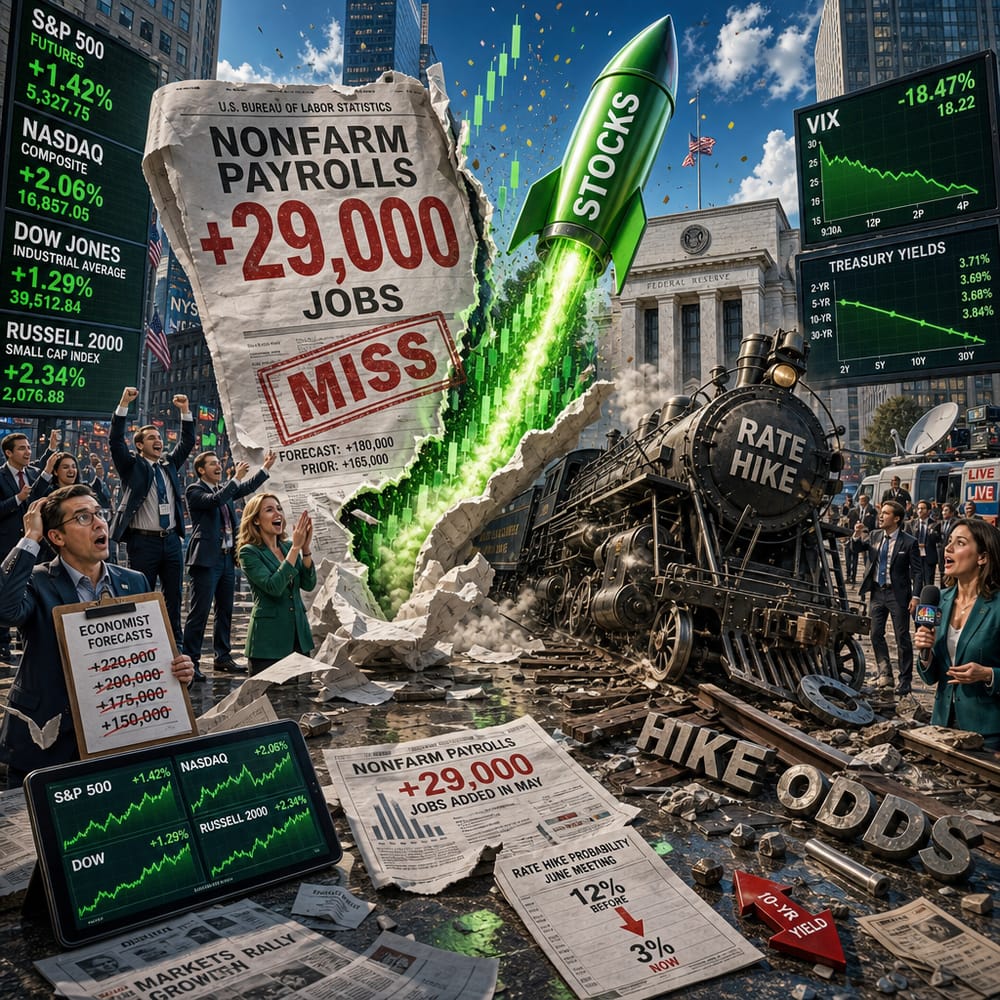
If you’re the type of person who thinks bad news is bad, well, have I got a Wall Street tale for you. Picture this: The U.S. economy stumbles, adding a mere 29,000 nonfarm payroll jobs — far below expectations. You’d think the stock market would react like a cat confronted with a cucumber. Yet, in this bizarre financial dance, the market decides to throw a party instead. Why? Because what frightens central bankers thrills investors.
In the topsy-turvy world of finance, a weak jobs report can be just the ticket for a market rally. The S&P 500, Nasdaq Composite, and Dow Jones Industrial Average all found themselves enjoying a bump. Even the often-overlooked Russell 2000 joined in the fun. So, what’s behind this seemingly backward celebration?
RATE-HIKE EXPECTATIONS TAKE A PLUNGE
Let’s connect the dots. The Federal Reserve, our nation’s designated interest rate arbiter, has been on a tear lately, hiking rates faster than you can say “inflation.” But fewer jobs may mean the economy isn’t as hot as everyone feared. So, the Fed might just have to ease up on all the rate hike madness.
Investors, always on the lookout for the nearest buffet of cheap credit, love this. Less aggressive rate hikes mean borrowing costs stay lower, potentially juicing up corporate profits and, ultimately, stock prices. The treasury yields also took a little dip, signaling that the bond market concurs: the Fed may be putting away its hammer soon.
SECTORS BENEFITING FROM THE RALLY
All this optimism ignited a rally across several sectors. Tech stocks, particularly those in the Nasdaq Composite, got a boost. Tech companies love low rates the way cats love napping—they thrive on the cheap borrowing costs to invest in innovation and expansion.
But it wasn’t just the tech wizards doing a happy dance. Consumer discretionary stocks also saw gains as consumers might feel a bit more comfortable spending if their borrowing costs aren't set to soar. And let's face it, in these topsy-turvy times, any bit of reassurance can send folks rushing to refresh their wardrobes or upgrade their gadgets.
CAN THIS TREND CONTINUE?
Now, here’s the million-dollar question: Could this “bad news is good news” narrative keep feeding into the market if the economy continues to show weakness? It’s a complicated dance. Prolonged economic weakness isn't good news — it’s just bad. Period. But as long as signs of moderation are mild enough to soothe the Fed without signaling recession, the market might just keep its cool.
However, more severe economic sluggishness could signal trouble and make investors reconsider this sunny optimism. If the next economic data points—GDP, unemployment claims, consumer spending—start to paint a picture of a sputtering economy, the party could quickly turn into a hangover.
THE ROAD AHEAD
Let’s face it, the market is as unpredictable as a toddler after a candy binge. The only constant is change, and right now, the market mood is as fickle as ever. Investors are balancing a multitude of risks and rewards, from global trade tensions to the AI spending spree.
In the meantime, for those retail investors scrolling Instagram and looking for the key takeaway: Keep an eye on the Fed, stay diversified, and maybe cut back on the cucumber videos. Because in this bizarro financial world, bad news might just keep being good news, until it isn't. As always, keep your wits about you and avoid betting the farm on yesterday's trends in today's volatile market.
This article is for informational purposes only and is not investment advice. Always do your own research or consult a licensed financial professional before making investment decisions.
© Copyright 2024. All Rights Reserved.
© Copyright 2024. All Rights Reserved.