

‘Bad News Is Good News’ Momentum: How a Shockingly Weak Jobs Report Propelled Stocks and What’s Next for Fed Policy
Wednesday, October 07, 2026
‘Bad News Is Good News’ Momentum: How a Shockingly Weak Jobs Report Propelled Stocks and What’s Next for Fed Policy
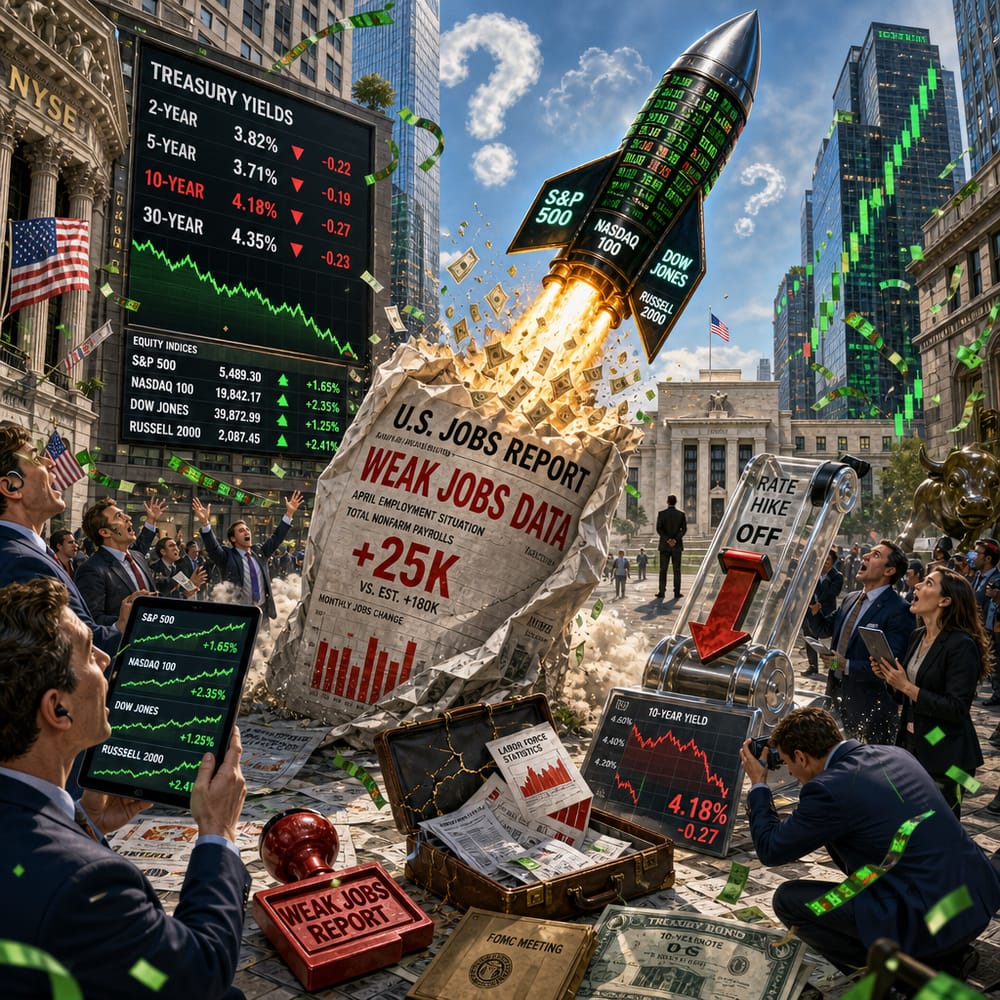
Welcome to the upside-down world of economics, where bad news can trigger champagne showers on Wall Street. Last week, a lackluster jobs report did just that. It wasn't just weak — it was feeble enough to make a toothpick look sturdy. Yet the markets danced, with the S&P 500, Nasdaq 100, and Dow Jones staging a rally that left investors wondering if they had stumbled into the Twilight Zone. Why? Because bad news sometimes means good news for your portfolio, thanks to our friends at the Federal Reserve.
You see, the Fed has been like the chaperone at a high school dance, keeping an eye on inflation like it's the overly enthusiastic kid ready to ruin the party. They've been on a rate-hiking spree, trying to keep inflation in check. But when a jobs report comes in weaker than a paper towel in a hurricane, it gives the Fed pause. It suggests the economy might not be overheating, which means they might hold off on making borrowing more expensive with another rate hike.
This past week, that’s exactly what happened. The underwhelming jobs numbers hinted that the economy wasn’t sprinting but more of a gentle jog. Investors, ever the opportunists, saw this as a cue to scoop up stocks in droves, betting that the Fed would ease off its rate-hike pedal. So, contrary to intuition, a weak jobs report sent the U.S. Treasury yields tumbling, setting off a buying spree in equities as investors anticipated a friendlier Fed.
Yet, it's not all roses in this garden of economic paradoxes. With great rallies come great responsibilities — or in this case, questions. How sustainable is this market euphoria, especially if the economy continues to produce data more disappointing than a stale doughnut?
Let’s dive into the sectors that made hay while the sun shone. Tech stocks, as usual, were the life of the party. The Nasdaq 100, bustling with tech darlings, saw gains as lower yields often mean cheaper financing for growth-oriented companies. Then there’s the Russell 2000, the scrappy index of small-cap stocks, which basked in the glow of the rally. Lower rates usually benefit smaller companies with less access to capital — a boon for these underdogs hoping to punch above their weight.
But before you start popping investment bottles, consider the precariousness of this dance. If future economic data continues to portray an economy more sluggish than a Monday morning coffee queue, the Fed might be forced to reconsider its stance. Another weak jobs report, and you might just see more of this topsy-turvy market action. But if the data swings the other way, showing unexpected strength, the Fed could resume its rate hikes faster than you can say "interest rates."
For those with their eyes on the bond market, the drop in Treasury yields came as a bit of a relief after a recent climb that felt like a rollercoaster going up. Lower yields generally mean bonds are less attractive compared to stocks, luring investors back into equities. But watch out for those Fed meetings, where policy shifts could turn the yield tide once again.
And what about the broader implications for your strategy? Well, if you're playing the long game, diversify like it’s going out of style. Keep an eye on sectors that thrive in a low-interest environment, like tech and consumer discretionary. But don't ignore the defensive plays—think healthcare and utilities—that might weather the storm should the Fed pull a fast one and raise rates due to inflation fears.
In this world where bad is good and good can be bad, staying nimble is key. The Fed's next move is as unpredictable as a cat on caffeine. So keep your ear to the ground, your portfolio balanced, and perhaps a touch of skepticism handy. After all, in this financial wonderland, the only certainty is uncertainty itself.
So, as we take a breather from last week’s market theatrics, remember this: In the wacky world of Wall Street, sometimes the best play is to expect the unexpected and prepare for anything. Until next time, stay sharp and keep your investments even sharper.
This article is for informational purposes only and is not investment advice. Always do your own research or consult a licensed financial professional before making investment decisions.
© Copyright 2024. All Rights Reserved.
© Copyright 2024. All Rights Reserved.