

AUD/USD Strength on Hold Following RBA Rate Pause
Saturday, August 15, 2026
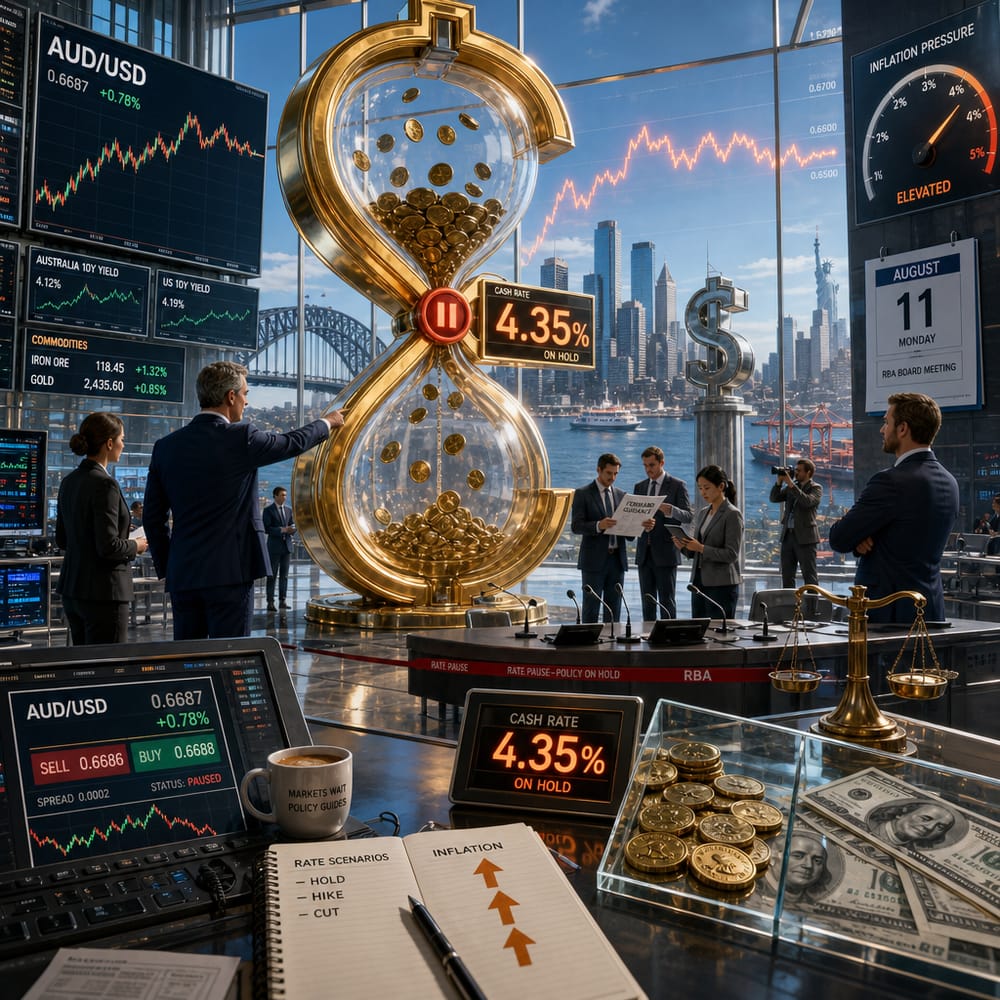
AUD/USD DANCE: CAN THE RBA’S PAUSE KEEP THE MUSIC PLAYING?
If you've ever played a game of poker, the recent move by the Reserve Bank of Australia (RBA) might feel familiar. On August 11, the RBA decided to hold its cash rate at 4.35%, opting to play its cards close to the chest rather than doubling down on interest rate hikes. With inflation pressures still lurking like a shadowy figure, the RBA's decision has left market spectators scratching their heads and wondering: Is Australia's central bank being prudent or is it bluffing about its next move?
For the retail investors keeping an eagle eye on the Australian Dollar's (AUD) performance against the U.S. Dollar (USD), this development is more than just a footnote in financial history—it’s a potential game-changer. The RBA's stance could very well be the puppeteer pulling the strings on the AUD/USD exchange rate in the coming weeks. But as with any good thriller, there are multiple subplots at play.
First, let's talk about the RBA's poker face. By holding the cash rate steady, the RBA is essentially saying, "Let's see how things play out before we make our next move." This cautious approach could mean that the bank is buying time to assess how previous rate hikes are impacting inflation and the broader economy. It’s like waiting to see if your planted seeds will grow before deciding to water them again.
The RBA's wait-and-see approach might be hawkish enough to keep the AUD from taking a nosedive, but is it enough to propel it upwards? Here’s where the plot thickens. External factors, like global commodity prices and China's economic data, are the wild cards in this story. Australia, with its economy heavily reliant on commodity exports, especially to China, feels every tremor from Beijing's economic rumblings.
Enter China, the friendly giant with which Australia plays a delicate dance. If China's economic data shows signs of weakness, it could spell trouble for the Aussie dollar. Why? Because a sluggish Chinese economy could mean less demand for Australia's metals and minerals, translating to a potential downturn for the AUD.
But wait, there's more. Global commodity prices are like a roller coaster, with thrilling highs and stomach-churning lows. Should prices for Australian exports like iron ore and coal catch an upward draft thanks to, say, a global infrastructure boom or supply chain hiccups causing scarcity, it could give the AUD a much-needed shot in the arm. Conversely, a slump in commodity prices would be like rain on the AUD's parade.
Now, you might be wondering, where does the USD fit into this picture? Well, the greenback’s moods can often be as unpredictable as a soap opera. With the U.S. Federal Reserve embarking on its own interest rate journeys, the USD could either bolster its strength or show signs of vulnerability. If the Fed decides to pump the brakes on rate hikes due to slowing inflation, the USD might lose some of its muscle, providing the AUD some breathing room.
So, what’s a retail investor to do in this tangled web of market machinations? Keep a keen eye on the RBA’s next meeting minutes and statements—they’re the closest thing we have to a crystal ball for the bank’s future actions. Also, keep your ear to the ground for any seismic shifts in global commodity prices or notable economic signals emanating from China.
The AUD/USD exchange rate is performing its own choreography on the global financial stage, and the RBA’s decisions are a key part of the choreography, but the show is far from over. With external influences like China’s economic health and global commodity trends acting as understudies, the script is subject to change.
In this thrilling saga of monetary policy and market dynamics, the only certainty is uncertainty. But for those willing to navigate the twists and turns, the journey could offer not just a lesson in economics but a potential for gains as well. So buckle up, because the AUD/USD dance is far from over, and the next chapter promises to be just as riveting as the last.
This article is for informational purposes only and is not investment advice. Always do your own research or consult a licensed financial professional before making investment decisions.
© Copyright 2024. All Rights Reserved.
© Copyright 2024. All Rights Reserved.