

ASML Raises Guidance Again—AI Chip Demand Still Roaring
Wednesday, July 15, 2026
ASML RAISES GUIDANCE AGAIN—AI CHIP DEMAND STILL ROARING
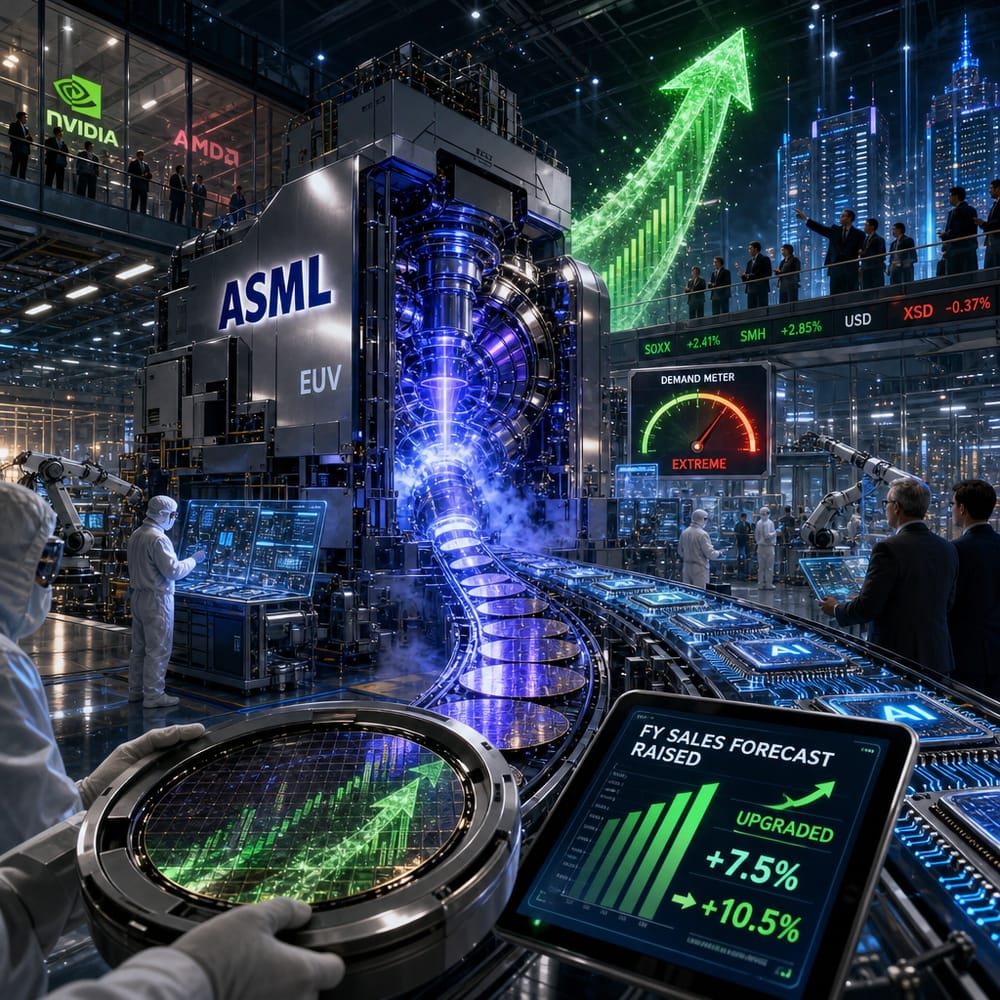
If you thought you were done hearing about the AI craze, think again. In an era where artificial intelligence is hotter than a midsummer day in Death Valley, ASML has just thrown another log on the fire. The Dutch semiconductor-equipment kingpin has once again raised its full-year sales forecast, thanks to insatiable demand for AI chips. That’s right—it's the second time this year, folks. And it’s not just small talk; they mean business with numbers nudging upwards towards a cool $49 billion to $45 billion in full-year sales. So if you’re not keeping an eye on ASML and its semiconductor buddies like Nvidia and AMD, you might want to reconsider your life choices.
ASML’s stock is looking like a rock star, glimmering 115% higher this year alone. And while it's easy to get lost in these dazzling numbers, this isn't just another Wall Street fairy tale. The demand for AI chips is real, and it’s driving a seismic shift in the semiconductor landscape. But wait—before you start throwing your money around like you’re auditioning for a role on Shark Tank, let’s dive deeper into what’s really happening.
First off, let’s address the elephant in the room: the looming budget constraints. IBM, one of the bigwigs in the tech scene, recently rang the alarm bells, warning that AI budget constraints are starting to weigh heavily on corporate tech spending. Companies are tightening their belts, not because they want to, but because they have to. As more businesses try to jump on the AI bandwagon, it's creating a tug-of-war in how dollars get spent.
While Nvidia and AMD are riding high on AI-driven demand, other tech sectors are feeling the pinch. IBM and similar tech giants are finding themselves in a pickle, as they shuffle their budgets to accommodate the high costs of AI integration. It’s like trying to fit a square peg in a round hole. So, where exactly are tech budgets shifting? Think cloud services and data management systems, which are now commanding a larger chunk of the pie. It’s the necessary infrastructure to support AI's growing needs.
Yet, here’s the kicker: despite these pressures, ASML's robust forecast indicates a counter-narrative. While some corners of the tech industry are whispering cautionary tales, the semiconductor realm—especially the AI segment—keeps singing a different tune. And if you ask CNBC’s Jim Cramer, he’ll tell you concerns about an AI bubble are overblown. Today’s profits and valuations, he argues, are far more grounded than the ones we saw during the dot-com debacle.
But don’t let that lull you into complacency. Yes, the semiconductor sector is thriving now, but the ripple effects of shifting tech budgets could eventually trickle down to these AI darlings. Peers in the tech sector are already feeling the heat. Some have seen their stock values drop, making them look like wallflowers at the AI party—awkwardly out of sync with the upbeat rhythm set by ASML and its ilk.
Of course, as with any market, there’s always a twist in the plot. The geopolitical landscape is a looming cloud of unpredictability. Just look at the recent tensions with Iran, which spiked oil prices and kept the market guessing. Any turbulent developments could send the market into a tailspin, rattling even the robust AI chip demand.
And lest you think this is just an American rollercoaster, think again. Across the Pacific, South Korea’s SK Hynix saw an 8% surge, riding the coattails of a rally in U.S. semiconductor stocks. The global appetite for AI chips isn’t just a passing trend; it’s a buffet with no closing time. Yet, as tempting as it is to gorge on these gains, savvy investors know to keep a weather eye on the horizon.
So, what’s the moral of the story? The semiconductor industry might be feasting now, but remember that every bull market eventually runs out of steam. For now, ASML and its semiconductor comrades are basking in the glow of AI’s relentless drive forward. But as the scene evolves and budgets continue to shift, it’s essential to stay nimble, informed, and ready to pivot as the market dictates. Because if there’s one thing Wall Street loves, it’s a good plot twist.
This article is for informational purposes only and is not investment advice. Always do your own research or consult a licensed financial professional before making investment decisions.
© Copyright 2024. All Rights Reserved.
© Copyright 2024. All Rights Reserved.