

Arm–Qualcomm Verdict—Minimal Damages, Minimal Market Reaction?
Tuesday, October 13, 2026
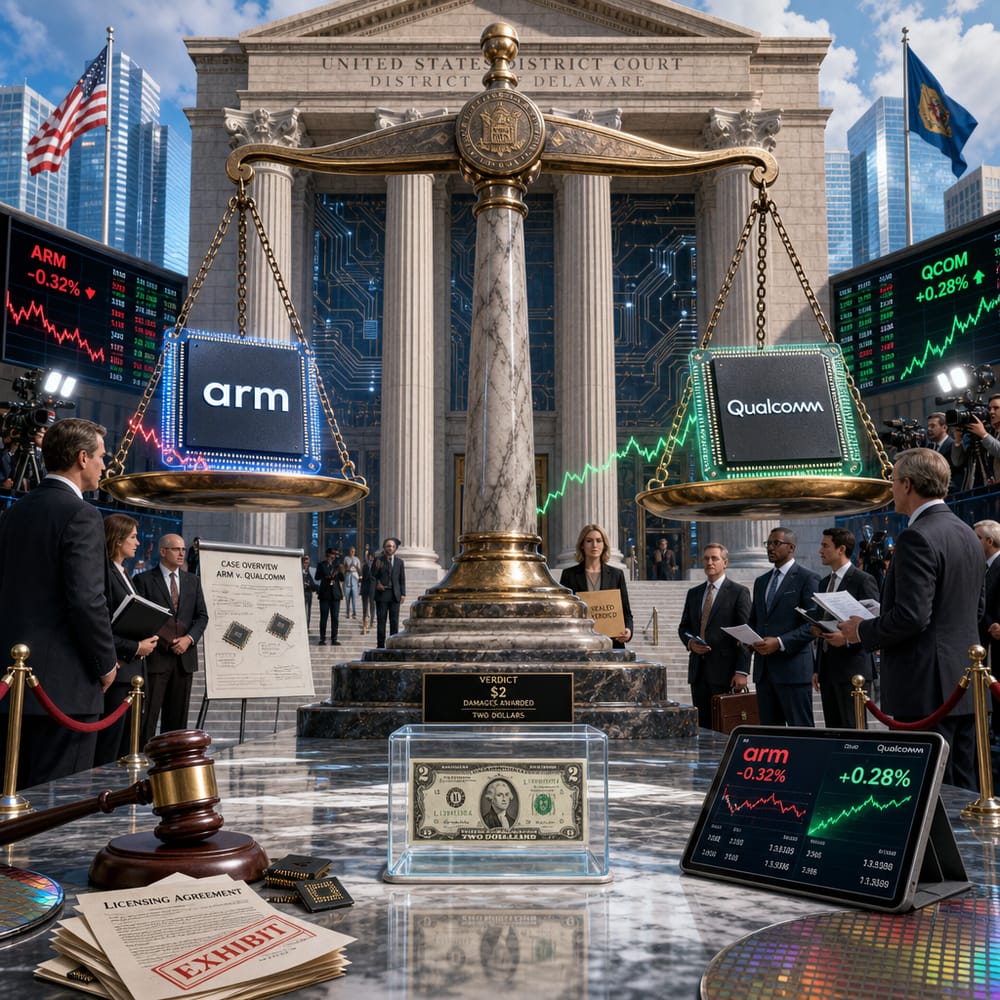
Here's a surefire way to get investors to spill their morning coffee: Tell them that a colossal legal clash between two tech giants ended with a jury awarding a whopping... two bucks. Yep, you read that right. A Delaware federal jury determined that Arm Holdings breached a licensing agreement with Qualcomm and threw in all of two whole dollars as damages. It's the kind of pocket change that might make you wonder if you’ve accidentally tuned into a sitcom instead of serious financial journalism.
So, what’s the upshot of this courtroom comedy? Qualcomm’s shares ticked up a smidge by 1%, while Arm’s shares took a minor dip of 1%. Not exactly fireworks, but in the world of high-stakes semiconductor warfare, even a blip is worth a closer look.
MARKET REACTION: A COLLECTIVE SHRUG
If you’re expecting Wall Street to react like a cat that just spotted a cucumber, think again. The market’s response was more of a collective shrug, a mere blip on the radar. Qualcomm's shares gained a modest lift, and Arm's shares saw a slight dip. For any retail investor armed with a smartphone and caffeine, this might seem underwhelming. After all, the stakes in the semiconductor industry are sky-high, especially when these two chip titans are in the ring. But hey, sometimes even the biggest dramas come with a laugh track.
STRATEGIC IMPLICATIONS: BEYOND THE VERDICT
Now, what does this $2 verdict really mean in the grand scheme of silicon and circuits? The strategic maneuvers here are as intricate as the chips themselves. Arm Holdings has been making a shift, moving away from their traditional role of licensing designs to actually selling chips. It's a move that’s reportedly ruffled feathers with some of their long-standing partners, including Qualcomm.
This jury verdict, even as financially inconsequential as it seems, underscores tensions that might be brewing beneath the surface. For Arm, the verdict could symbolize a need for a recalibration of its strategy, possibly heralding changes in how it partners and competes with major players in the market. Qualcomm, on the other hand, might feel emboldened by this courtroom moral victory, even if it won’t exactly pad their coffers.
FUTURE LEGAL BATTLES: THE TIP OF THE ICEBERG?
Now, let’s not kid ourselves. This isn’t the last we’re going to hear of legal skirmishes between chip designers and manufacturers. The semiconductor industry is notorious for its complex web of patents, cross-licensing agreements, and fierce competition. This $2 verdict could very well be the opening act in a much longer play.
Could we see more lawsuits or, perhaps, more settlements to avoid this kind of public spectacle? Absolutely. As companies like Arm continue to evolve their business models, the friction with partners who are now their competitors could spark more legal fireworks. Investors should keep an eye on the horizon for any ripple effects that could influence stock performance in the tech sector.
WHY IT MATTERS FOR INVESTORS
For retail investors, this curious case is a reminder of the intricate dynamics that drive the tech industry. The semiconductor sector is notorious for its volatility and cut-throat competition. Legal battles, like this one, can often be a precursor to larger strategic shifts within a company, which could impact everything from stock prices to market competition.
While the $2 verdict itself might not shake the financial world, the tensions it highlights could be a signal to investors to watch for potential shifts in partnerships, strategies, and market dynamics within the semiconductor industry.
In short, while this particular courtroom saga concluded with a whimper rather than a bang, it might just be the calm before a much bigger storm in the chip world. So, keep your eyes peeled and your portfolios ready—because in the fast-paced world of tech stocks, the next plot twist might just be a headline away.
This article is for informational purposes only and is not investment advice. Always do your own research or consult a licensed financial professional before making investment decisions.
© Copyright 2024. All Rights Reserved.
© Copyright 2024. All Rights Reserved.