

AMD Sinks ~8% on Mixed Beat and Guidance Despite Strong Results
Wednesday, August 05, 2026
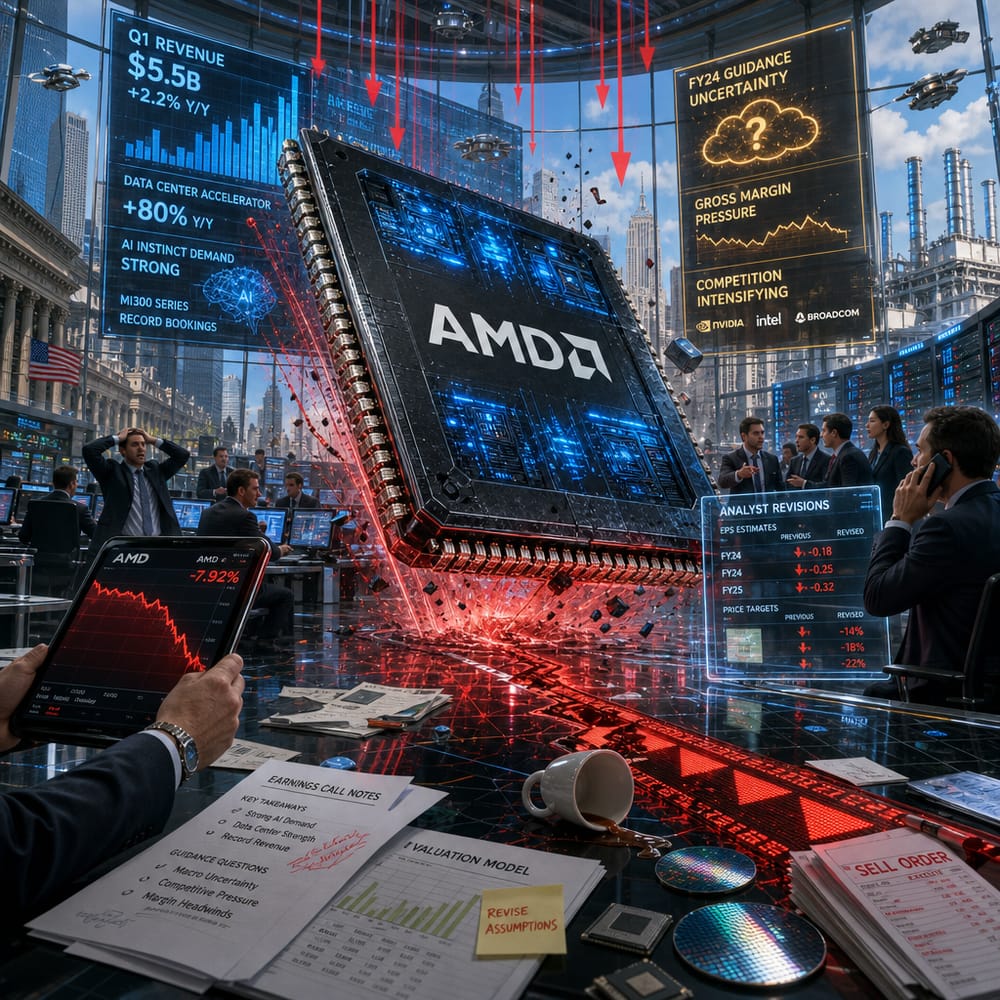
AMD SINKS 8% ON MIXED BEAT AND GUIDANCE DESPITE STRONG RESULTS
Ever seen a stock take a nosedive after a seemingly strong earnings report? Welcome to the strange world of AMD, where solid numbers don't always mean stock market success. AMD just released a report showing impressive revenue growth, yet the stock promptly dropped about 8%. What gives? Let's dive into the semiconductor rabbit hole and find out.
THE NUMBERS GAME
So where did AMD shine, and where did it stumble? For starters, AMD's revenue clocked in way above Wall Street expectations, fueled by the company's foray into AI hardware—a sizzling hot sector right now. But here's the catch: while AMD scored high on revenue, it played a less exciting tune on future guidance. Essentially, the company painted a picture of growth that might slow down, leaving investors feeling a bit like they just got their ice cream stolen.
The market is a bit like a cat; it’s got nine lives but will always be curious. Investors wanted to know if AMD could keep the magic alive. Turns out, they weren’t convinced. This led to the stock taking a hit even though the earnings report was technically a “beat.”
WHAT THE EXPERTS ARE SAYING
Analysts are divided like a family at Thanksgiving dinner. Some say AMD is positioned to grab a bigger slice of the AI pie, while others caution that it might be time to take the fork out. The company's cautious guidance has even the most optimistic investors scratching their heads.
Some analysts point out that AMD could struggle to keep pace with its heavyweight rival, Nvidia. Nvidia has essentially set up a fortress in the AI and data center space, with major endorsements (Elon Musk's SpaceX announcement about sticking with Nvidia is hard to ignore). So, AMD has some catching up to do if it wants to be the cool kid on the AI block.
THE BIGGER PICTURE
But let’s zoom out a bit. This isn't just about AMD. The entire semiconductor sector is undergoing a bit of an identity crisis. The industry is bracing itself for a potential rotation—from speculative growth plays to solid, stable value. Investors seem to be sending a clear message: show us the money, not just a fancy growth story.
This sentiment is echoed in recent market moves, where other companies have been punished for similar reasons. SpaceX also faced a share-price dip due to its massive AI spending, even though it posted strong earnings. It's almost as if the market is saying, "We've seen the AI circus, now show us the profits."
WHAT DOES THIS MEAN FOR AMD?
AMD's dip could suggest a pivot in investor mentality. The company might need to batten down the hatches and focus on delivering consistent, reliable profitability. No more moonshots; it's time to get grounded.
This doesn't mean the end for AMD. It means that investors are becoming more selective, looking for companies that can not only talk the talk but walk the walk. In simpler terms, if AMD can prove that its AI-driven gains are sustainable, it could regain investor confidence.
SO, WHAT NOW?
If you're a retail investor wondering what to do next, it might be time to evaluate your strategy. Consider whether you're in it for the short-term gains or the long-haul stability. AMD's story highlights the importance of looking beyond just the headline numbers.
In the world of semiconductors, it’s not just about who can sprint; it's about who can run the marathon. If AMD wants to regain its footing, it’ll need to show investors that it’s more than just a one-trick pony in the AI rodeo.
In the meantime, keep your eyes peeled. As the tech landscape shifts, there's bound to be more drama, more surprises, and more opportunities for those who are quick to catch them. Whether AMD can be a leader or if it will remain an underdog in Nvidia's shadow is a question only the future can answer. But one thing is for sure: the semiconductor sector isn't going out of style anytime soon.
This article is for informational purposes only and is not investment advice. Always do your own research or consult a licensed financial professional before making investment decisions.
© Copyright 2024. All Rights Reserved.
© Copyright 2024. All Rights Reserved.