

AMD's Steep One-Day Drop on Large Short Position Disclosure
Friday, November 20, 2026
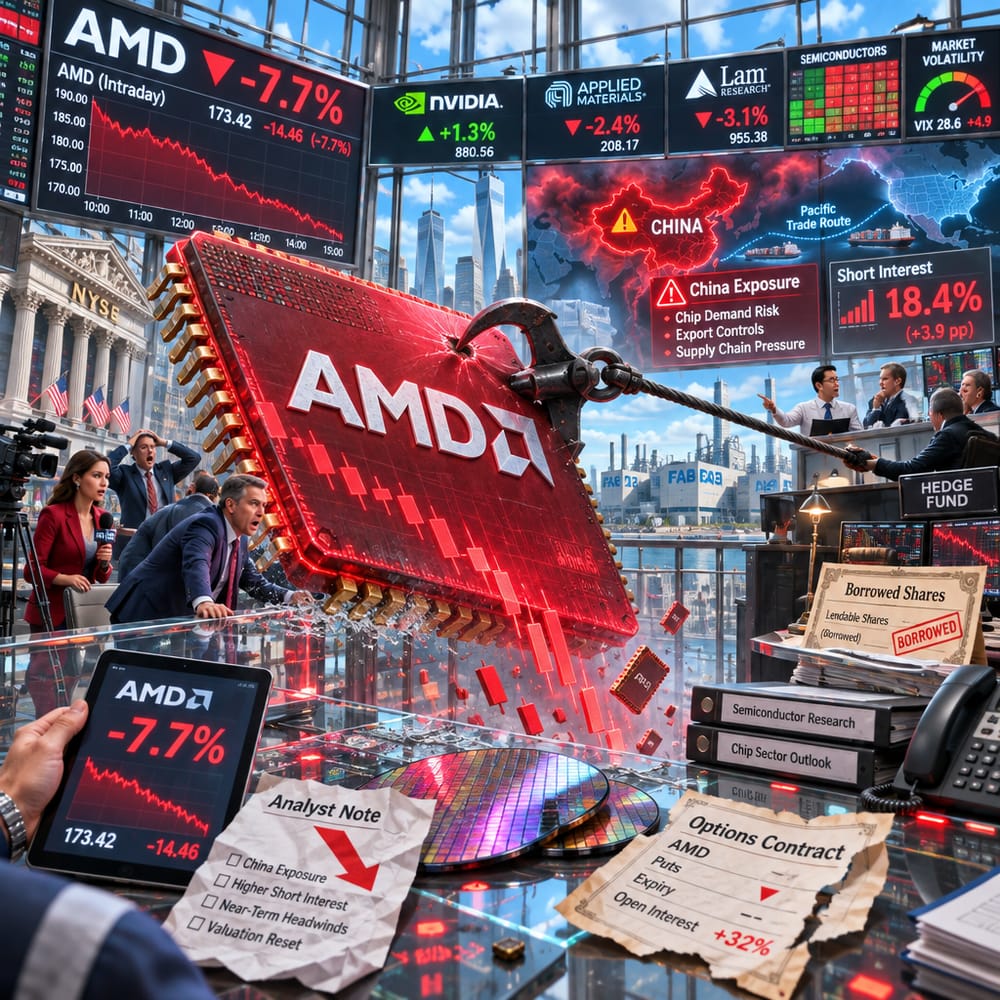
AMD TUMBLES AS HUNTERBROOK CAPITAL BETS AGAINST IT: SHOULD YOU?
Picture this: you're sitting at your favorite cafe, sipping on a latte and scrolling through the day's market news, when BAM! You see it — AMD shares have nosedived 7.7% in one day. Why? Because Hunterbrook Capital just revealed they're betting big against the chip giant. Yep, shorting AMD like it’s going out of style. Suddenly your coffee doesn't taste as smooth. But what does this mean for your portfolio, and should you worry about the whole semiconductor sector?
First, let’s unspool Hunterbrook Capital’s play. When a firm decides to short a stock, it's essentially betting on the company’s value dropping. Like a high-stakes game of financial limbo, the lower it goes, the better for the shorts. Hunterbrook's move is as bold as it is risky, and it's got retail investors scratching their heads. The reason for their pessimism? China.
TAKING THE CHINA CARD
The big wrinkle here is AMD's exposure to China, which is about as comforting as a blindfolded tightrope walk with all the geopolitical tension floating around. The Chinese market is crucial for tech companies, but the ongoing tug-of-war between China and the U.S. over AI supremacy adds layers of complexity and risk. Hunterbrook is banking on these tensions boiling over and impacting AMD. It’s a fascinating bet, but does it make AMD the proverbial canary in the semiconductor coal mine?
RIPPLE EFFECTS ON THE CHIP SECTOR
When a heavyweight like AMD takes a hit, ripples spread across the tech world, making other chip stocks like Nvidia, Applied Materials, and Lam Research look over their shoulders. On the same sell-off day, Nvidia saw a decent drop of its own, suggesting that the market's a bit jittery about semiconductors right now.
Every tech investor knows that the chip sector has been riding a wave of AI-driven demand. But here's the thing — waves can crash just as spectacularly as they rise. Tensions with China are just one potential storm cloud; the other is the sheer pace of AI development, which can often outstrip the capabilities of current hardware.
Looking at Anthropic's recent woes, where their shares dipped significantly after a flashy IPO, it's clear that there's a reality check sweeping through the AI trade. Investors are becoming increasingly skittish about the sector, and AMD's drop could be a harbinger of more volatility.
WHAT'S IN IT FOR YOU?
So, what’s an investor to do when the semiconductor giants start showing signs of vertigo? First, consider the risks. A short position disclosure, especially from a firm with as much clout as Hunterbrook, signals that there might be a rough patch ahead for AMD and perhaps its peers.
Evaluate your own risk tolerance. Does the prospect of more volatility in the semiconductor space make you want to bail, or are you in it for the long haul, ready to buy on the dip? If the latter, AMD's temporary woes might just offer a bargain. Tech stocks have long been seen as growth engines, and a broad pullback could offer some juicy opportunities, provided you're comfortable with the accompanying rollercoaster.
On the flip side, take a leaf out of Hunterbrook's playbook. If you suspect the market's set to face more turbulence, exploring options strategies like put options — essentially insurance policies against your investments — might be wise.
In the grand scheme of things, Hunterbrook's maneuver is a vivid reminder of the intricacies and unpredictability inherent in the stock market, especially in sectors as dynamic as semiconductors. Whether you choose to stay, sell, or short alongside Hunterbrook, remember: the market is as much about psychology as it is about numbers.
Final takeaway? Keep your eyes peeled and your coffee strong, because if the past few days have taught us anything, it's that in this market, surprises lurk around every corner.
This article is for informational purposes only and is not investment advice. Always do your own research or consult a licensed financial professional before making investment decisions.
© Copyright 2024. All Rights Reserved.
© Copyright 2024. All Rights Reserved.