

AMD's Data Center Revenue Surge
Thursday, September 24, 2026
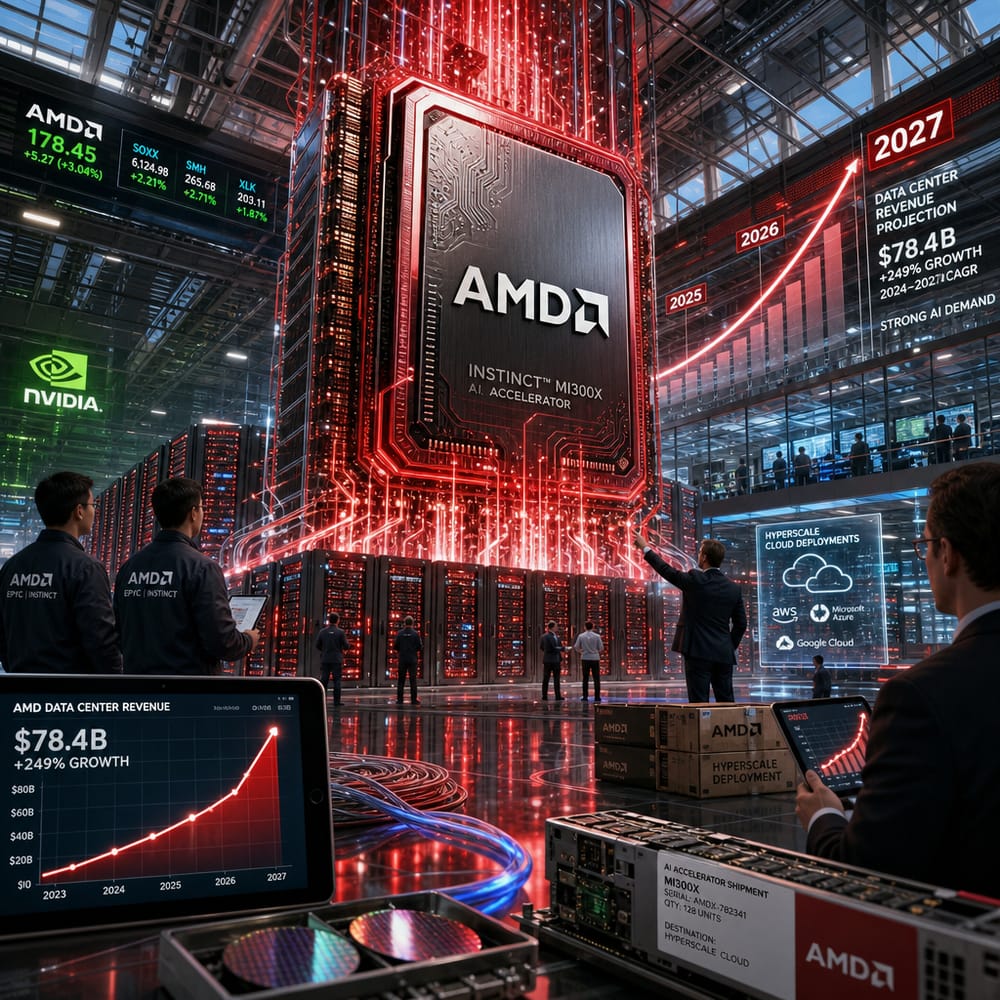
AMD is setting the stage for quite the showdown in the AI data center arena, and it’s not a drill. Picture AMD as the scrappy upstart challenging the trophy-holder, Nvidia, for a slice of the AI pie that everyone wants a taste of. With a bold prediction that its data center segment revenue will more than double by 2027, AMD is looking to shake up the status quo. And how, you ask? By riding the wave of AI accelerator shipments that are poised to redefine the landscape.
So why does this matter to investors with their eyes glued to stock tickers? It's simple: AMD's ambitious plans could spell a seismic shift in market dynamics, positioning it as a real contender against Nvidia in the high-stakes AI data center market. But before you pop the champagne, let’s dive into what AMD’s strategy looks like, how it stacks up against the competition, and the risks and rewards that come with betting on this tech giant.
THE BATTLE PLAN: AMD VS. THE COMPETITION
At the heart of AMD's strategy is a focus on AI accelerators—hardware that supercharges the processing of AI tasks. This niche is currently dominated by Nvidia, which has had a head start with its GPU technology. Nvidia's chips are practically synonymous with AI acceleration, making it the incumbent to beat. But AMD is not content to play second fiddle. The company is sharpening its tools, specifically its adaptive compute acceleration platform, to lure customers away from Nvidia's embrace.
AMD's approach is to offer robust performance at a potentially lower cost, which could be a game-changer for budget-conscious data centers. The promise of competitive price-to-performance ratios could be AMD's ace in the hole, appealing to data centers looking to maximize bang for their buck.
RISKS AND REWARDS: A DOUBLE-EDGED SWORD
Now, let’s address the elephant in the room—the risks. Investing in AMD's bold move is not without its pitfalls. The tech landscape is as volatile as they come, rife with rapid innovations and shifting consumer preferences. One wrong move or misjudged market demand, and AMD could find itself grappling with underutilized inventory and falling stock prices.
On the flip side, the rewards could be substantial. If AMD manages to pull off its strategy, investors could see significant gains. The company's stock may get a healthy boost from increased revenue and market share. Moreover, if AMD successfully eats into Nvidia's territory, it could lead to a re-rating of its stock, as analysts reassess the company’s growth potential.
SHORT TERM VS. LONG TERM: THE CRYSTAL BALL VIEW
In the short term, expect some market jitters as AMD gears up for this ambitious endeavor. Stock prices might experience volatility as investors react to quarterly earnings and market rumors. However, for the long-term investor, the potential for AMD to double its data center revenue by 2027 offers a tantalizing prospect.
This ambitious goal, if achieved, could not only boost AMD’s financial standing but also strengthen its position in the tech hierarchy, shaking the foundations of the current Nvidia-dominated landscape. However, the road to 2027 is fraught with competition and the ever-present threat of technological leapfrogging.
THE BOTTOM LINE
So, what’s the takeaway here for the everyday retail investor? Well, think of AMD as a high-risk, high-reward player. If you’re the kind of investor who thrives on the thrill of what could be, AMD might just be worth the gamble. But, as always, weigh your risk tolerance and keep an eye on market developments.
AMD's journey to AI dominance is just beginning, and the stakes have never been higher. The battle lines are drawn, and the market is watching. Whether AMD can make its ambitious projections a reality could mark one of the most exciting chapters in tech investing yet. Grab your popcorn; this one's going to be a showstopper.
This article is for informational purposes only and is not investment advice. Always do your own research or consult a licensed financial professional before making investment decisions.
© Copyright 2024. All Rights Reserved.
© Copyright 2024. All Rights Reserved.