

AMD's 7% Rebound Post-Q2 Earnings
Sunday, August 16, 2026
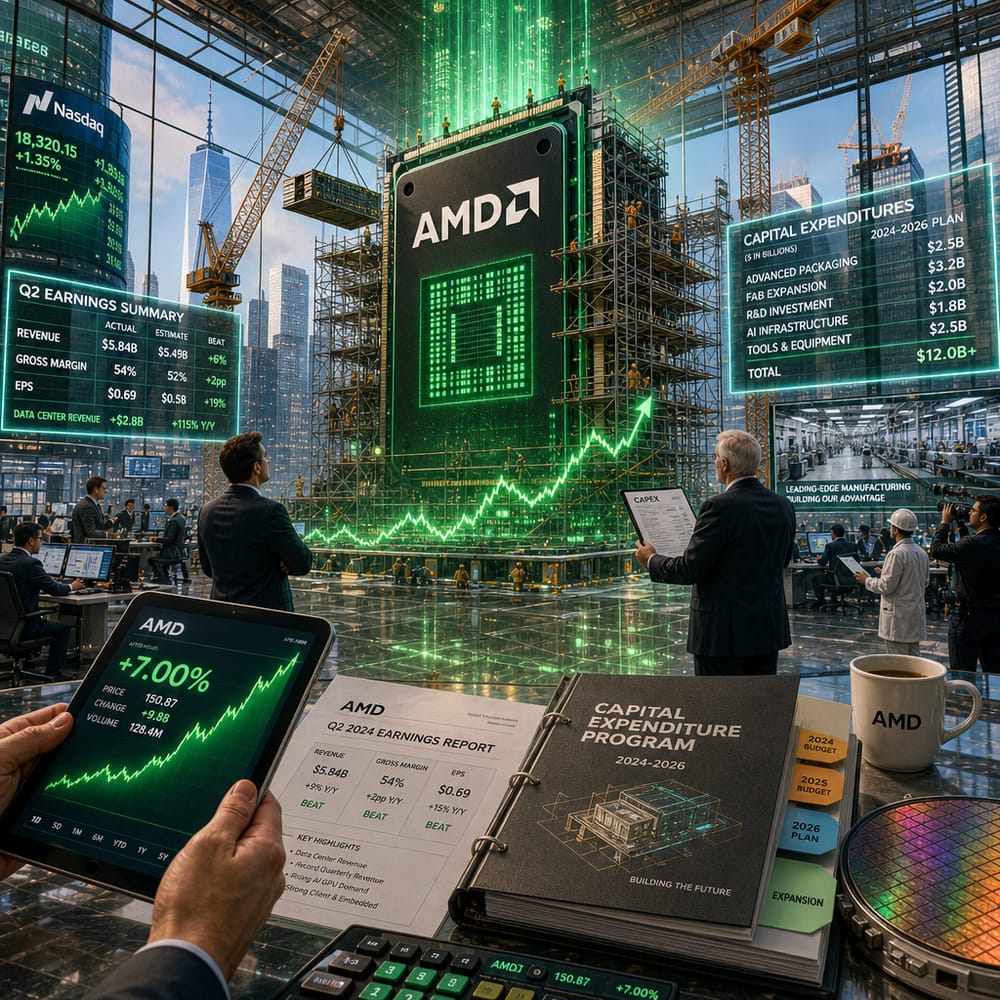
AMD just pulled a rabbit out of its silicon hat. Despite upping its capex ante, AMD's stock leapt about 7% after announcing Q2 earnings that beat Wall Street's wildest dreams. So what's the magic formula behind this tech giant's recent gains, and why are investors still smiling through the cash splurge?
Let's start by decoding AMD’s earnings beat—a cocktail mixed with a splash of unexpected strength in its data center division and a dash of resilience in its semi-custom chips, the kind that power your favorite gaming consoles. The gaming sector's insatiable thirst for more horsepower is giving AMD’s chips more street cred (and cash flow) than a limited edition Lamborghini. Plus, with AI becoming the hottest ticket in tech town, AMD is positioned as a key player with its robust lineup of GPUs—graphic processing units, the graphics card's muscle-bound cousin.
Now, let's talk about the elephant-sized investment in the room: AMD's capital expenditures. The company announced a significant ramp-up in spending, which might sound scarier than a haunted house full of unsold graphics cards. But here's the kicker: it signals AMD's serious intent to double-down on its growth prospects. Sure, increased spending could put a squeeze on margins—think of it like a financial corset—but in the long run, it’s an investment in a glitzy future of innovation and expansion.
Increased capex is like beefing up your home gym during a fitness craze. It’s not just about what you spend today, but about sculpting yourself for tomorrow’s triathlon. AMD’s CEO, Dr. Lisa Su, knows that staying competitive means investing heavily in research and development, fab capacity, and strategic partnerships. These elements are crucial to maintain momentum against fierce rivals like NVIDIA and Intel, which are also sprinting on the semiconductor treadmill.
But what about those potential growth areas for AMD? Well, the tech giant is betting big on a few key arenas. First up, the AI revolution: with machine learning and AI applications swelling in number like tech keynotes in Silicon Valley, AMD’s GPUs are becoming increasingly sought after. Plus, the burgeoning demand for cloud computing means data centers will need even more processing power, a gap AMD is eager to fill.
Then there's the gaming sector—the industry that treats Moore's Law like a mere suggestion. As games become more visually demanding and immersive, AMD's chips will continue to be the engine under the hood of consoles and gaming PCs around the globe. And let's not forget the automotive industry, where AMD is quietly revving up its engines to make inroads with chips for self-driving and connected vehicles.
The investor confidence reflected in AMD's recent stock performance isn't just blind faith—it’s a calculated bet on AMD's roadmap for dominance. Despite the immediate hit to margins from increased spending, market watchers are betting that the pay-off will come in the form of enhanced product lines, broader market penetration, and fortified supply chains.
So, why did AMD's stock jump when they announced they'd be spending more? Simply put, it's about seeing the bigger picture. Investors are eyeing the potential for AMD to tap into these roaring markets, armed with the latest and greatest in chip technology. The future might be uncertain, but one thing’s clear: AMD isn’t just sitting on the tech sidelines; it's gearing up to play the long game.
In the watchful eyes of Wall Street, AMD’s hefty spending spree isn’t a sign of recklessness but of readiness. They've thrown their chips on the table—literally—and are all-in on a strategy to catapult the company into a new era of growth. For retail investors scrolling through their feeds, AMD's narrative is a reminder that sometimes, in the tech sector, it pays to spend big to win big.
This article is for informational purposes only and is not investment advice. Always do your own research or consult a licensed financial professional before making investment decisions.
© Copyright 2024. All Rights Reserved.
© Copyright 2024. All Rights Reserved.