

Akamai Turns Away AI Workload Demand Amid Power Constraints
Monday, November 23, 2026
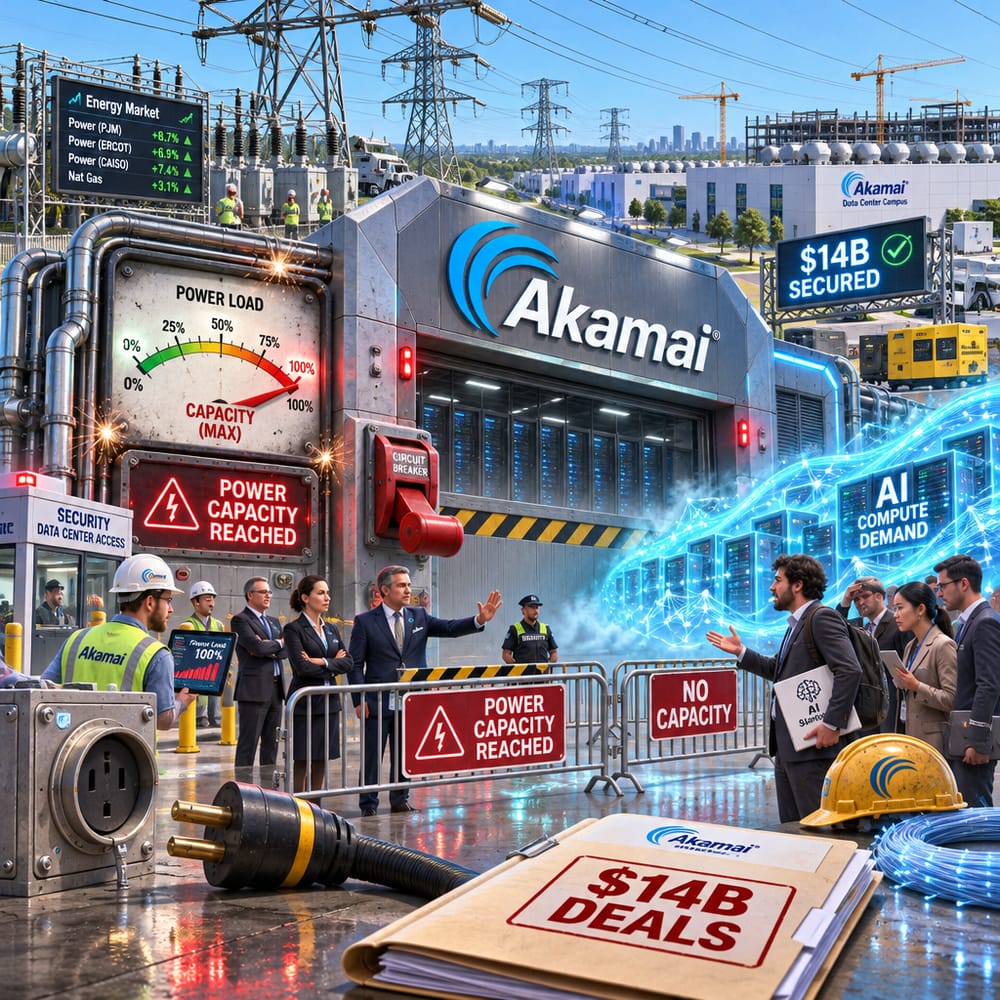
AKAMAI TURNS AWAY AI WORKLOAD DEMAND AMID POWER CONSTRAINTS
Akamai Technologies is turning down work, but not for the reasons you might think. While most companies are hungry for any scrap of business during an economic downturn, Akamai has found itself in the enviable yet perplexing position of saying no. The reason? Not enough power. Yes, in this 21st-century tech race, it turns out it's not just about having the fastest chips or the cleverest algorithms; sometimes, it's the plain old electric juice that's the bottleneck.
Imagine being offered a whopping $14 billion worth of deals and having to slam the door on some because you can't plug them in. That's the reality for Akamai, a major player in the cloud services arena. Despite its technological prowess and a suite of services that would make any CTO swoon, Akamai is being thwarted by the most basic of utilities. So let's dive into this peculiar digital-age pinch.
THE ELECTRIC ELEPHANT IN THE ROOM
To set the scene, Akamai has been a heavyweight champion in securing cloud infrastructure contracts. But as it turns out, all those shiny new AI workloads that businesses are clamoring to run require a massive amount of energy—equivalent to powering a small city. Akamai's existing data centers are simply not equipped to handle the surge in demand for the latest AI technology. It’s like trying to charge a Tesla with a couple of AA batteries; it’s just not going to cut it.
RETHINKING CLOUD STRATEGIES
This conundrum is forcing tech companies everywhere to rethink their strategies. For Akamai, the power shortage isn't just a bump in the road; it's a full-blown roadblock. This predicament underscores a critical issue in the tech world: the physical limitations of cloud infrastructure. All those clever cloud strategies and AI ambitions are meaningless if you can't power them up. It's a stark reminder that for all the talk of the digital transformation, we still live in a very physical world.
So, what’s the solution? Akamai, along with its tech peers, is exploring a few avenues. One option is to invest in new data centers designed to handle larger loads. But building infrastructure from scratch isn't a quick fix; it takes years and a heap of dollars. Alternatively, they're looking at boosting their energy efficiency and finding more sustainable energy sources. Think solar panels and wind farms instead of fossil fuels. But again, these solutions require time and investment, and time is the one thing you don’t have when you’re sitting on a $14 billion pile of potential business.
WHAT DOES THIS MEAN FOR AKAMAI'S FUTURE?
Turning away business because of power constraints isn’t just a missed opportunity; it’s a signal that Akamai needs to adapt—and fast. The company’s ability to grow and remain competitive in the cloud space hinges on its capacity to solve these power issues. The question is, how quickly can they resolve the problem before their competitors swoop in to fill the void?
In the short term, Akamai might face challenges in capitalizing on the booming AI sector. But, this could also be a wake-up call prompting them to innovate. Perhaps it will spur accelerated action and strategic partnerships that could bolster their capabilities in the long run. Akamai could emerge not only as a cloud leader but as a pioneer in efficient, sustainable computing.
A CALL TO ACTION IN THE TECH WORLD
For the wider tech world, Akamai's power pinch is a cautionary tale. It highlights the importance of infrastructure in the digital age. Companies can't afford to ignore the foundational aspects like energy requirements even as they chase after the next big thing in AI or cloud computing.
There’s a lesson here: no matter how high-tech our world becomes, we're fundamentally rooted in the physical limitations of infrastructure. The smartest companies will be those that balance digital innovation with real-world practicality.
In the end, Akamai's situation is a reminder that sometimes, it’s not just about the next big idea. It's about having the power to make that idea a reality—literally. So, as you plug into the future, remember to check the wattage.
This article is for informational purposes only and is not investment advice. Always do your own research or consult a licensed financial professional before making investment decisions.
© Copyright 2024. All Rights Reserved.
© Copyright 2024. All Rights Reserved.