

AI-Led Rebound Fuels Nasdaq and S&P, While Small-Caps Stall
Wednesday, November 11, 2026
AI-LED REBOUND FUELS NASDAQ AND S&P, WHILE SMALL-CAPS STALL
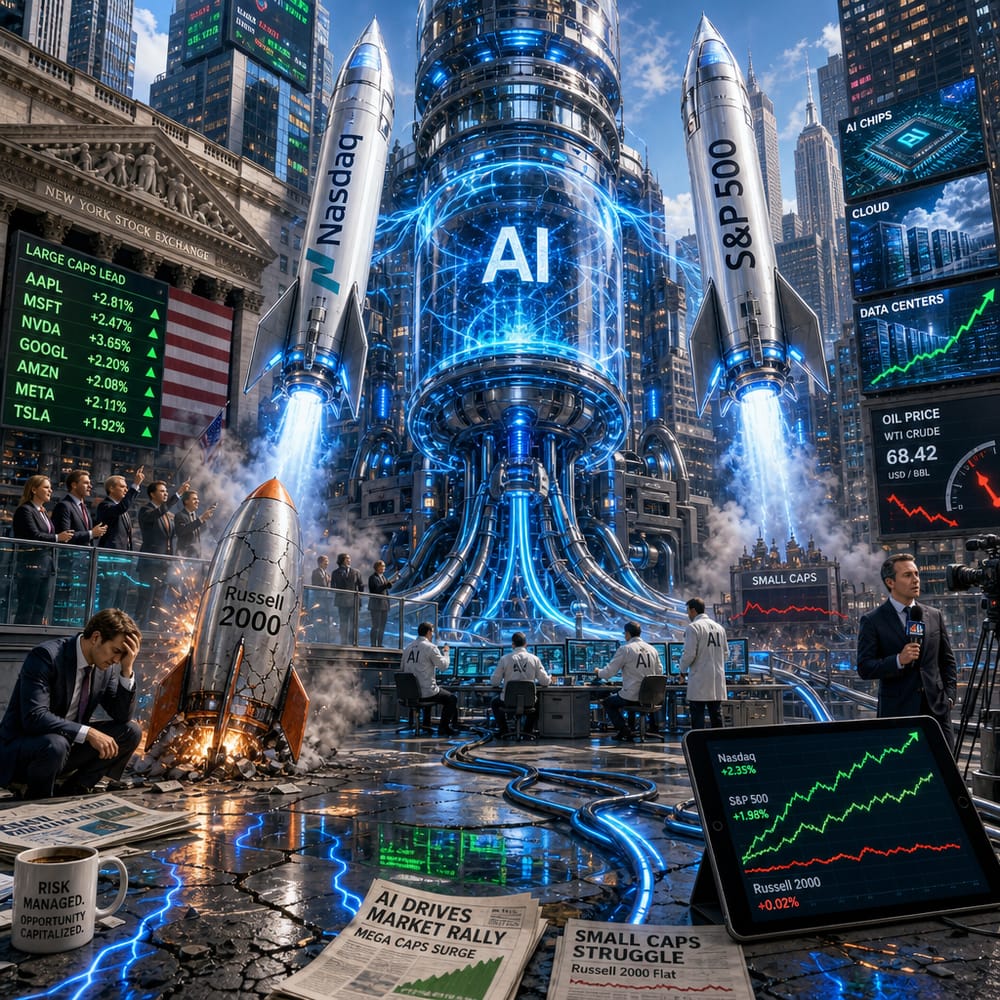
If you’ve been snoozing on AI stocks, it’s time for a wake-up call. The Nasdaq and S&P 500 are doing a little dance up the charts, thanks to a tech rally led by AI juggernauts, while smaller companies on the Russell 2000 watch from the sidelines like wallflowers at the high school prom. What’s driving this tech revival, and why are those small-caps missing out on the fun?
Let's start with the star of the show: AI stocks. CoreWeave, a company that’s basically a VIP in the AI cloud scene, just dropped a stellar earnings report that had investors acting like it was Black Friday and shares were going for half off. The company’s CEO, Michael Intrator, did a victory lap, confirming that demand for AI infrastructure is sky-high—think concert tickets for a band’s farewell tour. This confidence in AI’s future sent CoreWeave shares soaring over 20%, and its ripple effect gave Nvidia the boost it needed after a rough week.
So, what’s the deal with AI stocks lighting up the leaderboard? In short, it’s about expectations and delivery. When investors see a company not just meeting but exceeding expectations—with a backlog 10 times oversubscribed according to Intrator—they get the warm fuzzies. It suggests the future is bright, orders are rolling in, and profits are likely to follow. For the broader market, when major players show strength, it reassures investors that perhaps the AI trade isn't as risky as feared.
Meanwhile, as the big guys dance, the Russell 2000 might as well be at home watching reruns. Why the lag? Part of it boils down to the fact that small-cap companies don't have the same tech-heavy exposure that the larger indices do. They're more sensitive to U.S. economic conditions and less to the global tech trends that are propping up the Nasdaqs of the world. With uncertainty still looming over interest rates and inflation, smaller businesses are feeling the pressure like a kid cramming for finals. Plus, these companies don’t have the deep pockets to cushion them against economic turbulence, making them a tougher sell for investors right now.
And then, there’s the oil situation. With oil prices taking a chill pill lately, it’s helping soothe inflation jitters—something that’s been a thorn in investors’ sides for quite some time. Suddenly, having confidence that costs won't spiral out of control is putting some wind back in the market’s sails. Cooling oil prices have broader implications, like making the cost of doing business cheaper for everyone, but the relief seems to be giving more juice to the big names than the little guys.
All of this is a classic tale of divergence. The big tech stocks are like the cool kids who didn't just show up to the party—they brought a keg. Meanwhile, smaller firms are trying to figure out how to get past the bouncer. The Nasdaq and S&P 500 are feasting on AI optimism, while the Russell 2000 is left to nibble on whatever crumbs are left after macroeconomic concerns and lower investor appetites.
For the everyday investor, this divergence speaks volumes about where market sentiment lies. It’s a reminder that in the world of investing, not all indexes are created equal. As AI continues to prove it isn't just another bubble about to burst, it’s shaping up to be a potent factor in determining which stocks win out. But as always, there’s a twist—just because the AI sector is on a hot streak doesn’t mean it's immune to the ups and downs of fickle market moods.
So, what’s ahead? Investors would be wise to keep one eye on those cooling oil prices while they lean into tech. As the landscape shifts, so will the opportunities, and those nimble enough to navigate the waves of this new AI tide might just find themselves surfing a winning trend. But for now, the takeaway is clear: big tech is back in the spotlight, and it’s not budging anytime soon. As for the smaller names dotting the Russell 2000, they might have to wait their turn—patience can be a virtue, after all.
This article is for informational purposes only and is not investment advice. Always do your own research or consult a licensed financial professional before making investment decisions.
© Copyright 2024. All Rights Reserved.
© Copyright 2024. All Rights Reserved.