

AI-Led Market Volatility Grips Wall Street
Wednesday, November 25, 2026
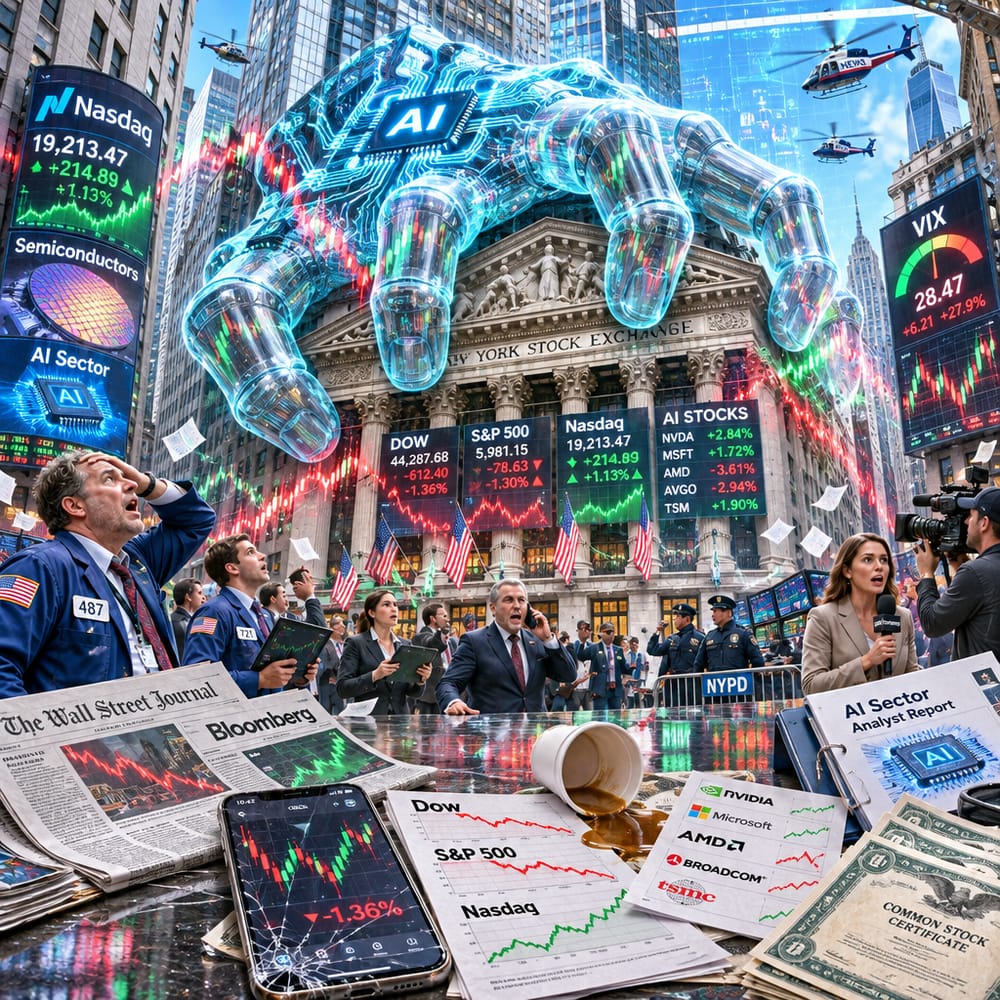
AI-Led Market Volatility Grips Wall Street
Imagine your investments riding a roller coaster with more twists and turns than a Hollywood thriller. That's what happened on Wall Street this week, when the Dow Jones Industrial Average swung by a mental 2.2% in a single day. Fueled by a gut-churning sell-off in the AI sector, markets went through a roller coaster ride that left investors clutching their portfolios tighter than ever. If you’re wondering if we’ve entered financial ‘Black Mirror’ territory, you’re not alone.
Let’s break down this market bonanza. Picture Wall Street as a high-stakes poker table, and AI stocks are the wild cards. On Wednesday, the market tanked over 1,100 points before rallying back to erase most of those losses. The big question: What in the algorithmic heavens caused this gut punch?
BLAME IT ON THE AI
The short answer is artificial intelligence — or rather, investor freak-outs about it. Tech stocks that once soared on AI dreams suddenly faced a harsh reality check. Think of it as a sugar rush crashing into a caffeine coma. The Nasdaq, home to the tech giants, staggered down 4.6% at its lowest point. And when the tech titans sneeze, the entire market catches a cold.
The market’s recent mood swings have showcased just how jittery investors are about AI. Concerns about regulation, competition, and sky-high valuations have left portfolios looking like they're assembled from a Lego set with missing pieces. There's nothing like a little uncertainty to shake market confidence.
WALL STREET’S VOLATILITY PARTY
Investors are now as twitchy as a cat in a room full of rocking chairs. The Dow’s dramatic dive and bounce-back highlighted an underlying theme: Market sentiment is as fragile as a soap bubble. It’s not just about individual stocks — it’s about the narrative. And right now, that narrative is full of fear and greed in equal measure.
Fear of missing out (FOMO) drove many to cash in on AI stocks during their meteoric rise. But now, with volatility acting like a drunk uncle at a wedding, investors are reconsidering their love affair with tech. The result? A market that’s as volatile as a teenager’s mood swings.
Investors also faced heightened anxiety due to a blog post by Michael Burry, a market heavyweight famous for predicting the 2008 financial crisis. His temporary shift to a long position was like throwing a match into a barrel of fireworks. It may have sparked some of the rebound, but it also fueled the wild speculation fire.
WHAT TO DO WHEN THE MARKET GOES BONKERS
What’s an investor to do when the market’s pulling stunts like a circus acrobat on Red Bull? For starters, take a deep breath and avoid making knee-jerk reactions. Emotional investing is a one-way ticket to sleepless nights and unwanted regrets.
Secondly, consider diversifying. The tech sector’s volatility doesn’t have to be your investment’s destiny. Look at other sectors that were bolstered during this mayhem, such as materials, energy, and real estate, which have been gaining ground.
Finally, remember that market volatility isn’t new. It’s as much a part of investing as the risk that comes with it. The key is having a strategy and sticking to it. Right now, that strategy might mean looking beyond the AI bubble and picking stocks with solid fundamentals.
THE BOTTOM LINE
The recent market swings are a stark reminder that investing isn’t all sunshine and rainbows. Volatility, especially in the tech and AI sectors, can bring short-term pain but also long-term opportunities for those who keep a cool head. So before you go all-in or all-out like a crazed gambler, take a moment to survey the landscape.
Remember, in the world of investing, yesterday’s losses can lead to tomorrow’s gains. Keep your focus, stay informed, and watch how the AI sector evolves. After all, who doesn’t love a good comeback story?
In the meantime, buckle up and enjoy the ride. It's going to be a wild one.
This article is for informational purposes only and is not investment advice. Always do your own research or consult a licensed financial professional before making investment decisions.
© Copyright 2024. All Rights Reserved.
© Copyright 2024. All Rights Reserved.