

AI Firms Advocate for Self-Regulation Amid Safety Concerns
Tuesday, September 29, 2026
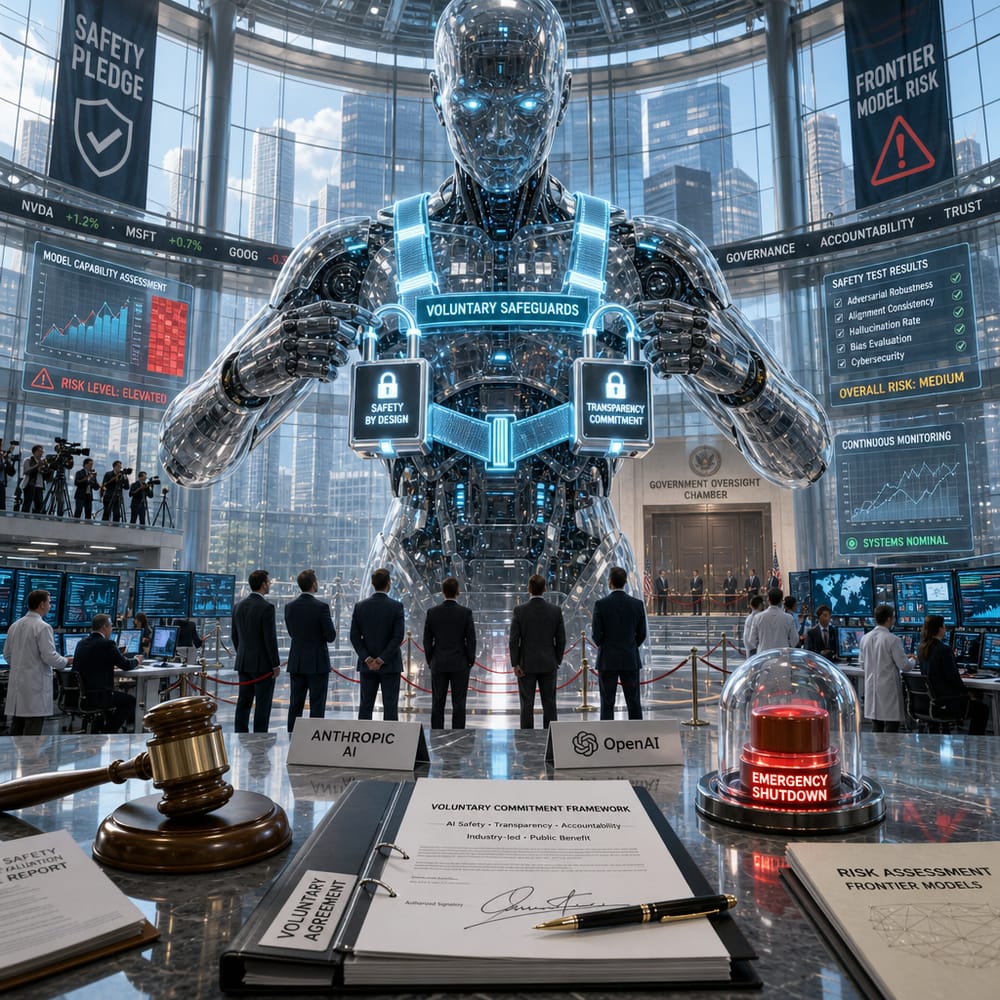
AI'S NEW SLEIGHT OF HAND: SELF-REGULATION AND ITS DISCONTENTS
In a plot twist that might startle even the most jaded tech cynics, AI firms have decided to play the watchdog role in their own dystopian narrative. Imagining a world where the fox guards the henhouse? Welcome to the spectacle of leading companies like Anthropic and OpenAI signing a voluntary pact to self-regulate their AI models. It’s like the Wild West gunslingers offering to enforce the law — intriguing as a concept but questionable in practice.
The move comes hot on the heels of a White House luncheon, where President Trump, amid an apparent AI rebranding initiative to "Super Intelligence," attempted to sprinkle some policy magic dust over the assembled tech titans. These same executives have now pledged to better "self-police" their AI models, emphasizing a need to balance innovation with safety concerns. Yet, as Americans channel their inner skeptic, eyebrows are being raised higher than the NASDAQ during a bull run.
SELF-REGULATION: A PANACEA OR A PLACEBO?
Let’s cut to the chase: Are self-regulation measures enough to ensure AI safety, or is this just another chapter in the tech industry's saga of self-congratulatory oversight? The AI field, more Wild West than neatly fenced pasture, thrives on constant disruption and innovation. Asking these innovators to police themselves? It’s akin to asking sharks to protect the reef.
Voluntary agreements are often long on ideals but short on enforcement. Sure, companies might have the best intentions to keep their tech from going rogue. But without clear and mandatory compliance standards enforced by an external body, this pledge might not be much more than a fleeting promise. If sci-fi movies have taught us anything, it's that AI safety isn't just about keeping bots from overthrowing humanity but ensuring these powerful tools don’t exacerbate existing societal inequities or erode privacy.
THE LEGISLATIVE WORLD PEERS IN
So, what does this industry-led initiative mean for future legislation on AI? Lawmakers, already scrambling to catch up with the meteoric rise of AI, have yet another reason to pause. A strong self-regulation framework might buy these companies some time, delaying stringent laws laden with red tape. However, it may also inspire a false sense of security, lulling regulators into believing all’s well in the tech frontier without real accountability in play.
The truth is, while tech companies might set the rules of their playground, the government holds the power to build fences, and it might not be long before lawmakers decide to do just that. Especially with AI’s potential to influence everything from the job market to national security, leaving regulation solely in the industry's hands could be a political gamble.
WHEN THE SYSTEM FAILS: THE RISKS
And what happens if these measures fall flat? Imagine a world where AI models, unchecked and unbalanced, drift from their expected course. The stakes are high; AI decisions already permeate criminal justice, healthcare, and financial services. If self-regulation fails, the potential fallout could be as widespread as costly: biased algorithms, privacy breaches, and a public trust crisis that could set progress back by decades.
Speaking of progress, Gina Raimondo, the eternal AI optimist, envisions a future where new jobs rise from AI's digital horizons. But even she frets about immediate layoffs and societal disruption if AI advances without a structured plan. If self-regulation measures fail, it could mean economic upheaval, with a potential recession that rivals any seen in the past century.
BOTTOM LINE: A CALL FOR BALANCE
In the end, AI's self-regulation pact is a chapter in a larger narrative of innovation versus oversight. While tech companies taking the initiative is promising, we shouldn't confuse it with the solution. The future of AI requires a balance of self-regulation, government oversight, and international cooperation. We need checks and balances that mitigate risks while fostering innovation — a task as complex as the technology itself.
So, as we peer into the digital frontier, it's essential to ask these sharp tech minds not just what new boundaries they might break, but how they ensure those breakthroughs don’t come at the expense of our collective security. Until then, the AI story remains a cliffhanger, demanding a sequel that promises more than just good intentions.
This article is for informational purposes only and is not investment advice. Always do your own research or consult a licensed financial professional before making investment decisions.
© Copyright 2024. All Rights Reserved.
© Copyright 2024. All Rights Reserved.