

AI-Driven Sell-Off: Market Correction and Sector Spillover
Thursday, November 26, 2026
AI-Driven Sell-Off: Market Correction and Sector Spillover
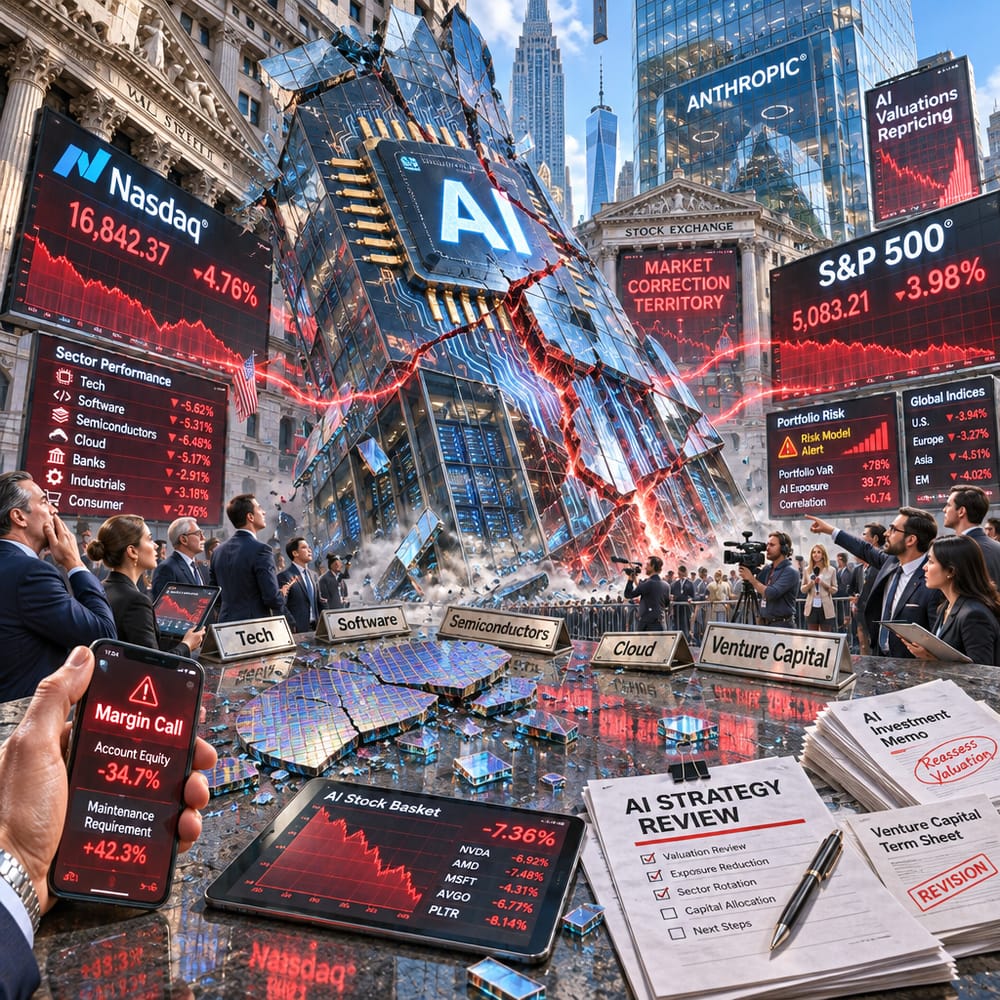
If you had any doubts that artificial intelligence (AI) is the new wild west of investing, the rollercoaster ride we've seen in the markets lately should clear that up. In a flurry of ones and zeros, AI-driven stocks nosedived, dragging major indices into correction territory and leaving investors clutching their portfolios like a lifeline on a sinking ship. Welcome to the brave new world of AI investment, where the stakes are high, and the ride is never smooth.
So, what the heck just happened? In a nutshell, the AI frenzy hit a speed bump. Or, more accurately, a brick wall. As everyone rushed headlong into AI stocks, expecting the future to be paved with silicon gold, reality threw a curveball. The sector that seemed like a can't-miss opportunity turned out to be more volatile than a caffeinated squirrel. The semiconductor industry, the cornerstone of AI, saw its stocks take a dive, with the PHLX Semiconductor Index tanking nearly 11% in just one day. Nvidia, a darling of the AI chip world, bounced around like a hyperactive yo-yo, experiencing a wild ride of ups and downs.
So, why the sudden sell-off? It's a perfect storm of reassessment and regulation. Investors, spooked by overpriced AI stocks and an uncertain global economic outlook, started to hit the brakes. Add in some government intervention—thanks to a new rule preventing Nvidia chips from being rented to Chinese companies—and you've got a recipe for a market correction. The Trump administration's crackdown on AI semiconductor exports to China certainly didn’t help matters, sparking fears of a tech Cold War.
As the dust settles, investors are scrambling to re-evaluate their strategies. The smart money is looking for safe havens, like a squirrel hoarding acorns for winter. Traditionally defensive sectors like healthcare, utilities, and consumer staples are getting a second look. Investors are shifting focus from high-risk, high-reward AI stocks to more stable, predictable industries. It's a classic flight to safety.
But does this mean AI is a busted flush? Not quite. While the recent crash has been a wake-up call, it doesn't spell doom for AI's potential. The tech is still revolutionary, with companies like Anthropic continuing to innovate in areas like ethical AI and data privacy. But after taking a hit, AI companies are being forced to recalibrate. They're focusing more on sustainable growth rather than just chasing the next big breakthrough. It’s a pivot from a sprint to a marathon mindset.
For retail investors, the post-crash landscape offers both challenges and opportunities. This might be the perfect time to dig deeper into the fundamentals of AI companies. Which ones have a solid business model? Who can weather the storm and come out stronger on the other side? It's the age-old question in investing: what's genuinely valuable and what's just hype?
AI's growing pains may also prompt broader sector rotation. As the initial excitement fades, investors are likely to diversify their portfolios, seeking out sectors that promise steady returns without the drama. It's a reminder that while tech can offer explosive growth, it also comes with a side of unpredictability. Diversification, as always, is key.
So, what should you do if you’ve been caught in the AI crossfire? First, take a breath. Panicking rarely leads to good financial decisions. Look at your portfolio critically and assess your risk tolerance. It might be time to rebalance, diving into those sectors that offer a bit more safety. Or, if you're feeling adventurous, now could be the time to buy the dip on AI stocks—but only if you've got the stomach for a bumpy ride.
In the end, the recent AI-driven sell-off is a reminder that while technology can drive incredible growth, it's not immune to the harsh realities of the market. Like any other investment, it's subject to the whims of investor sentiment, economic conditions, and regulatory environments. As we move forward, expect more twists and turns. Keep your eyes peeled and your portfolio diversified, and you just might come out ahead in this high-stakes game of technological roulette.
This article is for informational purposes only and is not investment advice. Always do your own research or consult a licensed financial professional before making investment decisions.
© Copyright 2024. All Rights Reserved.
© Copyright 2024. All Rights Reserved.