

Advance Q2 GDP Misses Expectations: Economic Resilience Under Scrutiny
Tuesday, August 25, 2026
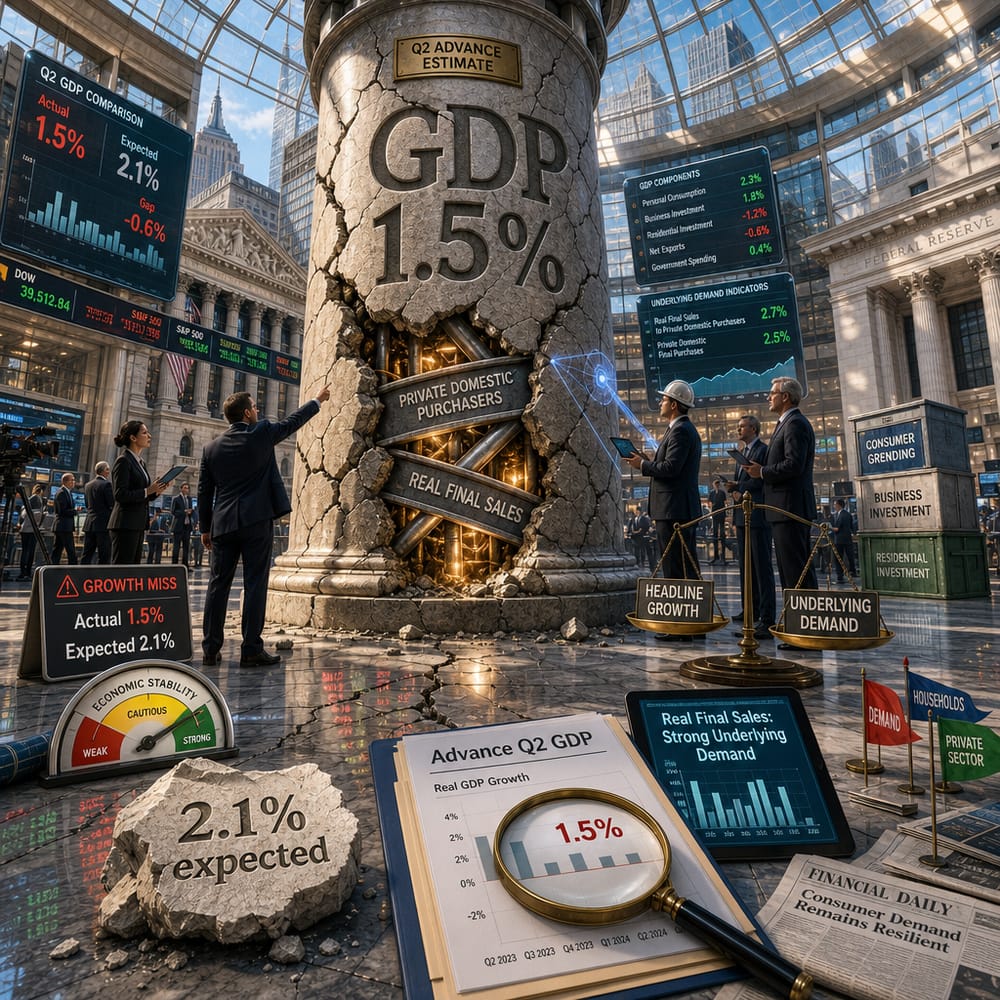
WHEN GDP FALLS SHORT: WHAT IT MEANS FOR THE ECONOMY AND YOUR WALLET
Surprise, surprise! The latest GDP numbers are in, and they're not exactly what the market was hoping for. The report card on America's economic health showed growth at a sluggish 1.5% for the second quarter, leaving us trailing behind the anticipated 2.1%. For anyone who was already concerned about the economy, this is the equivalent of discovering your diet soda has real sugar in it. But wait—before you panic and start stuffing cash under your mattress, let's dig a little deeper.
WHERE DID THE GDP GO WRONG?
So, what gives? Why did GDP growth hit the brakes? Well, the usual suspects are at play. Increased interest rates have started to creep into consumer spending, and while businesses are still hiring, they're not exactly in a rush to add new workers. Meanwhile, our old friend inflation is still hanging around, having an awkward conversation with your grocery bill.
Yet, here's a twist: while the GDP headline number is coughing in the dust, underlying demand is doing jumping jacks. Yep, real final sales—basically the stuff people are actually buying—are showing some surprising resilience. This metric strips out the inventory pile-ups and gives us a clearer picture of what consumers and businesses are really up to. So, while the headline GDP number is playing the blues, the underlying demand is singing rock 'n' roll.
WHAT DOES STRONG UNDERLYING DEMAND MEAN?
You might be thinking, "If people are still buying stuff, why is GDP stumbling?" It’s a bit like watching a fast runner trip on their shoelace. Most parts of the economy are performing well, but a few missteps have thrown off the overall pace. Businesses are cautious with their inventories, not wanting to overstock in an uncertain environment. Plus, sectors like real estate are feeling the pinch from those pesky interest rates.
Still, strong underlying demand throws a wrench into the narrative of doom and gloom. It suggests that consumers are not entirely hunkering down and that businesses are cautiously optimistic. This underlying strength can provide a cushion, potentially softening any economic slowdown and preventing things from going full-on recessionary.
WHAT ABOUT THE FED?
Now, let's talk about the Federal Reserve—the folks who might as well have "Economy R Us" on their business cards. The gap between the disappointing GDP number and the robust underlying demand data puts them in a bit of a pickle. Do they continue their campaign of interest rate hikes to squash inflation, or do they take a breather to avoid strangling growth?
The Fed knows it needs to balance these two forces, like a tightrope walker over a pit of alligators (or in this case, inflation and stagnation). Strong demand signals that there's still some zest in the economy, which might make them reluctant to cut rates anytime soon. But they also don't want to slam the brakes too hard if the economic engine is still humming.
WHAT SHOULD WE DO ABOUT IT?
So, investors, what's the takeaway here? First, stay informed but don't let every GDP twitch send you into cardiac arrest. Look for investments that can weather economic fluctuations, maybe those tied to consumer staples or technology. These sectors often have the staying power to endure economic ups and downs.
Second, keep an eye on the Fed's next moves. Their policy decisions will impact both the economy and market sentiment. Stay diversified and consider hedging strategies to protect your portfolio against interest rate volatility.
And finally, remember that the economy, like your favorite TV show, has plot twists. Today’s GDP miss doesn’t signal the end of the series, but rather a compelling subplot in a longer story. Stick around—the next episode might just surprise you.
This article is for informational purposes only and is not investment advice. Always do your own research or consult a licensed financial professional before making investment decisions.
© Copyright 2024. All Rights Reserved.
© Copyright 2024. All Rights Reserved.