

A Tale of Yields: Why the Fed Model’s Latest Signal Has Investors Squirming
Tuesday, November 19, 2024
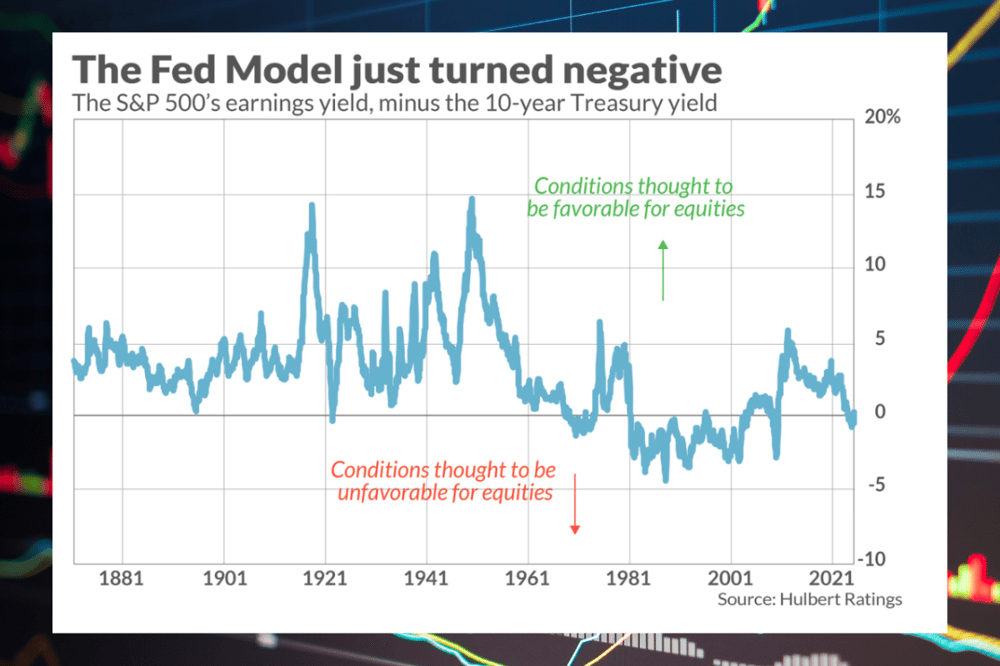
For the first time in over a decade, the so-called “Fed model” is flashing a warning signal, and investors are debating whether to shrug it off or run for cover. The model—a stock market bellwether that measures the gap between the S&P 500’s earnings yield and the 10-year Treasury yield—has dipped into negative territory. Historically, this has been rare and, when it happens, unsettling. But does it really matter?
What’s the Fed Model, and Why the Fuss?
First, a quick explainer. The Fed model compares the earnings yield of stocks (basically the inverse of the price-to-earnings ratio) with the yield on 10-year Treasury bonds. When stocks offer a higher yield than bonds, they’re considered relatively attractive; when the reverse happens, bonds seem like the better bet.
Right now, the S&P 500’s earnings yield stands at 3.9%, while the 10-year Treasury yield is sitting at 4.46%. That’s a gap of more than half a percentage point in favor of Treasurys, a stark shift from the low-rate bonanza investors have enjoyed for years. The last time this model was in such dire straits? During the 2008-2009 financial crisis—a period etched in the annals of market mayhem.
The Good, the Bad, and the Misleading
While the Fed model’s flashing red lights have caught attention, some experts argue its predictive powers are, well, underwhelming. A deep dive into historical data—courtesy of Yale’s Robert Shiller—shows that the Fed model has been a lackluster forecaster of stock returns. In fact, plain-old earnings yield alone has been more accurate.
Why? The model compares apples and oranges. Stock market earnings are a “real” yield, accounting for inflationary growth over time, whereas Treasury yields are nominal, unadjusted for inflation. This mismatch muddies the waters, leading to what experts call a “money illusion.”
Cliff Asness to the Rescue
Two decades ago, Cliff Asness of AQR Capital Management dismantled the Fed model in his paper “Fight the Fed Model”. He argued that the model’s simplicity masks its fundamental flaw: conflating real and nominal metrics. It’s common sense that crumbles under scrutiny—Wall Street strategists may love it, but Asness made clear that love is misplaced.
What’s Next for Markets?
Does this mean stocks are doomed? Not necessarily. While the Fed model suggests headwinds, plenty of other factors are in play. Inflation, central bank policies, geopolitical tensions—you name it. The real takeaway here isn’t that stocks are overvalued but that this particular metric shouldn’t dominate your investment decisions.
Investors would do well to keep their heads level. The market thrives on uncertainty, and relying on a single, flawed signal to make sweeping predictions is a recipe for regret. The Fed model may be flashing, but that doesn’t mean the sky is falling—at least not yet.
© Copyright 2024. All Rights Reserved.
© Copyright 2024. All Rights Reserved.